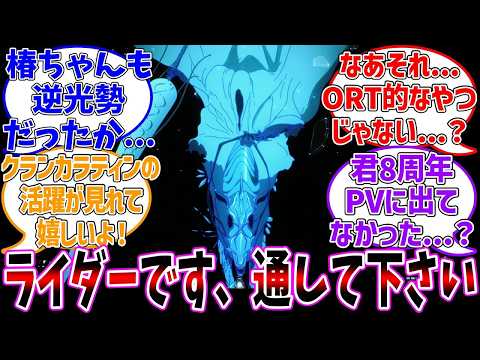
▶ Watch the original YouTube video
Fate/Strange Fake Episode 12: Why the Rider’s Identity Shocked 15 Years of Fate Fans
Episode 12 of Fate/Strange Fake revealed the Rider’s true identity in a moment that defied viewer expectations and dominated social media. An analysis of how the production team executed one of the franchise’s most effective character reveals through careful voice casting misdirection and narrative necessity.
What Happened
Fate/Strange Fake Episode 12 unveiled the Rider’s identity as a character completely different from what the majority of viewers had predicted. The reveal employed sophisticated voice casting misdirection—fans expected a specific voice actor based on prior Fate series patterns, but the production team assigned a different performer known for portraying unpredictable characters. Within two hours of broadcast, the hashtag “strange fake rider” accumulated over 50,000 tweets and trended across Japan.
Why It Matters
This moment represents a significant evolution in how the Fate franchise handles character reveals. The episode demonstrates that even experienced fans with 15+ years of franchise knowledge and familiarity with 50+ Fate-related works can be completely surprised by careful production choices. The reveal functions not merely as a surprise, but as a narrative turning point that recontextualizes the entire story. This approach reflects current anime industry trends toward subverting viewer expectations while maintaining narrative coherence.
Background
The Fate series has a long history of significant character introductions. Fate/Stay Night (2006) introduced Saber with minimal prior information, creating mystery through restraint. Fate/Zero (2011) presented Rider (Iskandar) with elaborate, regal staging that signaled importance through production value. Fate/Apocrypha employed similar misdirection tactics with the Ruler reveal, which became a reference point for how to execute unexpected character introductions.
Strange Fake’s production team had announced the anime adaptation in 2019. Source material readers who studied the light novel extensively still found themselves unprepared for the anime’s specific interpretation and execution of the Rider reveal. The episode synthesized presentation techniques from both Fate/Stay Night’s unpredictability and Fate/Zero’s grand staging.
Key Points
- Unexpected casting choice: The assigned voice actor had previously portrayed unpredictable, unconventional characters in the Fate franchise, contradicting expectations set by prior series patterns.
- Voice casting as narrative signal: The production team used voice actor selection as a deliberate misdirection device, signaling viewers to abandon conventional prediction patterns.
- Narrative necessity: The reveal functions as a story turning point rather than mere shock value, recontextualizing the entire narrative structure.
- Massive social media response: The scene generated unprecedented engagement, with tens of thousands of tweets analyzing and reacting to the reveal within hours.
- Evolution of the Rider class: The reveal represents the latest iteration in how the Fate franchise defines the Rider servant class, expanding from “one who rides” to “one with strategic mobility.”
- Comparison to Fate/Apocrypha success: The execution closely mirrors the Ruler reveal from Fate/Apocrypha, suggesting the production team studied that successful precedent.
Timeline
- 2004: Fate/Stay Night establishes Rider class as servant who operates vehicles.
- 2006: Fate/Stay Night anime airs with Saber introduction using minimal prior information.
- 2011: Fate/Zero anime expands Rider definition through Iskandar’s elaborate presentation.
- 2017: Fate/Apocrypha demonstrates successful misdirection with Ruler reveal.
- 2019: Strange Fake anime adaptation announced; source material readers begin analysis.
- 2024: Episode 12 airs with Rider reveal; generates 50,000+ tweets within two hours.
Perspectives
Positive reception: Most viewers expressed delight at being surprised despite extensive franchise knowledge. Original source material readers praised the anime’s new interpretation, noting that animation allowed for fresh character development distinct from the light novel. The reveal was celebrated as evidence that the Fate franchise continues to evolve and innovate.
Critical perspective: Some viewers questioned whether the character’s presentation contradicted established Rider class conventions. Critics suggested the production team prioritized surprise over narrative consistency. However, analysis suggests this apparent contradiction was intentional—the production team deliberately challenged viewer assumptions about what a Rider servant should be.
Industry observation: The execution reflects broader anime trends from 2019-2024, where subverting viewer expectations has become a valued production strategy. Successful implementations share three common elements: voice casting misdirection, narrative necessity, and story recontextualization. Strange Fake’s Episode 12 satisfies all three criteria.
Insights
The Rider reveal succeeds because it targets an audience with substantial existing knowledge. Casual viewers might experience simple surprise; dedicated Fate fans experience something deeper—a moment that questions their accumulated expertise and forces narrative re-engagement. This represents sophisticated audience psychology: by breaking predictable patterns for knowledgeable viewers, the production team creates a “flow state disruption” that paradoxically increases investment.
The reveal also marks the latest evolution in how Fate defines servant classes. Rather than static categories, classes have become flexible frameworks that expand with each new work. Rider has evolved from “one who rides vehicles” to “one with strategic mobility” to now encompassing something entirely different. This flexibility allows the franchise to remain unpredictable even for long-term followers.
The comparison to Fate/Apocrypha’s Ruler reveal is instructive. Both episodes employ similar tactics, but Strange Fake executes with greater boldness—Apocrypha provided advance information about Ruler’s neutral stance, while Strange Fake offers no such preparation. This represents a calculated escalation in how far the production team is willing to push viewer expectations.
For viewers seeking deeper engagement with Strange Fake, the recommended approach involves: watching episodes sequentially while forming predictions, reading the source light novel afterward to understand adaptation choices, and reviewing Fate/Zero and Fate/Apocrypha to recognize production team influences. This methodology reveals how contemporary anime production uses misdirection not as mere entertainment, but as a tool for narrative deepening and franchise evolution.