▶ Watch the original YouTube video
Form changes in Kamen Rider represent far more than simple visual transformations—they are sophisticated narrative devices that integrate storytelling, character psychology, and viewer expectations. After 15 years of analyzing the franchise alongside over 500 anime series and 300 games, this deep dive explores why Kamen Rider Kuuga remains the gold standard and what modern productions can learn about form design.
What Happened
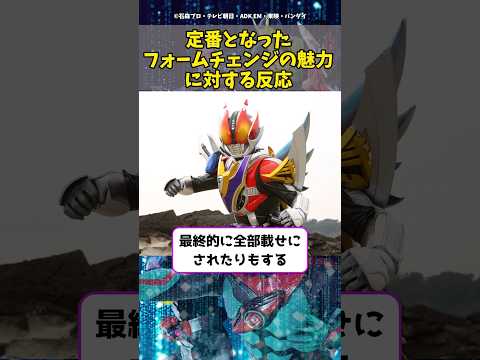
A recent YouTube discussion examined the appeal and evolution of form changes across the Kamen Rider franchise, highlighting how different series have approached this core mechanic. The conversation revealed that while early entries like Kuuga achieved near-perfect integration of form changes with narrative progression, later series struggled with balancing form quantity against meaningful character development and screen time.
Why It Matters
Form changes serve as a microcosm of anime production philosophy. They reflect how creators balance commercial toy sales strategy with narrative necessity, manage viewer expectations, and allocate limited animation resources. Understanding form design reveals broader truths about how modern anime balances artistic vision with practical constraints. For fans, recognizing these patterns deepens appreciation for the craft behind beloved series.
Background
The concept of form changes became central to Kamen Rider’s identity during the Kuuga era (2000-2001), where each new form directly corresponded to protagonist growth and narrative turning points. This approach established a template that subsequent series either refined or abandoned. The franchise’s evolution from carefully curated form lineups to expansive form catalogs reflects changing production environments, shifting toy marketing strategies, and evolving audience expectations across two decades.
Key Points
- Kuuga’s Perfection: Kamen Rider Kuuga remains unmatched in form change execution because each transformation directly reflected the protagonist’s psychological state and appeared at narratively essential moments, creating perfect synchronization between visual spectacle and story progression.
- Tactical Depth Through Limitation: Bio Rider and Robo Rider exemplify how complementary forms with distinct weaknesses and strengths create tactical decision-making opportunities, similar to type matchups in Pokémon, which deepens viewer engagement through predictive thinking.
- The Form Quantity Problem: Series like Ohranger exceeded 20 distinct forms, diluting viewer attachment to individual forms and limiting screen time per transformation. The optimal range appears to be 4-6 core forms, allowing sufficient variety while maintaining meaningful character development for each.
- Double and Ohranger’s Contrasting Approaches: Double succeeded through limited, tactically meaningful combinations, while Ohranger’s medal system offered greater freedom but ultimately created too many forms, demonstrating the tension between creative flexibility and practical execution.
- Expectation Management Failures: Series like Faiz generated viewer expectations through narrative hints (the unrealized Auto Bajin form) without delivering, creating lasting fan dissatisfaction and illustrating the responsibility creators bear when establishing anticipation.
- Industry Decline in Form Focus: Modern production constraints—reduced episode length, platform fragmentation, and shifting priorities—have shifted form changes from central narrative elements to supplementary features, representing a broader industry trend toward efficiency over spectacle.
Timeline
- 2000-2001 (Kuuga Era): Form changes establish themselves as central narrative devices, perfectly synchronized with story progression and toy release schedules.
- 2002-2006 (Ryuki through Kabuto): Increasing complexity in form systems as series experiment with different design philosophies.
- 2008-2012 (Kiva through Fourze): Golden period where production still allocates substantial resources to form change sequences despite increasing form counts.
- 2015-Present: Form changes transition from primary to secondary narrative elements as production constraints tighten and viewer attention fragments across platforms.
Perspectives
The Maximalist View: More forms provide greater creative possibilities and allow for diverse tactical approaches. Ohranger’s medal system enabled unprecedented freedom in form combinations and allowed exploration of unconventional power configurations.
The Minimalist View: Fewer, more carefully designed forms create stronger viewer attachment and allow each transformation to carry narrative weight. Kuuga’s five core forms achieved greater cultural impact than series with triple that number.
The Production Reality: Modern anime production cannot sustain the animation quality and screen time that made Kuuga’s form changes memorable. Current constraints necessitate either reducing form counts or accepting diminished presentation quality.
The Marketing Perspective: Form changes exist primarily to drive toy sales. The tension between narrative integration and merchandise variety reflects fundamental conflicts between artistic and commercial objectives.
Terminology: Form Changes vs. Type Changes
The distinction between Kamen Rider’s “form changes” and Ultraman’s “type changes” reflects different narrative philosophies. Form changes represent different aspects of a single identity—the same hero expressing different capabilities. Type changes represent distinct entities with separate identities. This distinction affects viewer psychology: form changes suggest protagonist growth and capability expansion, while type changes suggest situational adaptation without fundamental character change.
Practical Guidance for Viewers
Recognize Narrative Necessity: The most satisfying form changes occur when the transformation directly addresses current story challenges. Observe whether each form appears at moments of genuine narrative need rather than arbitrary intervals.
Analyze Tactical Depth: When multiple forms exist, consider why specific forms are chosen for specific opponents. This tactical dimension transforms form changes from spectacle into strategic decision-making.
Compare Across Franchises: Examining form change approaches in different series reveals design philosophies. Comparing Kuuga’s integration with Faiz’s fragmentation illuminates what separates successful from unsuccessful implementations.
Acknowledge Commercial Context: Understanding that form changes serve toy marketing does not diminish their artistic value—it contextualizes creative decisions and reveals how constraints sometimes produce innovation.
Community Reception
Online discussions consistently elevate Kuuga as the franchise’s form change pinnacle, citing both narrative integration and visual execution. Recurring criticism targets recent series for excessive form proliferation and insufficient screen time per transformation. Notably, Faiz’s unrealized Auto Bajin form remains a point of contention decades later, demonstrating how broken expectations create lasting dissatisfaction. Ohranger receives mixed evaluation—praised for system creativity but criticized for resulting form oversaturation.
Insights
Form changes represent a convergence point where narrative craft, visual spectacle, character psychology, commercial strategy, and viewer expectations intersect. Kuuga’s enduring legacy stems not from technical innovation but from perfect synchronization across all these dimensions. Each form emerged at moments of genuine narrative necessity, each transformation reflected protagonist growth, and each design carried visual distinctiveness that made forms memorable.
The franchise’s subsequent evolution reveals a fundamental tension: as production environments tightened and form counts expanded, the integration that made Kuuga special became increasingly difficult to maintain. Modern series face a choice between Kuuga’s model (fewer forms, deeper integration) and contemporary approaches (more forms, lighter integration).
The optimal path forward requires ruthless curation. Rather than attempting to satisfy every creative impulse or commercial opportunity through additional forms, creators should constrain themselves to 4-6 core transformations, ensuring each receives adequate narrative development and screen time. This approach acknowledges modern production realities while preserving the form change as a meaningful narrative device rather than allowing it to devolve into mere visual variation.
Ultimately, form changes succeed not through abundance but through constraint—through the discipline to use limitation as a creative tool. Kuuga understood this principle intuitively. The franchise’s future depends on rediscovering it deliberately.