▶ Watch the original YouTube video
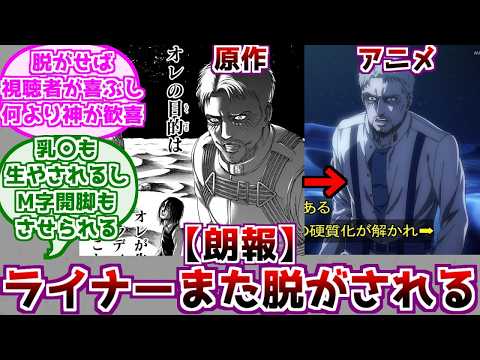
When MAPPA took over production of Attack on Titan’s Final Season, a pivotal scene depicting character Reiner’s psychological breakdown through explicit visual representation ignited widespread discussion online. The scene highlighted fundamental differences in artistic philosophy between MAPPA and the previous studio WIT STUDIO, raising questions about how anime studios balance creative expression with audience expectations.
What Happened
In Attack on Titan’s Final Season Part 3-4, produced by MAPPA, a scene depicting character Reiner in a state of psychological collapse featured explicit visual representation that differed significantly from how WIT STUDIO handled similar moments in earlier seasons. The scene became a focal point for discussion about production company philosophies and artistic choices in anime adaptation.
Why It Matters
This moment represents a broader shift in anime production toward more direct visual storytelling. The debate surrounding the scene illuminates how different studios approach the same source material, the influence of international streaming platforms on content standards, and how viewer expectations evolve over time. Understanding these differences provides insight into the current direction of anime as a medium and the creative decisions that shape how stories are told visually.
Background
Attack on Titan began airing in 2013 under WIT STUDIO, establishing a visual language characterized by restraint and suggestive imagery. When MAPPA assumed production duties for the final season in 2022, the studio brought its own distinct aesthetic—one developed through works like Jujutsu Kaisen and Chainsaw Man—that favors more explicit and direct visual representation. This transition marked a significant stylistic shift for a series that had maintained visual consistency for nearly a decade.
Reiner Braun’s character arc represents one of Attack on Titan’s most psychologically complex narratives. By the Final Season, his internal conflict—stemming from his dual identity as a Marleyan warrior and infiltrator, combined with the burden of his titan powers—reaches a breaking point. The scene in question occurs at a moment when Reiner’s psychological state is fundamentally fractured, making it a critical juncture for character development.
Key Points
- Studio Transition Impact: WIT STUDIO employed suggestive, indirect visual representation, while MAPPA adopted explicit, direct imagery to convey the same emotional content
- Artistic Philosophy Difference: WIT STUDIO prioritized viewer imagination and Japanese aesthetic restraint; MAPPA emphasized international visual standards and psychological clarity
- Character Psychology: The scene functions as visual representation of Reiner’s loss of human dignity and complete psychological deterioration at a critical narrative moment
- Source Material Fidelity: MAPPA’s approach reflects closer adherence to the original manga’s raw and explicit visual style compared to WIT STUDIO’s adaptations
- Mixed Audience Reception: Responses ranged from praise for psychological authenticity to criticism of unnecessary explicitness, reflecting differing viewer expectations
- Industry Trend: The shift represents a broader movement toward more direct expression in anime, influenced by streaming platform standards and international audience expectations
Timeline
- April 2013: Attack on Titan premieres under WIT STUDIO with distinctive visual restraint
- 2020: MAPPA gains recognition for direct visual approach through Jujutsu Kaisen
- 2022: MAPPA assumes production of Attack on Titan Final Season Part 3-4
- 2022 (Final Season Air Date): Reiner scene airs and generates significant online discussion
- Post-Broadcast: Critical reassessment gradually shifts toward acceptance of MAPPA’s stylistic approach
Comparative Analysis: Studio Expression Styles
A detailed examination of both studios’ approaches reveals consistent patterns across their respective works:
| Title | Studio | Physical Representation | Violence Approach | Psychological Integration |
|---|---|---|---|---|
| Attack on Titan (Seasons 1-3) | WIT STUDIO | Suggestive, indirect | Restrained, viewer-dependent | Expressed through facial expressions and environment |
| Attack on Titan (Final Season) | MAPPA | Explicit, direct | Detailed, visually comprehensive | Expressed through physical depiction |
| Jujutsu Kaisen | MAPPA | Explicit, direct | Detailed, visually comprehensive | Expressed through physical depiction |
| Demon Slayer | ufotable | Aesthetic, refined | Visually stylized, effect-focused | Expressed through movement and composition |
Perspectives
Supporters of MAPPA’s Approach: Viewers and critics who favored the explicit representation argued that it authentically conveyed Reiner’s complete psychological breakdown. They noted that the scene’s directness created immediate emotional impact and demonstrated fidelity to the original manga’s raw visual style. This perspective emphasized that mature storytelling requires mature visual language, and that MAPPA’s choice respected the narrative’s gravity.
Critics of the Explicit Representation: Those who questioned MAPPA’s choice suggested the scene crossed into unnecessary explicitness. They argued that WIT STUDIO’s more restrained approach demonstrated greater artistic sophistication and that the same psychological content could be conveyed through suggestion rather than explicit depiction. This camp valued the elegance of constraint and questioned whether directness necessarily improved storytelling.
Industry Context Perspective: Analysts noted that MAPPA’s approach reflects broader industry trends influenced by international streaming platforms like Netflix. As anime reaches global audiences with varying content standards, studios increasingly adopt more direct visual language to ensure clarity across cultural contexts. This perspective frames MAPPA’s choice as pragmatic adaptation to contemporary distribution realities rather than purely artistic preference.
Insights
The Reiner scene debate reveals several important truths about contemporary anime production. First, the transition from WIT STUDIO to MAPPA was never merely a technical handoff—it represented a fundamental philosophical shift in how the same story could be visually interpreted. Both approaches are internally consistent with their respective studios’ broader bodies of work, suggesting these are deliberate artistic choices rather than inconsistencies.
Second, the scene demonstrates how viewer expectations crystallize around early creative decisions. Audiences who formed their understanding of Attack on Titan through WIT STUDIO’s visual language experienced MAPPA’s approach as a departure, even when both studios were attempting to convey identical psychological content. This suggests that artistic style becomes inseparable from audience perception of a work’s identity.
Third, the discussion highlights the influence of distribution platforms on creative expression. MAPPA’s stronger relationships with international streaming services correlates with its adoption of more universally legible visual language. As anime increasingly targets global audiences, the tension between Japanese aesthetic traditions (which favor suggestion and restraint) and international visual standards (which favor clarity and directness) will likely intensify.
Finally, the gradual shift in audience reception—from initial criticism toward eventual acceptance—indicates that viewers can adapt to new visual languages when given context and time. The scene’s meaning became clearer as audiences understood MAPPA’s consistent artistic philosophy across multiple works, suggesting that studio identity and consistency matter as much as individual creative choices.
The broader implication is that anime’s future will likely feature greater stylistic diversity as different studios establish distinct visual identities. Rather than a single “correct” approach to adaptation, audiences may increasingly encounter multiple valid interpretations of the same source material, each reflecting different production philosophies and distribution contexts.