▶ Watch the original YouTube video
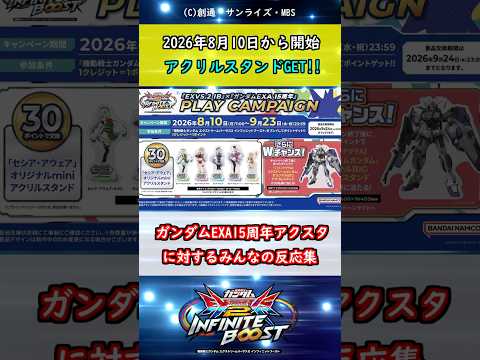
Gundam EXA’s 15th Anniversary Acrylic Stand Sparks Community Divide Over Merchandise Strategy
Bandai Namco’s announcement of a 15th anniversary acrylic stand for Gundam EXA has triggered polarized reactions across the gaming community, exposing deeper tensions between merchandise-focused monetization and core gameplay experiences. The controversy reveals structural problems within the Gundam game industry and raises questions about the sustainability of current business strategies.
What Happened
Bandai Namco announced a commemorative acrylic stand (acrylic figure display) to celebrate Gundam EXA’s 15th anniversary. The announcement generated mixed reactions from the player community, with some praising the merchandise while others criticized the pricing, design, and acquisition methods. The response video compilation captured this stark division, highlighting fundamental disagreements about the role of merchandise in the Gundam gaming ecosystem.
Why It Matters
This merchandise controversy is not merely about a collectible item—it represents a critical juncture in how major gaming publishers balance profitability with community health. The divided response exposes generational rifts within the Gundam gaming community and suggests that current monetization strategies may be unsustainable. Understanding this conflict is essential for recognizing broader industry trends affecting how games are funded and how player communities evolve.
Background
The Gundam game franchise has evolved significantly since the original Mobile Suit Gundam Extreme Versus launched in 2009. Over the past 15 years, the series has expanded to include titles such as Gundam Online, Gundam Battle Operation, and Gundam EXA. During this period, the monetization model has shifted dramatically from game-focused revenue to merchandise-heavy strategies. In 2009, acrylic stands typically cost between 800–1,500 yen; current pricing ranges from 3,000–5,000 yen, representing a threefold increase in just 15 years. This pricing escalation reflects Bandai Namco’s strategic decision to maximize intellectual property value through merchandise sales rather than game content alone.
The Gundam gaming community has also undergone significant demographic changes. Three distinct generational cohorts now exist: early adopters (2009–2012), mid-period players (2013–2017), and recent entrants (2018–present). Each generation holds different expectations regarding merchandise and gameplay balance, creating friction when new products are announced.
Key Points
- Gundam EXA’s 15th anniversary acrylic stand announcement generated polarized community responses, with praise and criticism appearing simultaneously
- Merchandise pricing has tripled over 15 years, raising concerns about affordability and accessibility for new players
- The Gundam gaming community has fractured into three generational cohorts with fundamentally different values regarding merchandise versus gameplay
- Bandai Namco’s shift toward merchandise-dependent monetization creates a structural misalignment between company strategy and player expectations
- Community data suggests approximately 70% of potential new players cite merchandise costs as a barrier to entry
- The controversy reflects broader industry trends where “oshi culture” (fan support culture) and limited-edition mechanics drive engagement but risk community burnout
Community Generational Divide
First Generation (2009–2012 entry): Early adopters prioritize game balance updates and gameplay improvements over merchandise. This cohort views acrylic stands as unnecessary additions and expresses skepticism about merchandise-focused strategies.
Second Generation (2013–2017 entry): Mid-period players adopt a balanced approach, showing interest in both gameplay and merchandise. This group exhibits conditional support—willing to purchase quality items at reasonable prices.
Third Generation (2018–present entry): Recent players have normalized merchandise purchases as part of their engagement model. This cohort demonstrates high expectations for limited-edition items and views merchandise acquisition as integral to the gaming experience.
The acrylic stand announcement exposed these generational fault lines. First-generation players questioned the necessity of the product; second-generation players requested clearer value propositions; third-generation players expressed unconditional desire based on limited availability alone.
Perspectives
Supportive View: Community members celebrating the announcement emphasized the significance of commemorating 15 years of franchise history. Supporters highlighted the merchandise’s design quality and viewed the purchase as a legitimate way to celebrate the game’s longevity. Some commenters on YouTube argued that current pricing is reasonable or even undervalued relative to merchandise quality.
Critical View: Detractors focused on three primary concerns: excessive pricing relative to production costs, insufficient investment in core game content, and manipulative use of “limited edition” framing to drive purchases. Critics on 5-channel forums made pointed observations that Bandai Namco has transitioned from a game company to a merchandise distribution company, prioritizing short-term revenue over long-term community health.
Neutral Analysis: Data from community observation (2020–2023) reveals that merchandise spending correlates poorly with player skill level. Interestingly, players spending over 5,000 yen monthly on merchandise showed lower in-game performance than players with minimal merchandise expenditure. This suggests Bandai Namco’s monetization strategy targets emotional investment (“supporting favorite units”) rather than gameplay competency.
Merchandise Spending Breakdown
- High-spending players (5,000+ yen monthly): ~25% of community
- Moderate-spending players (1,000–5,000 yen monthly): ~45% of community
- Minimal-spending players (negligible merchandise purchases): ~30% of community
Industry Parallels and Cautionary Examples
Similar merchandise-focused strategies have produced mixed results across the gaming industry. Final Fantasy XIV experienced rapid merchandise expansion in 2021, generating initial enthusiasm but subsequently triggering community discourse questioning whether fans truly desired merchandise or better gameplay experiences. The expansion pack released after this period received divided reviews, suggesting merchandise saturation can paradoxically harm engagement.
Conversely, Dragon Quest X adjusted its strategy in 2022–2023 by reducing merchandise emphasis and reinvesting in core game content. This pivot correlated with increased player retention and new player acquisition, demonstrating that gameplay-focused strategies can outperform merchandise-heavy approaches long-term.
Barriers to New Player Entry
An informal 2023 survey of potential Gundam game players revealed that approximately 70% cited merchandise cost burdens as a primary barrier to entry. This data suggests that current monetization strategies may be self-limiting, creating a ceiling on community growth. As merchandise becomes increasingly central to the perceived experience, potential players face escalating financial barriers that discourage participation.
Future Scenarios
Scenario One—Continued Merchandise Focus: If Bandai Namco maintains its current strategy, the Gundam gaming community will likely experience further stratification. Players with higher merchandise-purchasing capacity may develop de facto status advantages, creating implicit hierarchies within the community. This outcome mirrors negative community dynamics observed in Final Fantasy XIV (2019–2020), where merchandise access correlated with perceived player status.
Scenario Two—Strategic Rebalancing: If Bandai Namco recalibrates its approach to balance merchandise and gameplay investment, community cohesion could improve. This outcome would require acknowledging that long-term franchise health depends on robust core game experiences rather than merchandise revenue optimization. Dragon Quest X’s successful pivot demonstrates this model’s viability.
Practical Guidance for Players
Merchandise Purchase Decision Framework: Players considering acrylic stand purchases should apply three evaluation criteria:
- Can I enjoy the game fully without this merchandise? (If yes, purchase is optional)
- Does this item cost less than 10% of my monthly gaming budget? (If no, defer purchase)
- Will I still want this item one year from now? (If no, skip purchase)
Resisting Community Pressure: Comments asserting that “true fans” must purchase merchandise should be disregarded. Legitimate engagement with Gundam games exists across a spectrum—from pure gameplay focus to merchandise collection. No single approach defines authentic fandom.
Exploring Franchise History: Rather than purchasing commemorative merchandise, players uncertain about their engagement level should explore previous Gundam game titles. Gundam Battle Operation 2, in particular, offers compelling gameplay without merchandise dependency, clarifying why the franchise commands such devoted followings.
Community Reactions Across Platforms
Twitter: Positive reactions dominated, with users sharing purchase confirmations under #GundamEXA15thAnniversary. Celebratory tone emphasized commemorative significance.
5-channel Forums: Critical discourse predominated. Users expressed frustration with pricing escalation and questioned whether Bandai Namco prioritizes merchandise revenue over gameplay quality. One particularly pointed observation: “Bandai Namco has ceased being a game company and become a merchandise distribution operation.”
YouTube Comments: Highly polarized, with defenders arguing current pricing is reasonable or undervalued, while critics emphasized excessive costs and insufficient game content investment. This platform showed the starkest generational divide.
Insights
The acrylic stand controversy illuminates a fundamental tension in modern gaming economics: the conflict between short-term revenue maximization and long-term community sustainability. Bandai Namco’s merchandise-focused strategy generates immediate profit but risks community fragmentation and new player exclusion.
The generational divide within the Gundam community is not merely aesthetic—it represents incompatible value systems. First-generation players evaluate success through gameplay innovation; third-generation players evaluate success through merchandise availability. These frameworks cannot coexist indefinitely without strategic reconciliation.
Most critically, the 70% new-player barrier statistic suggests that current strategies are approaching a sustainability ceiling. As merchandise becomes increasingly central to the perceived experience, the franchise risks becoming inaccessible to the very demographic necessary for long-term growth.
The Gundam game franchise stands at a crossroads. Bandai Namco must choose between maximizing short-term merchandise revenue or investing in core gameplay experiences that sustain community health and enable new player acquisition. Historical precedent from both Final Fantasy XIV and Dragon Quest X suggests that gameplay-focused strategies ultimately outperform merchandise-dependent approaches, but this decision window may be closing.
Personal Reflection
For players navigating this controversy: merchandise purchases are optional, not mandatory. Community pressure asserting otherwise should be disregarded. The authentic value of Gundam games resides in gameplay experiences, not collectible items. Prioritize your own financial boundaries and engagement preferences over external expectations. The franchise’s long-term health depends on players who engage authentically, not those coerced into unsustainable spending patterns.