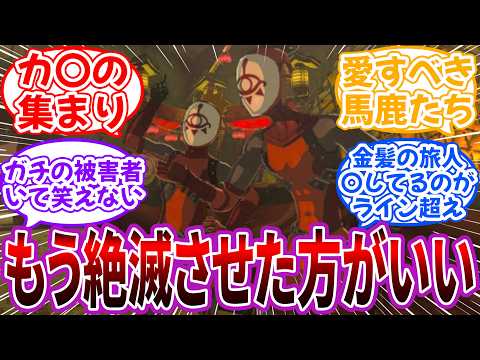
▶ Watch the original YouTube video
Zelda: Tears of the Kingdom – The Yiga Clan Explained: Why This ‘Funny’ Villain Group Isn’t Funny at All
The Yiga Clan in The Legend of Zelda: Tears of the Kingdom presents a disturbing contradiction: they appear comedic on the surface but commit horrific crimes including murder, extortion, and espionage. This analysis explores why the game’s most seemingly lighthearted enemy faction is actually its most unsettling, and what the developers intended with this complex moral design.
What Happened
The Yiga Clan returns in Tears of the Kingdom as a major antagonistic force, but with significantly expanded characterization compared to their appearance in Breath of the Wild. While they maintain a cartoonish aesthetic—complete with their distinctive banana obsession and comedic animations—their actual in-game behavior reveals a ruthless organization engaged in indiscriminate murder, blackmail, infiltration, and terrorism. The clan operates with religious fervor under their leader Master Kohga, maintaining a 10,000-year vendetta against Hyrule while targeting innocent civilians who have no connection to their historical grievances.
Why It Matters
The Yiga Clan represents a significant evolution in video game enemy design. Rather than presenting a simple “good versus evil” dynamic, the game forces players to confront a morally complex scenario: an enemy faction with legitimate historical trauma that has nonetheless become an unjustifiable terrorist organization. This design choice elevates Tears of the Kingdom beyond a straightforward action game, embedding philosophical questions about revenge, justice, and moral culpability into core gameplay. The clan’s existence challenges players to reconcile sympathy for their past with condemnation of their present actions—a tension that modern games increasingly explore but rarely execute with such discomfort.
Background
The Yiga Clan are descendants of the Sheikah tribe, who were exiled by the royal family of Hyrule approximately 10,000 years before the events of Tears of the Kingdom. This banishment provides the historical justification for their vendetta. However, the clan has evolved far beyond a simple resistance movement. Over millennia, they have developed into a hierarchical organization with sophisticated technology derived from ancient Sheikah knowledge, including underground bases and advanced weaponry. By the time of Tears of the Kingdom—100 years after Breath of the Wild—the Yiga have infiltrated Hyrulean society with sleeper agents embedded in villages, positioned to gather intelligence and eliminate threats to their organization.
The clan’s structure centers on Master Kohga, a figure who combines absurdist comedic traits (his inexplicable love of bananas) with genuine organizational competence and ruthless leadership. This juxtaposition is deliberate: Kohga is simultaneously ridiculous and terrifying, embodying the game’s central design tension.
Key Points
- Visual-Behavioral Disconnect: The Yiga Clan’s cartoonish appearance and animations directly contradict their actions—murder, extortion, espionage, and terrorism—creating cognitive dissonance that prevents players from dismissing them as simple comic relief.
- Justified Past, Unjustified Present: While their 10,000-year-old exile provides understandable motivation, their current targeting of unrelated civilians cannot be morally justified, creating a fundamental contradiction in their ideology.
- Organizational Persistence: The clan’s continued existence and operational capacity across centuries, combined with their obsessive pursuit of Link, suggests fanatical commitment rather than rational revenge—a characteristic of real-world terrorist organizations.
- Technological Sophistication: The Yiga’s mastery of ancient Sheikah technology and ability to construct underground infrastructure demonstrates they are not merely a ragtag militia but a technologically advanced threat.
- Infiltration Strategy: The placement of Yiga operatives within villages as spies and sleeper agents introduces a psychological element of distrust, making the game world feel unsafe and unpredictable.
- Moral Ambiguity for Players: The clan forces players to question whether they are fighting “evil” or simply eliminating a group with understandable grievances—a discomfort that extends beyond typical game morality.
Comparative Analysis: Enemy Factions Across Games
To understand the Yiga Clan’s uniqueness, comparison with other game franchises proves instructive. The Rocket Gang from Pokémon operates as a comedic criminal organization focused primarily on Pokémon theft, with limited direct threat to human life. The Yiga, by contrast, engage in systematic murder. The Mogma from Skyward Sword function as more abstract antagonists without the human characteristics that make the Yiga unsettling. The Yiga occupy a distinct category: they possess human motivation, organizational structure, and moral complexity while simultaneously committing atrocities that cannot be rationalized.
| Enemy Faction | Game | Motivation | Primary Crimes | Player Emotional Response |
|---|---|---|---|---|
| Yiga Clan | Tears of the Kingdom | Historical exile and revenge | Indiscriminate murder, extortion, espionage | Complex (simultaneous sympathy and revulsion) |
| Rocket Gang | Pokémon | Profit and criminal enterprise | Pokémon theft | Contempt (comedic) |
| Mogma | Skyward Sword | Territorial/instinctual | Territorial aggression | Pure antagonism |
Why the Yiga Clan Isn’t Funny
The Aesthetic-Action Paradox: The fundamental discomfort stems from the disconnect between how the Yiga look and behave versus what they actually do. Their exaggerated animations and banana obsession suggest comedic relief, yet they commit cold-blooded murder. This creates psychological friction that prevents laughter.
Revenge Versus Terrorism: While the Yiga’s historical grievance is understandable, their current actions exceed any reasonable definition of justified revenge. Murdering unrelated villagers 10,000 years after the original offense crosses the line from resistance to terrorism. This moral indefensibility makes them impossible to sympathize with, despite their tragic origin story.
Cult-Like Fanaticism: The Yiga’s unwavering devotion to Master Kohga across 10,000 years suggests religious fanaticism rather than rational political motivation. They worship Kohga as a deity and follow his commands absolutely. This cultish behavior mirrors real-world terrorist organizations, introducing uncomfortable parallels to contemporary violence.
Technological Weaponization: The Yiga’s sophisticated use of ancient Sheikah technology—the very technology designed to protect Hyrule—represents a perversion of sacred knowledge. This technological competence elevates them from simple bandits to a genuine existential threat.
Real-World Resonance: Online discussions frequently compare the Yiga Clan to actual terrorist organizations like ISIS or Al-Qaeda. The parallels are uncomfortable: a historically marginalized group using past grievances to justify present violence against civilians, employing sleeper agents, and operating under charismatic leadership. This real-world resonance prevents the clan from functioning as simple entertainment.
Design Intent and Modern Game Trends
Contemporary game design increasingly rejects simplistic moral binaries. Titles like The Last of Us series and Disco Elysium present antagonistic factions as morally complex entities with legitimate perspectives. The Yiga Clan fits this trend but with a crucial distinction: their complexity does not excuse their actions. The developers appear to have deliberately designed them as a test case—can a faction be simultaneously understandable and inexcusable? The answer, according to player reception, is yes, and the resulting discomfort is intentional.
This design choice elevates Tears of the Kingdom from a pure action game to a work exploring moral philosophy. Every encounter with the Yiga becomes not merely a combat challenge but a moral statement. Players are forced to kill enemies they might partially understand, embedding ethical weight into mechanical action.
Narrative Unresolved: The Kohga Question
The game’s ending presents an ambiguity: Master Kohga flies away rather than being definitively defeated. This departure suggests either narrative incompleteness or deliberate setup for future installments. The Yiga Clan is not destroyed in Tears of the Kingdom—merely scattered. Many members survive, and their organizational structure remains intact. This leaves open the possibility of their return in future games, maintaining the moral tension the franchise has introduced.
Player Reception and Online Discourse
Across social media platforms, player reactions reveal the intended discomfort. Twitter users frequently note: “The Yiga Clan looks funny but they’re actually murdering people, so I can’t laugh.” YouTube comments contain sophisticated moral analysis: “I understand the Hyrulean royal family was wrong to exile them, but that doesn’t justify killing innocent villagers.” Forum discussions oscillate between extreme positions—”they deserve extermination” versus “their situation is tragic”—reflecting the moral ambiguity the game has created.
This diversity of interpretation suggests the Yiga Clan design succeeded in its apparent objective: to create an enemy faction that resists simple moral categorization and forces players to engage in genuine ethical reasoning rather than reflexive button-pressing.
Practical Combat Strategies
For players seeking to efficiently defeat Yiga operatives, several tactics prove effective. Bullet Time (Vitality) allows temporary enemy freezing, enabling concentrated damage output. Ancient weapons, which the Yiga themselves employ, prove particularly effective against them—a design choice that reinforces their technological sophistication. Explosive weapons exploit their vulnerabilities more efficiently than standard melee combat. Denying them escape routes and maintaining offensive pressure shortens encounters. Additionally, playing Breath of the Wild prior to Tears of the Kingdom provides essential context for understanding the Yiga’s evolution and historical significance.
Broader Implications
The Yiga Clan represents a maturation in video game narrative design. Rather than presenting moral lessons through exposition or cutscenes, the game embeds ethical complexity into the fundamental act of combat. Every enemy encounter becomes a philosophical question: Is this justified? The answer is deliberately uncomfortable. The Yiga Clan cannot be dismissed as simple villains, nor can they be sympathized with as victims. They exist in moral ambiguity, forcing players to construct their own ethical frameworks rather than accepting pre-determined moral hierarchies.
This design choice elevates Tears of the Kingdom beyond entertainment into the realm of interactive art. The game asks not “Can you defeat this enemy?” but “Should you?” and “Why?” These questions linger long after gameplay concludes, suggesting that the Yiga Clan’s true purpose is not mechanical challenge but philosophical provocation.