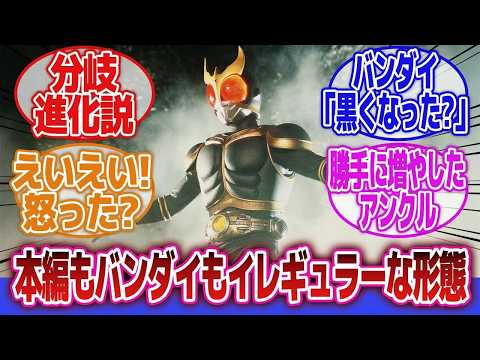
▶ Watch the original YouTube video
Kamen Rider Kuuga’s Hidden Forms: Analyzing Fan Theories and Production Design
Online fan communities have engaged in extensive debate about Kamen Rider Kuuga’s mysterious hidden forms—Amazing Mighty, Rising, and Ultimate—revealing how the series masterfully balanced commercial product strategy with sophisticated narrative design. These discussions highlight how the show’s intentional narrative ambiguity has sustained fan analysis for over two decades.
What Happened
Kamen Rider Kuuga, which aired in 2000, introduced a transformation system featuring multiple forms that were never fully explained within the main narrative. Fan communities across Twitter, 5channel, and YouTube have developed detailed theories about these hidden forms, particularly regarding why certain transformations appear outside the main storyline and how they relate to the series’ core themes. The debate centers on whether these design choices were intentional artistic decisions or compromises resulting from production constraints and sponsor demands.
Why It Matters
Kuuga represents a watershed moment in tokusatsu (Japanese special effects) storytelling, establishing narrative techniques that influenced the entire Heisei Rider era. The series’ approach to leaving narrative gaps and allowing fan interpretation has become a defining characteristic of modern tokusatsu production. Understanding how Kuuga balanced commercial requirements with artistic vision provides insight into how contemporary media properties manage similar tensions between creative intent and market demands. Additionally, the sustained fan engagement with these questions demonstrates how thoughtfully designed ambiguity can create lasting cultural resonance.
Background
Kamen Rider Kuuga premiered in 2000 as the first entry in the Heisei Rider series, following the original Showa era Kamen Rider shows. The protagonist, Yusuke Godai, discovers an ancient belt called the Arcle that grants him transformation abilities. Throughout the series, Godai acquires multiple forms—Mighty Form, Dragon Form, Pegasus Form, Titan Form, and later Amazing Mighty, Rising, and Ultimate forms. However, the series never explicitly explains how or why these transformations occur, or what triggers their emergence. The Amazing Mighty and Black forms appear primarily in supplementary materials and films rather than the main broadcast narrative. This structural choice created a persistent mystery that has driven fan analysis for over two decades.
The ancient Kuuga, a predecessor who sealed away all Grongi monsters using only the basic form, presents a narrative paradox: if the original Kuuga needed no advanced forms, why does Godai require multiple transformations? This question became central to fan interpretations of the series’ thematic concerns about humanity and monstrosity.
Key Points
- The “Out-of-Narrative” Forms: Amazing Mighty and Black forms appear primarily in films and supplementary materials, creating a distinction between “main narrative” and “alternate route” content that balances sponsor product lines with story coherence.
- Rising Form as System Malfunction: Fan consensus interprets Rising Form not as an intentional power acquisition but as an automatic system response to electrical shock—suggesting the Arcle functions as a self-evolving AI-like system rather than a simple transformation device.
- Ultimate Form’s Narrative Displacement: The limited appearances of Ultimate Form suggest it was originally designed as the final transformation but was repositioned due to broadcast format changes, creating unintended thematic resonance.
- Ancient Kuuga’s Minimalism: The revelation that the original Kuuga sealed all Grongi using only the basic form raises fundamental questions about whether form multiplication reflects genuine power growth or psychological/narrative necessity.
- The Arcle as Living System: The belt demonstrates autonomous evolution capabilities, responding to the wearer’s critical situations by unlocking new functions—a proto-AI concept ahead of its time.
- Thematic Integration of Ambiguity: The series’ refusal to explain form mechanics reinforces its central theme: the horror of human transformation into monstrosity, leaving viewers uncertain about the boundary between intentional evolution and involuntary corruption.
Timeline
- 2000: Kamen Rider Kuuga broadcasts, introducing the Heisei Rider era with unexplained transformation mechanics.
- Early 2000s: Supplementary films and materials introduce Amazing Mighty and other forms outside the main narrative.
- 2001: Kamen Rider Agito premieres as the direct successor, expanding on Kuuga’s multi-form concept.
- 2002: Kamen Rider Ryuki introduces parallel world concepts, extending Kuuga’s narrative multiplicity framework.
- 2009: Kamen Rider Decade explicitly explores parallel worlds and alternate routes, directly building on Kuuga’s foundational approach.
- 2008 onwards: Retrospective fan analysis intensifies as viewers discover and rewatch the series, generating sustained online discussion.
Perspectives
Commercial Strategy Interpretation: Some fans argue that Amazing Mighty and Black forms exist primarily to support Bandai’s product line, with the “alternate route” concept serving as post-hoc justification for what was fundamentally a marketing decision. This perspective views the narrative gaps as compromises rather than artistic choices.
Intentional Ambiguity Interpretation: Other analysts contend that Kuuga’s narrative structure deliberately mirrors its thematic concerns. The refusal to explain transformations reinforces the series’ exploration of involuntary monstrosity—viewers experience the same uncertainty about form mechanics that Godai experiences about his own transformation. From this perspective, the “out-of-narrative” forms represent Godai’s loss of agency and humanity.
System Evolution Interpretation: Fan consensus increasingly supports the theory that the Arcle functions as an autonomous system that evolves in response to critical situations. Rising Form emerges not from Godai acquiring lightning powers but from the belt’s self-protective mechanisms activating during electrical shock. This interpretation positions the Arcle as a quasi-sentient entity with its own agenda, separate from Godai’s conscious will.
Narrative Displacement Theory: Technical analysis suggests that Ultimate Form was originally conceived as the final transformation but was repositioned due to broadcast format changes. Rather than representing a failure of planning, this displacement creates unintended thematic depth—the “wrong” form appearing at the “wrong” time mirrors Godai’s loss of control over his own transformation.
Insights
Kamen Rider Kuuga demonstrates that narrative ambiguity, when deployed strategically, can enhance rather than diminish a work’s thematic resonance. The series’ refusal to explain its transformation mechanics creates productive uncertainty that mirrors the protagonist’s own confusion about his monstrous nature. What might appear as production constraints or commercial compromises actually function as sophisticated storytelling devices.
The distinction between “main narrative” and “alternate route” content—whether intentional or accidental—establishes a framework that subsequent Heisei Rider series would formalize and expand. Ryuki’s parallel worlds and Decade’s multiverse explicitly build on Kuuga’s implicit suggestion that multiple narrative possibilities coexist. This suggests that Kuuga’s apparent structural limitations became generative principles for an entire era of tokusatsu production.
The sustained fan engagement with Kuuga’s mysteries indicates that audiences value interpretive space over complete explanation. Twenty years after broadcast, fans continue generating new analyses because the series respects their intelligence enough to leave gaps. This approach contrasts with productions that prioritize comprehensive exposition, suggesting that strategic narrative restraint creates more enduring cultural artifacts.
The ancient Kuuga paradox—that the original sealed all monsters using only basic form while the modern Kuuga requires multiple transformations—ultimately reflects the series’ central concern: the difference between fighting as a human and fighting as a monster. The original Kuuga maintained his humanity; Godai progressively abandons his. The multiplication of forms tracks not power growth but the progressive erosion of human identity, making each new transformation a small death rather than an enhancement.