▶ Watch the original YouTube video
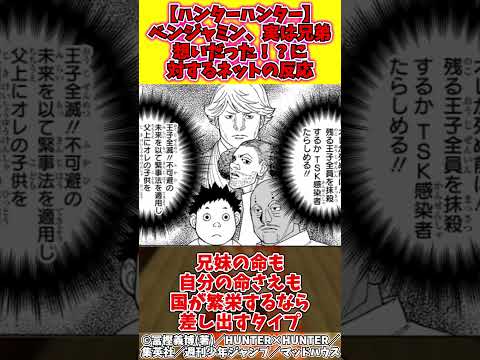
Hunter x Hunter: Benjamin’s Brotherly Love Reveals Togashi’s Depth in Character Writing
Fans of Hunter x Hunter have discovered a surprising complexity in Benjamin, the seemingly ruthless royal heir, as evidence of his genuine care for his siblings challenges the typical “cold-hearted villain” archetype. This character depth reflects Yoshihiro Togashi’s sophisticated approach to portraying human complexity within the Royal Succession Arc’s exploration of family and power dynamics.
What Happened
Benjamin Hui Guo Rou, one of the primary antagonists in Hunter x Hunter’s Royal Succession Arc, has been re-evaluated by fans and analysts following the revelation of his genuine affection for his siblings. Rather than displaying the purely selfish ambition expected of a royal competitor, Benjamin exhibits moments of protective concern and emotional vulnerability toward his brothers and sisters, suggesting a more nuanced character than initially apparent. This discovery has sparked widespread discussion across social media platforms, anime forums, and fan communities about the true nature of his character and his role within the broader narrative.
Why It Matters
Benjamin’s characterization exemplifies modern storytelling’s shift away from simplistic moral binaries toward complex, contradictory characters that reflect human reality. In an era where audiences increasingly demand psychological depth and emotional authenticity, Benjamin’s simultaneous pursuit of power and genuine familial bonds resonates with contemporary viewers. This complexity elevates the Royal Succession Arc from a straightforward power struggle into a meditation on the incompatibility of personal ambition and family loyalty, a theme that defines much of modern anime and manga. Furthermore, Benjamin’s character demonstrates how antagonists can drive narrative depth and thematic exploration without requiring redemption or moral simplification.
Background
The Royal Succession Arc, which aired during 2012-2013 in the manga serialization, marked a significant thematic shift in Hunter x Hunter. Following the Chimera Ant Arc’s exploration of individual desire and survival, the Royal Succession Arc refocused the narrative on family relationships and the corrupting nature of power within a dynastic context. Benjamin, as the strongest and most ambitious of the royal heirs, initially appeared to embody the ruthless antagonist archetype common in shonen anime. However, as the arc progressed, subtle moments revealed his capacity for genuine emotion regarding his siblings, contradicting the expected characterization and suggesting intentional complexity in Togashi’s writing.
The Royal Family of Kakin, with its numerous heirs competing for succession, provides an ideal setting for exploring how familial bonds persist even amid ruthless competition. Benjamin’s position as the frontrunner in this competition makes his emotional attachments particularly significant, as they represent a vulnerability that complicates his path to power.
Key Points
- Emotional Contradiction: Benjamin demonstrates inconsistent behavior toward his siblings, alternating between protective concern and cold opposition, suggesting simultaneous emotional investment and ruthless ambition
- Maternal Relationship: Unlike other royal heirs who treat their mothers as mere blood relations, Benjamin exhibits genuine emotional regard for his mother, the queen, revealing a capacity for familial affection
- Thematic Alignment: Benjamin’s internal conflict between power-seeking and family loyalty embodies the Royal Succession Arc’s central theme of the incompatibility between personal ambition and human connection
- Modern Character Archetype: Benjamin’s complexity mirrors contemporary antagonists in works like Code Geass and Attack on Titan, reflecting current storytelling conventions that prioritize psychological depth over moral clarity
- Fan Reception: Social media responses indicate strong emotional engagement with Benjamin’s character, with fans expressing surprise at his humanity and appreciation for Togashi’s nuanced portrayal
- Narrative Implications: Benjamin’s emotional vulnerability creates uncertainty regarding his future actions, suggesting his feelings may significantly influence the arc’s conclusion
Timeline
- 2012-2013: Royal Succession Arc serializes in Hunter x Hunter manga, introducing Benjamin as a primary antagonist
- Initial Perception: Readers interpret Benjamin as a conventional ruthless villain pursuing power without moral constraint
- Character Development: Subtle scenes reveal Benjamin’s protective feelings toward siblings and emotional connection to family members
- Fan Realization: Online communities recognize and discuss Benjamin’s complexity, initiating character re-evaluation
- Ongoing Analysis: Current discussions speculate on how Benjamin’s emotional attachments will influence future narrative developments
Perspectives
The Complexity Interpretation: Many fans and analysts view Benjamin’s brotherly affection as evidence of sophisticated character writing. They argue that his simultaneous pursuit of power and genuine familial love creates a psychologically realistic portrayal of someone caught between personal ambition and human connection. This perspective celebrates Togashi’s ability to transcend simplistic character archetypes.
The Ruthless Pragmatist View: Other observers maintain that Benjamin remains fundamentally a villain, arguing that his emotional displays do not genuinely constrain his actions or ultimate goals. From this perspective, Benjamin’s moments of affection are either manipulative performances or minor emotional fluctuations that do not alter his essential nature as a power-seeking antagonist.
The Thematic Lens: A third perspective emphasizes Benjamin’s role as a vehicle for exploring the Royal Succession Arc’s central themes. Rather than debating his moral status, this interpretation focuses on how his character embodies the fundamental conflict between individual ambition and family bonds that defines the arc’s narrative purpose.
Comparative Analysis
Benjamin’s characterization follows patterns established in other contemporary anime and manga. Eren Yeager from Attack on Titan similarly pursues grand ideological goals while experiencing conflicting emotions regarding his relationships. Lelouch vi Britannia from Code Geass demonstrates how familial love, particularly toward a sibling, can undermine ruthless ambition. Light Yagami from Death Note illustrates how personal relationships resist complete subordination to power-seeking objectives. These parallels suggest that Benjamin’s complexity reflects broader trends in modern storytelling that reject moral simplicity in favor of psychological authenticity.
Insights
Benjamin’s characterization represents a fundamental evolution in how contemporary storytelling approaches antagonists and morally complex characters. Rather than viewing villainy and humanity as mutually exclusive, modern narratives increasingly portray them as coexisting within single individuals. Benjamin embodies this approach by simultaneously pursuing power and experiencing genuine familial affection, creating a character whose actions remain unpredictable because his motivations are genuinely contradictory.
This complexity serves the Royal Succession Arc’s thematic exploration of power’s corrupting influence and the persistence of human connection even within ruthless competition. Benjamin’s internal conflict between ambition and emotion raises fundamental questions about whether individuals can maintain their humanity while pursuing absolute power, and whether familial bonds can survive the pressures of dynastic succession.
The strong fan response to Benjamin’s character depth reflects contemporary audiences’ preference for psychological realism over moral clarity. In an era of increasing narrative sophistication, characters who embody contradictions and resist simple categorization resonate more powerfully than traditional archetypes. Benjamin’s “brotherly love” is significant not because it redeems him or simplifies his character, but precisely because it complicates him, creating a figure whose future actions remain genuinely uncertain.
Togashi’s portrayal of Benjamin demonstrates that character depth emerges not from moral consistency but from the authentic portrayal of competing human impulses. The most compelling characters are often those whose internal contradictions mirror the complexity of actual human experience, where love and ambition, loyalty and desire, coexist in uncomfortable tension. Benjamin’s character validates this approach, suggesting that the future of character-driven storytelling lies not in moral clarity but in psychological authenticity.