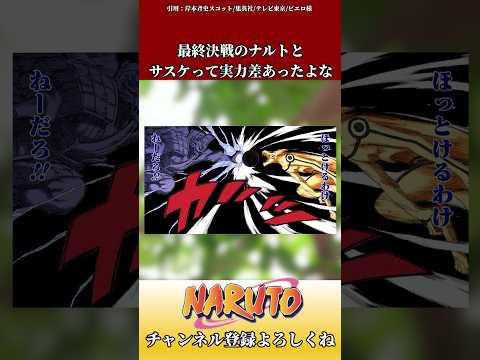
▶ Watch the original YouTube video
Did Naruto Really Overpower Sasuke in Their Final Battle? A Deep Analysis of the Power Gap Debate
More than a decade after Naruto’s final battle with Sasuke aired, fans continue to debate whether a genuine power gap existed between the two rivals. A comprehensive analysis of online reactions, comparative storytelling, and character development reveals that the answer is far more complex than simple victory or defeat.
What Happened
Naruto Uzumaki and Sasuke Uchiha’s climactic final battle remains one of the most discussed moments in anime history. The confrontation, which aired in November 2014, depicted Naruto achieving complete control over the Nine-Tailed Fox’s power and receiving the Six Paths Sage’s abilities, while Sasuke awakened the Rinnegan and activated his complete Susanoo form. Despite both characters reaching unprecedented power levels, Naruto emerged victorious in what many viewers perceived as a one-sided encounter. This outcome sparked widespread online debate questioning whether the power difference was as substantial as the battle’s presentation suggested.
Why It Matters
The final battle’s power dynamics carry significant implications for how the series’ central theme—the rivalry and equality between Naruto and Sasuke—was ultimately resolved. Throughout the entire narrative, the story repeatedly emphasized that these two characters were equals, destined rivals whose fates were intertwined. A decisive power gap in their final confrontation contradicts this long-established narrative foundation, raising questions about storytelling consistency and whether the anime’s presentation aligned with the original manga’s intent. This debate reflects broader concerns about how anime adaptations handle climactic moments and whether visual spectacle can overshadow narrative coherence.
Background
Naruto and Sasuke’s relationship evolved throughout the series as the central emotional and thematic core. From their initial rivalry as academy students to their repeated confrontations across the narrative, their power levels remained relatively balanced, with victories alternating based on circumstances, growth, and psychological state. By the final arc, both characters had acquired god-like abilities—Naruto through the Nine-Tailed Fox’s cooperation and the Six Paths Sage’s blessing, and Sasuke through the Rinnegan and Eternal Mangekyo Sharingan. The final battle was meant to serve as the ultimate resolution to their rivalry, yet the execution raised questions among viewers about whether the power disparity accurately reflected their character development and the series’ thematic promises.
Key Points
- Widespread skepticism about power gap: Online fan communities predominantly question whether Naruto’s superiority was as clear-cut as the battle’s presentation suggested, with many arguing the power levels should have been more evenly matched.
- Sasuke’s physical limitations: Sasuke’s loss of his right arm is cited as a significant factor that may have artificially created a power imbalance rather than representing a genuine difference in raw ability.
- Rapid power escalation concerns: Naruto’s swift acquisition of the Six Paths Sage’s power is viewed by some as poorly explained, raising questions about whether this sudden boost was sufficiently justified narratively.
- Anime versus manga discrepancies: The anime adaptation’s visual presentation emphasizes Naruto’s dominance more heavily than the original manga, which includes more dialogue and psychological depth.
- Definition ambiguity: “Power” encompasses multiple dimensions—pure combat strength, tactical skill, mental fortitude, and adaptability—and different interpretations of which factors matter most lead to conflicting conclusions about who was truly stronger.
- Thematic inconsistency: The battle’s outcome contradicts the series’ repeated messaging about Naruto and Sasuke’s fundamental equality as rivals.
Timeline
- November 2014: Naruto’s final battle with Sasuke airs in the anime adaptation, becoming an immediate topic of fan discussion.
- 2014–2015: Initial wave of online debate regarding the power gap and battle’s narrative satisfaction.
- 2015–2024: Continuous discussion persists across social media, forums, and video platforms, with no consensus reached.
- Present day: The debate remains active, with new viewers discovering and re-evaluating the final battle through various online platforms.
Perspectives
The “Power Gap Exists” Perspective: Supporters of this view argue that Naruto’s acquisition of the Six Paths Sage’s power and complete Nine-Tailed Fox control objectively granted him superior combat ability compared to Sasuke’s Rinnegan and Susanoo. From a pure numerical standpoint of chakra quantity and technique potency, Naruto’s advantages were demonstrable and significant.
The “No Genuine Power Gap” Perspective: Critics contend that Sasuke’s physical handicap (missing arm) artificially created an imbalance that masked equal underlying power levels. They argue that both characters achieved comparable god-tier abilities simultaneously, and the battle’s outcome reflected circumstantial disadvantage rather than superior strength. Some suggest that Sasuke’s psychological state—marked by lingering conflict and uncertainty—rather than raw power determined the outcome.
The “Multidimensional Power” Perspective: A more nuanced view recognizes that “power” is not monolithic. Naruto excelled in pure combat strength and mental clarity, while Sasuke demonstrated superior tactical skill and environmental adaptation. Neither character was universally “stronger”—their relative advantages varied by dimension of combat ability. This interpretation suggests the debate itself stems from conflating different types of power into a single metric.
The “Narrative Execution Problem” Perspective: Some analysts argue the core issue is not whether a power gap existed, but whether the story adequately explained and justified it. The rapid nature of Naruto’s power acquisition and the anime’s emphasis on visual spectacle over psychological depth created ambiguity about the battle’s true meaning, leaving viewers unsatisfied regardless of the actual power dynamics.
Comparative Analysis with Similar Works
Examining other anime series with climactic rival battles reveals different approaches to power dynamics and narrative satisfaction:
Fullmetal Alchemist: Brotherhood resolved its final confrontation through wisdom and spiritual maturity rather than raw power, creating high viewer satisfaction despite the protagonist not being overwhelmingly stronger. The narrative clearly communicated why the protagonist prevailed.
Bleach featured a protagonist who suddenly became dramatically more powerful than his rival, similar to Naruto. However, this series also faced criticism for the rapid power escalation, suggesting that visual dominance alone does not guarantee narrative satisfaction.
JoJo’s Bizarre Adventure maintained relatively balanced power levels between protagonist and antagonist, emphasizing wit and determination over raw strength, which garnered consistent praise for thematic coherence.
These comparisons suggest that the presence or absence of a power gap is less important than whether the narrative clearly communicates the reasons for the outcome and maintains consistency with established themes.
The Complexity of “Power” in Combat Narratives
A critical insight from analyzing this debate is that “power” in combat narratives comprises multiple dimensions that are often conflated:
Pure Combat Strength: Raw physical ability, chakra quantity, and technique potency—dimensions where Naruto held clear advantages.
Combat Technique: Experience, tactical knowledge, and strategic application—areas where Sasuke demonstrated considerable skill.
Mental Fortitude: Psychological resolve and clarity of purpose—where Naruto’s unified mindset contrasted with Sasuke’s internal conflict.
Environmental Adaptation: Ability to respond to changing circumstances—a dimension where both characters showed competence but with different strengths.
Matchup Compatibility: Specific advantages or disadvantages against a particular opponent—a factor that varies independently of overall power level.
The persistent online debate likely stems from different participants emphasizing different dimensions of power. Those focusing on pure combat strength see a clear Naruto advantage, while those weighing tactical skill and psychological factors see a more balanced matchup.
Anime Adaptation Choices and Their Impact
Comparison between the original manga and anime adaptation reveals significant differences in how the final battle was presented. The manga version incorporates extensive dialogue, internal monologue, and psychological exploration that contextualizes the power dynamics. The anime adaptation, conversely, prioritizes visual spectacle and action sequences, reducing the psychological and philosophical elements that provided narrative justification in the source material.
This adaptation choice may have contributed to viewer confusion about the battle’s meaning. Without the manga’s deeper character introspection, the anime’s presentation of Naruto’s dominance appears more one-sided and less narratively justified. The visual emphasis on combat power over psychological complexity created an impression of imbalance that the original manga’s more balanced presentation might have mitigated.
Industry Trends and Narrative Choices
The final battle’s presentation reflects broader trends in anime production from the 2010s onward. During this period, anime increasingly featured protagonists acquiring overwhelming power and dominating opponents, as seen in series like Overlord, That Time I Got Reincarnated as a Slime, and Attack on Titan. This trend correlates with the expansion of streaming platforms and evolving audience preferences.
Naruto’s final battle may reflect production staff assumptions about viewer expectations for protagonist triumph and power fantasy fulfillment. However, this industry trend conflicted with the specific narrative foundation Naruto had established—the fundamental equality and interdependence of its two central characters. The resulting tension between industry trends and series-specific thematic promises created the narrative dissonance that sparked ongoing debate.
Insights
The persistent debate about Naruto and Sasuke’s final battle reveals several important truths about anime storytelling and fan engagement. First, the presence or absence of a power gap matters less than narrative clarity and thematic consistency. Viewers can accept either outcome—dominant victory or balanced struggle—provided the story adequately explains and justifies the result.
Second, the gap between fan expectations and narrative execution creates lasting dissatisfaction that persists for years. The series spent over a decade establishing Naruto and Sasuke as equals, creating an implicit contract with viewers that their final confrontation would reflect this equality. Breaking that contract without sufficient narrative justification generated the skepticism that continues today.
Third, the distinction between pure power and the multidimensional nature of combat ability remains underexplored in fan discourse. More precise language distinguishing between combat strength, tactical skill, psychological state, and circumstantial factors would clarify rather than resolve the debate, potentially leading to more nuanced appreciation of the battle’s actual narrative content.
Finally, the anime adaptation’s emphasis on visual spectacle over psychological depth represents a significant choice with lasting consequences. The original manga’s more balanced presentation of the final battle, incorporating extensive dialogue and introspection, may have provided the narrative justification that the anime’s action-focused approach sacrificed. This suggests that adaptation choices fundamentally shape how audiences interpret and evaluate source material.
Ultimately, Naruto’s final battle with Sasuke was neither a perfect narrative resolution nor a complete failure. It represented a complex outcome shaped by different power dimensions, physical circumstances, psychological states, and thematic tensions. Whether viewers find this satisfying depends largely on which aspects of the narrative they prioritize and how they interpret the series’ central themes about rivalry, equality, and growth.