▶ Watch the original YouTube video
Why Hisoka Approved Leorio’s Hunter Exam Interview: A Deep Analysis of Character Psychology in Hunter x Hunter
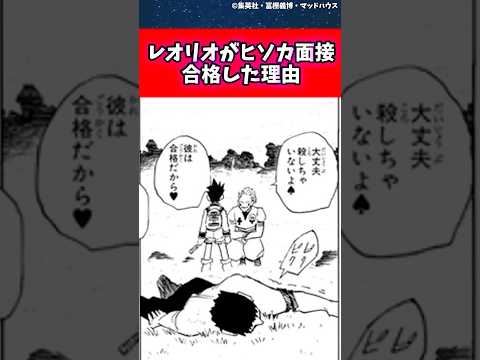
In one of Hunter x Hunter’s most pivotal moments, the enigmatic Hisoka approves Leorio for the Hunter Exam despite the latter appearing weaker than other candidates. This unexpected decision has sparked years of debate among fans, but a careful analysis reveals that Hisoka valued not raw strength, but unwavering commitment to a meaningful goal—a principle that defines the series’ approach to character development.
What Happened
During the Hunter Exam’s interview phase, Hisoka—one of the most unpredictable and powerful characters in the series—unexpectedly approves Leorio for advancement. Unlike Gon, Killua, and Kurapika, whose primary motivation is becoming a Hunter, Leorio’s stated goal is to become a doctor. This distinction becomes crucial to understanding Hisoka’s decision. Rather than dismissing Leorio as weak or unmotivated, Hisoka recognizes something in the young man’s unwavering commitment to his medical ambitions that resonates with his own complex value system.
Why It Matters
This moment encapsulates one of Hunter x Hunter’s central themes: that strength is not merely physical, but rooted in conviction and purpose. Hisoka’s approval of Leorio demonstrates that the series operates on a more nuanced understanding of character evaluation than surface-level power comparisons. The scene also illustrates how creator Yoshihiro Togashi constructs characters with layered motivations, making them feel authentic and unpredictable. For viewers, this moment challenges assumptions about what makes someone worthy of advancement and forces reconsideration of Leorio’s role in the narrative.
Background
The Hunter Exam serves as the narrative framework through which Togashi introduces the main cast and establishes their individual motivations. The interview phase is particularly significant because it cannot measure physical strength—instead, it probes the psychological and emotional foundations of each candidate’s ambitions. Leorio, initially presented as the least remarkable of the main characters, stands apart by pursuing medicine rather than the abstract goal of becoming a Hunter. This specificity of purpose, combined with his genuine commitment to helping others through medical science, creates a profile that intrigues Hisoka in ways that raw talent alone cannot.
Key Points
- Hisoka values commitment over raw power: His approval of Leorio reflects an appreciation for unwavering dedication to a concrete goal, not merely physical strength.
- Leorio’s medical ambition sets him apart: Unlike other candidates seeking the abstract title of Hunter, Leorio pursues medicine—a specific, challenging, and altruistic path.
- The interview format reveals character essence: The Hunter Exam’s interview phase is designed to evaluate psychological and emotional foundations rather than combat ability.
- Hisoka’s complex value system: His character operates on a philosophy that recognizes and respects alternative perspectives and unconventional motivations.
- Thematic consistency across anime: Similar patterns appear in other acclaimed series, where powerful characters evaluate others based on spiritual conviction rather than measurable strength.
- Fan interpretation varies by analytical depth: Understanding this scene requires recognizing Hisoka as a character with consistent internal logic, not merely as an unpredictable force.
Timeline
- Hunter Exam begins: Candidates are introduced with their individual motivations and backgrounds.
- Physical trials conclude: The first and second phases test combat ability and survival instinct.
- Interview phase commences: Hisoka, serving as an examiner, conducts individual interviews with candidates.
- Leorio’s interview: Leorio presents his medical ambitions to Hisoka, who unexpectedly approves him.
- Other candidates interviewed: Gon, Killua, and Kurapika undergo their own evaluations, providing contrast to Leorio’s experience.
Perspectives
Fan interpretations of this scene vary significantly. On Twitter and YouTube, many viewers support the analysis that Hisoka recognized Leorio’s genuine commitment and respected his unconventional path. This interpretation aligns with a more sophisticated reading of Hisoka’s character as someone guided by a consistent, if unconventional, philosophy rather than pure whimsy.
Conversely, some online communities express skepticism, suggesting that Hisoka’s approval might be arbitrary or based on factors not explicitly revealed in the narrative. This perspective emphasizes Hisoka’s unpredictability and questions whether viewers can truly understand his motivations.
A third interpretation, gaining traction in analytical communities, proposes that Hisoka sees in Leorio a reflection of his own duality—the gap between one’s public role and private motivations. Just as Hisoka pursues combat while maintaining a Hunter’s facade, Leorio pursues medicine while becoming a Hunter. This parallel creates a form of mutual recognition between the two characters.
Insights
Leorio’s approval by Hisoka represents a deliberate narrative choice by Togashi to establish that the Hunter universe values diversity of purpose. The series does not present a monolithic definition of strength or worthiness; instead, it acknowledges that individuals can pursue the Hunter license for vastly different reasons, and that commitment to one’s true goal is itself a form of strength.
This scene also foreshadows the series’ later exploration of how individual ambitions interact with the role of Hunter. Leorio’s character arc—balancing medical aspirations with Hunter responsibilities—becomes a recurring theme that enriches the overall narrative.
Furthermore, the scene demonstrates Togashi’s sophisticated approach to character psychology. Rather than relying on explicit exposition, the narrative trusts viewers to infer Hisoka’s reasoning through careful observation of his behavior and the context of the interview. This approach elevates Hunter x Hunter beyond conventional shonen storytelling, positioning it as a work that rewards analytical engagement and rewards viewers who pay attention to character motivation and internal consistency.
The enduring debate around this moment—spanning over a decade since the anime’s broadcast—testifies to the scene’s effectiveness. It presents a character interaction that appears simple on the surface but reveals layers of complexity upon examination, embodying the series’ broader commitment to nuanced character development and thematic depth.