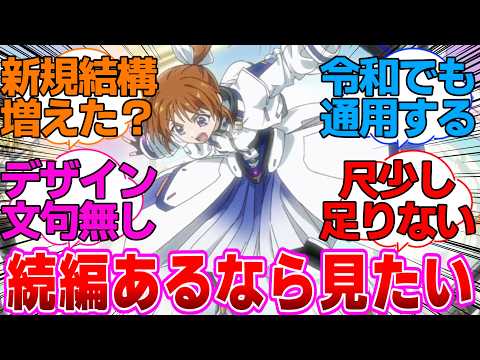
▶ Watch the original YouTube video
Why Fans Still Crave a New Magical Girl Lyrical Nanoha Sequel After 20 Years
Following the release of Magical Girl Lyrical Nanoha EXCEEDS Gun Blaze Vengeance, longtime fans have reignited calls for a new sequel to the beloved magical girl franchise. After nearly two decades of devoted fandom and over 500 anime watched, one longtime viewer explains why this series stands apart in its demand for continuation.
What Happened
The release of Magical Girl Lyrical Nanoha EXCEEDS Gun Blaze Vengeance has sparked widespread fan discussion across social media platforms, with viewers expressing strong desire for a new sequel. A compilation video on YouTube has aggregated these fan reactions, revealing sustained enthusiasm for continuing the franchise despite the nearly two-decade gap since the last major installment.
Why It Matters
The persistent demand for a Nanoha sequel reveals important trends in anime fandom and industry strategy. Unlike typical franchise revivals driven by nostalgia, the Nanoha fanbase’s expectations are rooted in narrative necessity. The series is uniquely structured around character development across real time—protagonists age and mature throughout the franchise—creating an inherent storytelling momentum that naturally invites continuation. This contrasts sharply with other magical girl franchises that reset their narratives with each new series.
Background
Magical Girl Lyrical Nanoha debuted in 2004 as a late-night anime during the early days of the medium’s digital distribution. The franchise initially appeared to be a conventional magical girl show but distinguished itself through complex character relationships and serialized storytelling. The protagonist, Nanoha Takamachi, begins as a sixth-grader and ages throughout the series—a rarity in the magical girl genre. Subsequent seasons (A’s, StrikerS, and others) followed her progression into adolescence and adulthood, each installment separated by significant in-universe time gaps.
The franchise has maintained a consistent world—the Time-Space Administration Bureau—across all canonical entries, allowing for genuine character continuity. This structural choice fundamentally differs from competitors like Pretty Cure, which resets its cast and setting with each new series to attract fresh audiences.
Key Points
- Fan demand for a Nanoha sequel stems from narrative structure rather than mere nostalgia, as the series is designed around character aging and development across real time
- The fanbase demonstrates unusually strong cohesion for a 20-year-old franchise, with sustained engagement across social media platforms and online communities
- Unlike other magical girl anime, Nanoha maintains a single continuous world and character timeline, creating natural storytelling momentum for sequels
- Recent industry successes with long-form sequels (Attack on Titan: The Final Season, Jujutsu Kaisen) demonstrate commercial viability for continuing established franchises
- Fan discussions reveal multiple preferred formats for continuation—theatrical films, television series, or original video animation (OVA)
- The series’ appeal transcends generational nostalgia; viewers’ life experiences have matured alongside the characters, creating deeper emotional investment
Timeline
- 2004: Magical Girl Lyrical Nanoha original series airs during late-night anime boom
- 2005: Nanoha A’s released, deepening character relationships and world-building
- 2007: StrikerS debuts, set nine years after A’s, repositioning Nanoha as an adult instructor
- 2009: Vivid Strike! and related spin-offs expand the franchise with next-generation characters
- 2024: EXCEEDS Gun Blaze Vengeance releases, reigniting sequel demand among longtime fans
Perspectives
Narrative Necessity Argument: Proponents of a sequel argue that the franchise’s fundamental design—characters aging in real time within a continuous world—creates an inherent storytelling obligation. Unlike episodic magical girl shows, Nanoha cannot simply reset; doing so would contradict the series’ core premise. The Time-Space Administration Bureau setting offers infinite narrative possibilities, with many unexplored story threads remaining.
Industry Viability Argument: Recent anime industry trends support sequel production. Attack on Titan: The Final Season and Jujutsu Kaisen achieved critical and commercial success by continuing established narratives rather than launching new properties. The Nanoha fanbase demonstrates the cohesion and sustained engagement necessary for profitable long-form production.
Production Reality Argument: Industry observers acknowledge significant barriers to sequel production: rising animation costs, staff availability, broadcast slot competition, and the challenge of maintaining quality across decades. These practical constraints explain the gap between fan demand and production reality.
Format Diversity Argument: Fan discussions reveal no consensus on preferred continuation format. Some advocate for theatrical films, others for television series, and still others for OVA releases. This diversity suggests multiple viable production pathways.
Insights
The sustained demand for a Nanoha sequel reflects a fundamental shift in anime fandom maturity. Contemporary audiences increasingly value narrative depth and character continuity over novelty. The franchise’s structural choice to age its characters in real time—a decision that seemed unconventional in 2004—has become its greatest asset, creating organic narrative momentum that persists across decades.
The Nanoha phenomenon also demonstrates the commercial potential of long-form storytelling in anime. Unlike franchises that rely on periodic reboots to attract new audiences, Nanoha has built a fanbase whose investment deepens with time. Viewers who discovered the series as students have matured into professionals and parents, their life experiences mirroring their favorite characters’ development. This synchronization between fictional and real-world timelines creates emotional resonance that transcends typical fandom.
The comparison with Pretty Cure is instructive. While Pretty Cure prioritizes new audience acquisition through narrative resets, Nanoha maximizes existing fanbase satisfaction through continuity. Both strategies have merit, but Nanoha‘s approach has proven sustainable across two decades, suggesting that depth-focused franchising may offer underexplored commercial opportunities in the anime industry.
The voice acting evolution across the franchise provides a subtle but powerful indicator of the series’ commitment to character aging. The protagonist’s voice actress, Rie Tanaka, has deliberately modulated her performance across installments—from youthful tones in the original series to more mature delivery in StrikerS. This vocal progression mirrors the character’s development and reinforces the franchise’s thematic commitment to growth and change.
Looking forward, three potential sequel directions emerge: a next-generation narrative centered on younger characters, an adult-era story following the original cast into professional and parental roles, or parallel-world explorations using the franchise’s time-travel mechanics. Each approach carries distinct advantages and risks, but the second option—depicting the original cast’s adult lives—appears most aligned with the franchise’s foundational themes.
Ultimately, the enduring demand for a Nanoha sequel represents not nostalgic attachment but active engagement with an ongoing narrative. For fans who have grown alongside these characters across two decades, a continuation would not be a new anime but rather the natural progression of a story that never truly ended.