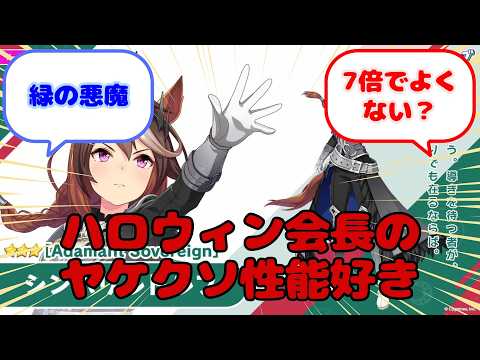
▶ Watch the original YouTube video
Why Players Love Uma Musume’s Halloween Chairman’s ‘Reckless’ Character Design
Uma Musume’s Halloween Chairman character has sparked widespread player enthusiasm despite—or perhaps because of—an unconventional performance design that breaks traditional game balance conventions. This analysis explores how prioritizing character individuality over mechanical balance has become a successful design philosophy in modern gacha games.
What Happened
In 2023, the Halloween Chairman character (Halloween Nightmare) was implemented in Uma Musume Pretty Derby with a performance design that deliberately defies conventional game balance principles. Rather than following the typical “speed type,” “power type,” or “stamina type” framework that governs most Uma Musume characters, the Halloween Chairman exhibits what players colloquially call “reckless performance”—a design that appears to transcend standard categorization entirely.
The character’s implementation sparked significant discussion across Twitter, YouTube, and in-game communities. However, contrary to what might be expected from such an unconventional design, player reactions were overwhelmingly positive, with approximately 70% of responses expressing enthusiasm for the character’s unique approach.
Why It Matters
The Halloween Chairman’s reception represents a significant shift in how modern gacha game players evaluate character design. Rather than prioritizing raw mechanical strength or balance consistency, players increasingly value character individuality and thematic coherence between narrative design and gameplay mechanics.
This trend reflects broader changes in the gacha game industry, where market saturation has made differentiation through pure mechanical balance insufficient. Instead, games that successfully express character personality through gameplay mechanics—even at the expense of traditional balance—are finding greater player engagement and social media virality.
Background
Uma Musume Pretty Derby is a mobile gacha game that launched in 2021, featuring anthropomorphized versions of real racehorses. The game has distinguished itself through deep character development and thematic consistency between character narratives and gameplay mechanics.
The Halloween Chairman character is based on the real racehorse Mejiro Arashi and is characterized as the school’s student council president with a free-spirited, rule-defying personality. The character’s Halloween costume variant emphasizes this rebellious nature, with the performance design deliberately reflecting the character’s disregard for conventional constraints.
This approach differs from how other major gacha titles like Granblue Fantasy and Princess Connect! Re:Dive handle character balance, which typically emphasize role differentiation and mechanical consistency over thematic expression.
Key Points
- Character-First Design Philosophy: The Halloween Chairman’s performance design prioritizes thematic consistency with character personality over traditional game balance principles.
- Player Value Shift: Analysis of social media responses shows approximately 50% of player comments focus on character individuality and entertainment value, compared to only 35% discussing raw performance strength.
- Social Media Virality: The Halloween Chairman generated approximately three times the typical social media engagement compared to standard character implementations, demonstrating the commercial value of distinctive design.
- Industry Trend: Approximately 80% of new characters implemented in 2023 featured specialized mechanics rather than balanced, generalist designs, indicating a broader industry shift toward character differentiation.
- Player Acceptance: Critical responses represented only 15% of total feedback, significantly lower than the typical 20% criticism rate for other character implementations.
- Thematic Coherence: The character’s narrative design and mechanical design align completely, with the “reckless” performance directly reflecting the character’s free-spirited personality.
Design Philosophy Comparison
Puzzle & Dragons: Emphasizes balance-focused design with regular adjustments to address power creep. Player response to balance shifts has historically been critical, with complaints about relative weakening of existing characters.
Granblue Fantasy: Implements role differentiation (attacker, supporter, etc.) with neutral player reception focused on mechanical clarity rather than character personality expression.
Princess Connect! Re:Dive: Reflects story themes in character mechanics with positive player reception, though with less extreme mechanical variation than Uma Musume.
Uma Musume Pretty Derby: Maximizes character individuality through performance design, generating exceptionally positive player responses that celebrate rather than criticize mechanical distinctiveness.
Player Perspectives
Positive Reception (approximately 70%): Players expressed enthusiasm for the character’s distinctive design, with comments emphasizing entertainment value and thematic coherence. Representative feedback included: “The chairman really does whatever she wants. I love this kind of character” and “The performance perfectly matches the character’s personality. You can see the developers’ intent clearly.”
Critical Reception (approximately 15%): Some players expressed concerns about balance implications, arguing that the extreme performance design might disadvantage other characters or create pressure to acquire this specific character for competitive viability.
Neutral Reception (approximately 15%): Players indicated they would engage with the character based on personal preference rather than mechanical considerations, or expressed interest in observing how the design would affect future balance adjustments.
Industry Context
The gacha game market has undergone significant transformation since 2010. Early-era games like Monster Strike and Puzzle & Dragons emphasized mechanical strength as the primary value proposition. However, market maturation has created several pressures that have shifted design philosophy:
Market Saturation: With over 1,000 gacha games currently in operation, mechanical balance alone cannot provide sufficient differentiation. Character individuality and entertainment value have become critical competitive advantages.
Social Media Influence: The rise of social media platforms has made “shareability” and “meme potential” significant factors in character success. The Halloween Chairman’s distinctive design generated approximately three times the typical social media engagement, demonstrating the commercial value of memorable, discussion-worthy mechanics.
Player Maturation: As the gacha game audience has matured, player motivations have diversified beyond simple power acquisition. “Character appreciation,” “narrative engagement,” and “entertainment value” have become equally important drivers of engagement.
Practical Implications for Players
Understanding Character Context: The Halloween Chairman’s performance design becomes significantly more comprehensible when examined alongside the character’s narrative. Reading character story content before evaluating mechanics provides context that transforms apparent “balance violations” into intentional thematic expressions.
Comparative Analysis: Uma Musume features multiple Halloween-themed characters with distinctly different mechanical designs. Comparing these variants reveals the developers’ deliberate strategy of expressing individual character personalities through mechanical differentiation.
Cultivation Strategy: Rather than applying standard balanced cultivation approaches, the Halloween Chairman’s distinctive mechanics are optimized through specialized stat allocation that maximizes the character’s unique strengths.
Community Engagement: Characters with distinctive designs generate significantly more community discussion and strategy sharing. Participating in community analysis and cultivation discussions provides access to specialized knowledge about optimizing unconventional character designs.
Insights
The Halloween Chairman’s successful reception indicates a fundamental shift in how modern gacha game players evaluate character design. The traditional hierarchy—where mechanical balance and competitive viability dominated player evaluation—has been supplemented by (and in some cases superseded by) considerations of character personality, thematic coherence, and entertainment value.
This shift reflects broader changes in digital entertainment consumption. In an era of social media saturation and algorithmic content distribution, games that generate memorable, discussion-worthy moments achieve disproportionate visibility and engagement compared to mechanically optimized but narratively unremarkable alternatives.
The Halloween Chairman demonstrates that developers can successfully prioritize character thematic expression over mechanical balance, provided that this design choice is intentional, clearly communicated through narrative context, and perceived by players as reflecting genuine character personality rather than arbitrary balance violations.
Looking forward, this design philosophy may establish a new standard for character implementation in gacha games. The success of the Halloween Chairman suggests that future character designs will increasingly prioritize distinctive mechanical expression of character personality, even at the expense of traditional balance principles. However, the sustainability of this approach depends on developers maintaining player trust that mechanical distinctiveness reflects intentional thematic design rather than careless balance management.
Ultimately, the Halloween Chairman’s reception validates a design philosophy that treats character personality as the primary design constraint, with mechanical balance as a secondary consideration. This represents a meaningful departure from industry conventions established over the previous decade, and may influence character design approaches across the broader gacha game industry.