▶ Watch the original YouTube video
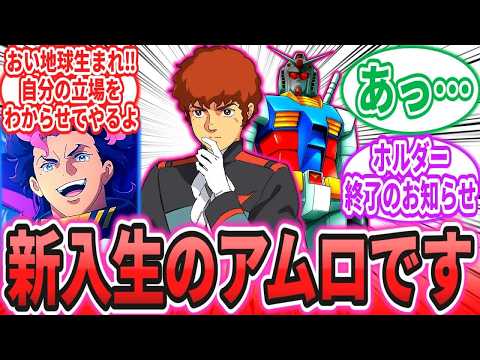
What If Amuro Ray Enrolled at Asticassia? Gundam Fans Explore a Fascinating Crossover Scenario
A thought-provoking hypothetical scenario has captivated the Gundam fanbase: what if Amuro Ray, the protagonist of the original Mobile Suit Gundam, transferred to Asticassia High School, the setting of Mobile Suit Gundam: The Witch from Mercury? This creative premise has sparked diverse online discussions that reveal fundamental differences between Gundam series across generations and their approaches to character development.
What Happened
An intriguing “what-if” scenario has gained traction within the Gundam community, imagining Amuro Ray—the legendary protagonist from the 1979 original Mobile Suit Gundam—as a new student at Asticassia High School, the elite mobile suit pilot academy featured in Mobile Suit Gundam: The Witch from Mercury (2022-2023). This premise has generated extensive online discussion across Twitter, YouTube, and fan forums, with viewers exploring how Amuro’s combat experience and character would interact with the academy’s social dynamics, political intrigue, and educational structure.
Why It Matters
This hypothetical scenario transcends simple character crossover fan fiction. It serves as a creative lens through which to examine how the Gundam franchise has evolved over 44 years, from 1979 to 2023. The comparison reveals fundamental shifts in how Gundam conceptualizes protagonist development: from forced conscription into warfare to deliberate enrollment in a structured educational institution. Understanding these differences illuminates the franchise’s thematic evolution and raises questions about whether character essence remains constant across different narrative contexts or whether environment fundamentally shapes identity.
Background
Amuro Ray is the protagonist of the original Mobile Suit Gundam, set in Universal Century 0079. He begins as an ordinary civilian teenager who is thrust into military conflict when the mobile suit RX-78 Gundam arrives at his colony. His character arc centers on rapid transformation from civilian to experienced warrior, driven by circumstances beyond his control. His defining traits include exceptional piloting ability, psychological resilience under combat stress, and emotional immaturity in social contexts.
Conversely, Stretta Mercury, protagonist of The Witch from Mercury, is a mobile suit pilot candidate who voluntarily enrolls at Asticassia High School with the explicit goal of becoming a pilot. Rather than being forced into conflict, she enters an institution designed to train pilots. The academy environment emphasizes social hierarchy, political factions (Ostrave, Benerit, Peil, Jetarque, and Grassley), romantic relationships, and institutional intrigue alongside combat training.
These two characters occupy fundamentally different narrative frameworks. Amuro’s story emphasizes survival and adaptation to sudden warfare. Stretta’s story emphasizes social navigation and political maneuvering within an educational hierarchy. The hypothetical scenario creates productive tension by asking what happens when these two different character archetypes and narrative contexts collide.
Key Points
- Contrasting Entry Points: Amuro enters warfare as a civilian conscript, while Stretta enters an academy as an aspiring pilot. This fundamental difference shapes their psychological development and social positioning.
- Combat Experience vs. Social Adaptation: Amuro’s strength lies in combat capability and tactical thinking. Stretta’s strength lies in social navigation and political awareness. The scenario highlights how different skill sets become relevant in different environments.
- Environmental Mismatch: Amuro’s combat experience and psychological trauma from warfare would create significant friction within an academic environment. His presence would disrupt existing power dynamics and social structures at Asticassia.
- Thematic Implications: The scenario raises questions about whether protagonist character is intrinsic or environmentally determined, and whether the same individual can maintain consistent identity across radically different narrative contexts.
- Franchise Evolution: The comparison reveals how Gundam has shifted from emphasizing military conflict and forced conscription to emphasizing institutional structures, social hierarchies, and political intrigue.
- Fan Engagement: The scenario has generated substantive discussion about narrative structure, character development, and the franchise’s thematic priorities across different eras.
Timeline
- 1979: Original Mobile Suit Gundam airs, introducing Amuro Ray as a civilian conscript in Universal Century 0079.
- 1985-1986: Mobile Suit Zeta Gundam presents Kamille Bidan, another civilian-turned-pilot in a different historical period.
- 1988: Mobile Suit Gundam: Char’s Counterattack features adult Amuro as an established military pilot.
- 2022-2023: Mobile Suit Gundam: The Witch from Mercury airs, introducing Stretta Mercury as a deliberate academy enrollee in a different narrative framework.
- 2024: The “what-if” scenario gains traction in fan communities, prompting comparative analysis of these different protagonist archetypes.
Perspectives
Supportive Interpretation: Many fans view this scenario as a legitimate thought experiment that illuminates the franchise’s evolution. They argue that comparing how Amuro would function in Stretta’s environment reveals essential truths about character development, narrative structure, and thematic priorities. This perspective treats the scenario as serious critical analysis rather than mere fan fiction.
Skeptical Interpretation: Some fans dismiss the scenario as superficial character swapping with limited analytical value. They contend that removing characters from their original contexts strips away the narrative and historical specificity that gives them meaning, making the exercise ultimately hollow.
Practical Narrative Perspective: Other fans focus on concrete storytelling implications, noting that Amuro’s combat experience would fundamentally destabilize Asticassia’s existing power structures. His presence would alter plot trajectories, character relationships, and thematic focus in ways that would require substantial narrative restructuring.
Psychological Perspective: Some analysts emphasize that Amuro’s psychological trauma from warfare—his emotional immaturity and difficulty with interpersonal relationships—would become more pronounced in an academic environment where social skills matter more than combat ability. This perspective highlights how environment can expose or amplify different aspects of character.
Insights
This scenario reveals that the Gundam franchise has undergone significant thematic evolution. Early Gundam works (1979-1988) centered on individuals forced into military conflict, emphasizing survival, adaptation, and the psychological costs of warfare. The Witch from Mercury represents a shift toward institutional narratives, where protagonists navigate social hierarchies, political factions, and educational structures.
The scenario also demonstrates that character identity in narrative is not entirely intrinsic but partially constituted by context. Amuro’s defining characteristics—exceptional combat ability, emotional immaturity, difficulty with social relationships—would manifest differently in an academic environment than in a military one. His strengths would become less relevant, while his weaknesses would become more pronounced.
Furthermore, the scenario highlights how different Gundam works prioritize different skill sets. Military-focused narratives reward combat capability and tactical thinking. Academy-focused narratives reward social navigation, political awareness, and emotional intelligence. The hypothetical transfer exposes these different value systems and asks which skills ultimately matter more for character development and narrative resolution.
The extensive fan engagement with this scenario suggests that audiences recognize and appreciate the franchise’s evolution. Rather than viewing different Gundam works as interchangeable, fans understand that each work operates within distinct narrative frameworks that shape character development in fundamental ways. The scenario becomes a vehicle for examining not just individual characters but the franchise’s changing approach to storytelling itself.