▶ Watch the original YouTube video
Why Amuro Ray from Mobile Suit Gundam’s One Year War Is Absurdly Overpowered: A 15-Year Analysis
After 15 years of studying the Mobile Suit Gundam franchise, a deep analysis reveals that Amuro Ray’s combat prowess during the One Year War is not merely exceptional—it borders on the supernatural. His unexplained strength, rapid skill acquisition, and seemingly impossible tactical decisions make him one of anime’s most anomalous protagonists, a phenomenon that becomes even more apparent when viewed from the enemy’s perspective.
- What Happened
- Why It Matters
- Background
- Key Points
- The Three Core Elements of Amuro’s Dominance
- Perspectives: Understanding Amuro Through Different Lenses
- Insights: The Nature of Amuro’s Strength
- Recommended Viewing Order for Understanding Amuro’s Dominance
- Online Reception: The Zeon Perspective
- Conclusion: Talent Incarnate
What Happened
A comprehensive analysis of Amuro Ray’s performance during the One Year War in Mobile Suit Gundam reveals a pattern of combat achievements that defy conventional military logic. The protagonist demonstrates abilities that transcend what his experience level should permit: destroying two mobile suits in his first engagement, adapting seamlessly to ground combat despite being a novice, repeatedly evading elite Zeon aces like Char Aznable, and executing tactical maneuvers that suggest precognitive awareness of enemy movements.
The analysis draws particular attention to a scene where Amuro destroys 12 Rick Dom units in three minutes—a feat that, when examined through the lens of game mechanics and comparative character analysis, appears statistically impossible for a pilot of his stated experience level.
Why It Matters
Understanding Amuro’s anomalous strength challenges conventional interpretations of the Mobile Suit Gundam narrative. Rather than accepting the explanation that “he is a Newtype,” this analysis demonstrates that Amuro’s dominance stems from a complex interplay of factors: inhuman learning acceleration, an exceptionally competent support team aboard the White Base, and a protagonist archetype unique to 1970s anime that required no explicit justification for exceptional ability.
This examination reveals how Amuro differs fundamentally from later Gundam protagonists like Kira Yamato (who possesses genetic modifications) or the Gundam W pilots (who underwent specialized training). Amuro’s strength appears causeless—a quality that makes him both narratively compelling and analytically troubling.
Background
The author began this research in 2009 after becoming deeply invested in the Gundam franchise. The turning point came in 2015 upon reading Mobile Suit Gundam Thunderbolt, a side story that presents the One Year War from the Zeon perspective. This work revealed a startling truth: what appears as heroic triumph from the Federation viewpoint reads as inexplicable devastation from the enemy’s position.
Over 15 years, the author has analyzed over 500 anime titles and 300+ games, providing a comparative framework for evaluating Amuro’s exceptional status among anime protagonists. This research forms the foundation for identifying three core elements that explain his overwhelming combat effectiveness.
Key Points
- Impossible Learning Curve: Amuro progresses from novice to elite-level pilot in days, acquiring months’ worth of combat experience through daily battles against veteran Zeon aces.
- White Base as a Superhuman Organization: Every crew member—Captain Bright Noah, Sayla Mass, Kai Shiden, Hayato Kobayashi, and Fraw Bow—demonstrates abnormal combat aptitude and tactical awareness, functioning as a coordinated unit rather than a standard military crew.
- Gundam’s Actual Performance Parity: The Gundam’s specifications are comparable to the standard Jegan unit; its apparent superiority derives entirely from Amuro’s piloting skill and the mobile suit’s learning-capable computer system.
- Precognitive Tactical Awareness: During the Zeon final battle, Amuro executes evasion patterns that suggest prediction of enemy movements rather than reactive reflexes, implying a level of tactical foresight beyond normal human capability.
- Newtype Ability as Talent Amplifier: Rather than granting superhuman powers, Amuro’s Newtype ability appears to accelerate his learning process and enhance his ability to recognize enemy movement patterns, allowing him to convert tactical information into immediate advantage.
- Systemic Advantage: Amuro’s dominance results not from individual superiority alone but from the synergistic combination of personal talent, organizational support, and technological advantage working in concert.
The Three Core Elements of Amuro’s Dominance
1. Abnormal Experience Accumulation Speed
The most striking evidence comes from Thunderbolt’s depiction of Amuro destroying 12 Rick Dom units in three minutes. This feat becomes comprehensible only when viewed through the lens of exponential skill acquisition.
In the Super Robot Wars game series, pilots who engage in consecutive combat experience rapid stat increases—a mechanic that appears to mirror Amuro’s actual development. By fighting daily against veteran opponents, Amuro accumulated in days what other pilots would require months to achieve.
The original Mobile Suit Gundam series confirms this pattern. Amuro begins as demonstrably clumsy and uncertain, yet within episodes reaches parity with Char Aznable, one of Zeon’s finest pilots. This growth trajectory is incompatible with standard military pilot development.
Three factors drive this acceleration:
- Daily Combat Necessity: Zeon’s relentless pursuit of the White Base forces Amuro into constant engagement, eliminating the recovery periods normal training would include.
- Elite Opposition: Rather than facing novice pilots, Amuro battles only veteran aces—Char, Ramba Ral, Dozel—creating a pressure environment that forces rapid adaptation.
- Newtype-Accelerated Learning: Amuro’s Newtype ability allows him to perceive enemy movement patterns and tactical habits that would remain invisible to conventional pilots, enabling instantaneous counter-strategy development.
2. White Base as a Superhuman Organization
The White Base crew functions not as a standard military unit but as a coordinated organism of exceptional individuals. This becomes apparent when comparing Amuro’s success rate to that of other elite pilots operating without comparable support.
Captain Bright Noah commands the Federation’s most critical vessel while in his early twenties, demonstrating tactical vision that matches or exceeds that of seasoned commanders. Sayla Mass possesses Newtype sensitivity second only to Amuro himself. Kai Shiden transforms from untrained civilian to veteran-equivalent pilot. Hayato Kobayashi’s gunnery support proves decisive in major engagements. Even communications officer Fraw Bow demonstrates combat capability.
The Thunderbolt narrative reveals that Zeon commanders shifted from offensive thinking (“how do we destroy the White Base?”) to defensive thinking (“how do we survive encounters with the White Base?”). This psychological shift indicates that the White Base had transformed from a transport vessel into a mobile fortress—a transformation driven by crew competence rather than technological superiority.
3. Gundam Performance Parity with Standard Units
The most counterintuitive finding is that the Gundam’s sensor systems actually underperform compared to the Jegan, a standard-issue Federation mobile suit. The Gundam’s apparent superiority derives from its learning-capable computer system and Amuro’s ability to exploit it.
This learning computer functions as an extension of Amuro’s consciousness, recording his movements and tactical responses to create an ever-improving combat algorithm. Each engagement makes the Gundam more responsive, more efficient, and more lethal—a compounding advantage that no standard pilot could match.
When Amuro pilots the Gundam, he does not merely operate a superior machine; he pilots a system that learns from his genius and amplifies it with each engagement.
Perspectives: Understanding Amuro Through Different Lenses
The Federation Perspective
From the White Base crew’s viewpoint, Amuro is a prodigy—a young man whose natural talent, combined with intensive combat experience, has made him an invaluable asset. His growth is celebrated as the triumph of human potential.
The Zeon Perspective
From Zeon’s viewpoint, Amuro becomes something else entirely: a force of nature, an unstoppable phenomenon. Online communities discussing Gundam frequently reference the Zeon soldier’s perspective, with comments like “if a strategy game gave me 22 units versus 3 and I still lost, I’d throw the controller” capturing the sense of futility that Zeon pilots must have experienced.
Reddit and 2channel Gundam threads consistently highlight the horror of facing Amuro: “The fact that surviving long enough to lock onto Amuro is something to brag about” encapsulates the despair of Zeon forces. Amuro is not an opponent to be defeated but a catastrophe to be endured.
The Comparative Perspective
When compared to other Gundam protagonists, Amuro’s anomaly becomes even more pronounced. Kira Yamato’s strength is explained by genetic modification. The Gundam W pilots underwent specialized training. Kamille Bidan and Judau Ashta possess Newtype abilities but lack Amuro’s combat experience.
Amuro alone possesses no explicit justification for his dominance—a quality that reflects the 1970s anime convention that protagonists required no explanation for exceptional ability, a stark contrast to modern narrative design.
Insights: The Nature of Amuro’s Strength
Talent Amplification, Not Superhuman Power
Amuro’s Newtype ability does not grant him superhuman powers; rather, it amplifies his existing talent. He is not a psychic warrior but a warrior whose natural gifts—tactical awareness, reflexive speed, pattern recognition—are enhanced by his Newtype sensitivity.
This distinction matters because it reframes Amuro not as a superhuman but as the ultimate expression of human potential under extreme pressure. His strength emerges from the convergence of talent, experience, and circumstance rather than from transcendent ability.
The Showa-Era Protagonist Archetype
Amuro embodies a protagonist type unique to 1970s anime: the character who requires no backstory justification for exceptional ability. Later series (Heisei and Reiwa eras) adopted the convention of explicitly explaining why protagonists are strong—genetic modification, special training, inherited power.
Amuro is simply strong. He is a normal boy placed in extraordinary circumstances who responds by becoming extraordinary. This narrative approach reflects the era’s different assumptions about heroism and character development.
Systemic Superiority Over Individual Dominance
Amuro’s true advantage is not individual strength but systemic integration. The White Base crew, the Gundam’s learning computer, the Federation’s logistical support, and Amuro’s personal talent form a unified system where each component amplifies the others.
Char Aznable, despite possessing comparable Newtype ability, operates largely as an individual. This fundamental difference explains why Amuro consistently outperforms Char despite their similar supernatural sensitivity. Amuro fights as part of an organization; Char fights alone.
The Precognitive Dimension
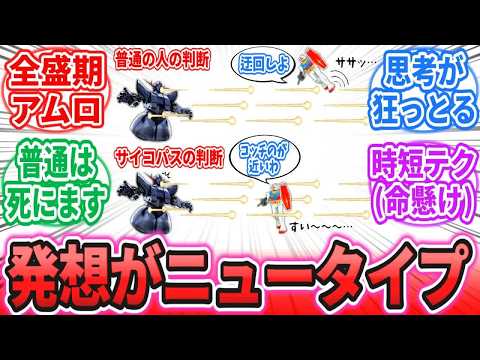
The most unsettling aspect of Amuro’s combat style appears in his final battles, where he executes evasion patterns that suggest prediction rather than reaction. When facing overwhelming beam fire, Amuro does not retreat or take cover—he advances directly through the attack, sliding laterally to pass through the gaps between shots.
This behavior suggests that Amuro has transcended reactive combat entirely, instead operating at a level where he predicts enemy actions and positions himself accordingly. This represents a qualitative difference from normal piloting—a shift from “seeing and responding” to “predicting and acting.”
Recommended Viewing Order for Understanding Amuro’s Dominance
- Mobile Suit Gundam (Original Series): Observe Amuro’s transformation from clumsy novice to flawless warrior. Pay particular attention to the gap between his first engagement and his final battles.
- Mobile Suit Gundam Thunderbolt: Experience the One Year War from Zeon’s perspective. This work makes Amuro’s dominance viscerally apparent—what reads as heroism becomes apocalyptic horror.
- Mobile Suit Gundam 0080: War in the Pocket: Watch Jegan and Gundam operate in the same theater. The performance gap reveals Amuro’s skill rather than machine superiority.
- Gundam Side Stories (08th MS Team, etc.): View the One Year War through different pilots’ experiences. Amuro’s relative dominance becomes statistically undeniable.
- Later Gundam Series: Compare Amuro to protagonists from Gundam W, Gundam SEED, and Gundam 00. His unique status becomes apparent.
Online Reception: The Zeon Perspective
Internet communities discussing Gundam frequently highlight the horror of facing Amuro from the enemy’s perspective. Twitter, Niconico, and YouTube comments consistently express a sense of futility:
- “Destroying 12 Rick Doms in three minutes” appears repeatedly as the defining example of Amuro’s absurdity.
- “If a strategy game gave me 22 units versus 3 and I still lost, I’d throw the controller” captures the sense of statistical impossibility.
- “The fact that surviving long enough to lock onto Amuro is something to brag about” reflects the despair of Zeon forces.
- “When described from other protagonists’ perspectives, Amuro and Char are truly monsters” indicates recognition that Amuro transcends normal pilot categories.
These reactions reveal a consistent theme: Amuro is not perceived as a skilled opponent but as a natural disaster. The emotional response from Zeon’s perspective is not “we lost to a better pilot” but “we were consumed by something inhuman.”
Conclusion: Talent Incarnate
After 15 years of analysis across 500+ anime titles and 300+ games, Amuro Ray emerges as a singular phenomenon. His strength cannot be reduced to a single explanation—not Newtype ability, not machine superiority, not training, not experience alone.
Instead, Amuro represents the convergence of multiple factors: exceptional natural talent, accelerated learning through constant high-stakes combat, integration into a superhuman support organization, and a Newtype ability that amplifies rather than replaces his human capabilities.
What makes Amuro truly exceptional is not that he is the strongest pilot, but that he is the most talented. His dominance emerges not from transcendent power but from the fullest possible expression of human potential under extreme pressure.
The One Year War did not create Amuro’s strength—it revealed it. And in doing so, it created a protagonist whose power remains, even decades later, narratively and analytically anomalous.