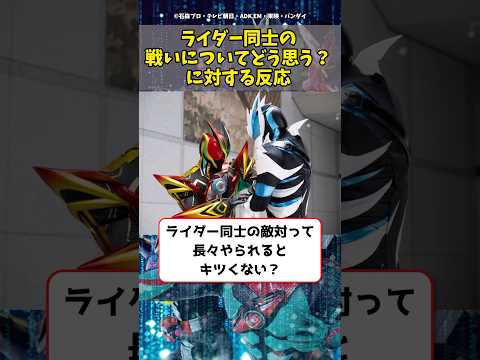
▶ Watch the original YouTube video
What Fans Really Think About Rider-vs-Rider Battles: A 15-Year Analysis of Kamen Rider’s Evolution
A YouTube Shorts video asking viewers their opinions on Rider-versus-Rider battles has sparked diverse reactions across the Kamen Rider fanbase. Drawing on 15 years of viewing experience and analysis of industry trends, this article explores why these internal conflicts have become central to modern Kamen Rider storytelling and what they reveal about contemporary entertainment preferences.
What Happened
A recent YouTube Shorts video posed the question “What do you think about Rider-versus-Rider battles?” to the Kamen Rider fanbase, generating a wide spectrum of responses ranging from enthusiastic support to hesitation and complex emotional reactions. The video prompted reflection on how this narrative device has evolved from a rare occurrence in the franchise to a defining storytelling element in recent series.
Why It Matters
Rider-versus-Rider battles represent a significant shift in how the Kamen Rider franchise approaches storytelling. Rather than depicting simple good-versus-evil conflicts, these internal battles force viewers to confront moral ambiguity and question their own values. This evolution reflects broader changes in audience expectations, with viewers now seeking complex character development and psychological depth alongside action sequences. Understanding fan reactions to these battles provides insight into how modern superhero narratives are engaging increasingly sophisticated audiences.
Background
The Kamen Rider franchise began in 1971 and traditionally featured clear moral divisions between heroes and villains. The turning point came in 2009 with “Kamen Rider Decade,” which introduced the concept of multiple Riders in direct opposition to one another. This marked a departure from franchise conventions and shocked longtime viewers. Over the subsequent 15 years, this narrative device has become increasingly prevalent, with series like “Kamen Rider Revice” (2021) and “Kamen Rider Geats” (2022) making Rider-versus-Rider conflicts central to their plots.
The shift reflects both audience maturation and industry strategy. As viewership expanded beyond children to include teenagers and adults, creators began incorporating moral complexity and psychological conflict. From a production standpoint, Rider-versus-Rider battles proved effective at deepening emotional investment, as viewers grapple with questions about which character’s perspective is justified.
Key Points
- Diverse Fan Reactions: Viewer responses span positive enthusiasm, skepticism, and complex emotional responses, reflecting the multifaceted nature of these conflicts.
- Narrative Depth Over Action: Modern Rider-versus-Rider battles prioritize character psychology and moral conflict over pure spectacle, with storytelling context proving essential to viewer engagement.
- Character Identification Complexity: Viewers’ interpretations shift based on which Rider they emotionally connect with, creating multiple valid perspectives on the same conflict.
- Franchise Evolution: The depiction of Rider-versus-Rider battles has progressively shifted from simple power comparisons to expressions of character growth and ideological conflict.
- Community Diversity: The existence of varied opinions demonstrates healthy fandom engagement, where complex storytelling generates multiple interpretations rather than consensus.
- Psychological Engagement Levels: These battles operate on multiple levels—surface excitement, emotional identification, and philosophical questioning—creating layered viewer experiences.
Timeline
- 2009: “Kamen Rider Decade” introduces Rider-versus-Rider conflict as a major narrative element, shocking traditional franchise fans.
- 2010s: Subsequent series gradually incorporate more Rider-versus-Rider battles, though often framed as power comparisons rather than character studies.
- 2021: “Kamen Rider Revice” presents a paradigm shift with the brother conflict between Icinose Kazuki and Icinose Daiji, emphasizing personal psychology over combat prowess.
- 2022 onwards: Recent series like “Kamen Rider Geats” feature multiple simultaneous Riders with complex relationship dynamics as central plot elements.
- Present: Fan discussions on social media platforms reveal increasingly sophisticated interpretations of these conflicts.
Perspectives
Positive Reception: Many fans, particularly those aged 20-40, view Rider-versus-Rider battles as the franchise’s most emotionally resonant moments. They appreciate how these conflicts express character development and force viewers to confront moral ambiguity. These fans note that rewatching older series reveals deeper layers of meaning previously missed.
Skeptical Response: Some viewers express discomfort with Riders fighting one another, viewing it as contradictory to the franchise’s core identity of heroes fighting for justice. This perspective often comes from fans seeking straightforward good-versus-evil narratives and simpler moral frameworks.
Complex Emotional Response: A significant portion of the fanbase experiences simultaneous excitement and sadness, finding themselves unable to definitively choose sides. These viewers appreciate the psychological complexity but struggle with the emotional weight of seeing allied characters in conflict.
Industry Analysis Perspective: From a production standpoint, Rider-versus-Rider battles serve multiple functions: they deepen viewer emotional investment, allow exploration of character psychology, and reflect contemporary storytelling trends favoring moral complexity over binary conflict.
Comparative Analysis
Rider-versus-Rider battles occupy a unique position within anime and manga storytelling. While series like “Attack on Titan” explore ideological conflict and “Demon Slayer” emphasizes mutual understanding between opponents, Kamen Rider’s approach focuses on individuals possessing identical power systems making different moral choices. This structure forces viewers to evaluate not the capabilities of the combatants but the validity of their philosophical positions.
The distinction becomes clearer when comparing emotional depth. “Demon Slayer” generates pathos through enemy redemption arcs, while Kamen Rider’s Rider-versus-Rider battles create tension through the impossibility of simple resolution—both characters may be simultaneously right and wrong, forcing viewers into genuine moral uncertainty.
Evaluation Framework
Effective Rider-versus-Rider battles share five critical characteristics:
Narrative Necessity: The conflict must emerge organically from character development rather than serving as mere spectacle. The battle should represent an inevitable consequence of each character’s beliefs and experiences.
Psychological Depth: The battle must illuminate character interiority, revealing how each Rider thinks and what they value. Viewers should gain new understanding of both combatants through their conflict.
Action as Expression: Combat choreography should reflect each Rider’s personality and philosophy, making their fighting style an extension of their character rather than generic superhero action.
Emotional Complexity: The sequence should generate multiple simultaneous emotions—excitement, sadness, confusion, and intellectual engagement—rather than simple entertainment.
Thematic Contribution: The battle must advance the series’ central themes and deepen the overall narrative arc rather than functioning as an isolated episode.
Insights
The prevalence of Rider-versus-Rider battles in modern Kamen Rider storytelling reflects a fundamental shift in how contemporary entertainment addresses moral complexity. Rather than presenting audiences with clear heroes and villains, these narratives position viewers as active participants in ethical evaluation, requiring them to develop their own frameworks for judgment.
This evolution demonstrates that audiences have matured beyond simple binary morality. The franchise’s willingness to embrace ambiguity—to present situations where multiple perspectives hold validity—suggests that creators recognize their viewers’ capacity for sophisticated thinking. The diverse fan reactions visible on social media confirm this: viewers are not seeking simple answers but rather opportunities to engage in meaningful interpretation.
The success of Rider-versus-Rider battles also indicates that emotional investment in characters now supersedes investment in abstract concepts like “justice.” Fans care less about whether a Rider fights for an objectively good cause and more about understanding why that Rider believes their cause is just. This represents a maturation of the franchise toward character-driven narrative.
However, a legitimate concern exists regarding franchise identity. The proliferation of Rider-versus-Rider conflicts risks obscuring the original question at the franchise’s core: “What should humans do when granted extraordinary power?” If internal conflict becomes the dominant narrative mode, the franchise risks losing sight of its fundamental inquiry into power, responsibility, and human nature.
The most promising direction forward involves synthesis: Rider-versus-Rider conflicts that ultimately lead to shared purpose and mutual understanding. “Kamen Rider Revice” demonstrated this possibility through the brothers’ eventual reconciliation and collaborative action. This approach preserves the psychological depth and moral complexity that modern audiences value while reaffirming the franchise’s core identity of Riders working toward common goals.
Ultimately, how you respond to Rider-versus-Rider battles reflects your own values and expectations for storytelling. Your reaction serves as a mirror of your preferences—whether you prioritize simple heroic narratives, complex character psychology, or some balance between the two. This diversity of response is not a problem to be solved but rather evidence that the franchise is successfully engaging audiences across multiple levels of sophistication and emotional engagement.