▶ Watch the original YouTube video
Analyzing Pucci’s Final Moments in JoJo Part 6: Anime Reception and Critical Evaluation
Pucci Emporio’s death in JoJo’s Bizarre Adventure Part 6 has sparked divided reactions among viewers, with some praising the scene’s thematic coherence while others critique its dramatic impact. Through comparative analysis with other major antagonists in the series, this examination reveals how Pucci’s inability to acknowledge his own weakness defines both his character and his ultimate defeat.
What Happened
In the climax of JoJo Part 6, Pucci—the series’ final antagonist—is defeated by Weather Report’s ability, which slowly crushes his head. This death scene differs significantly from the manga version, where Pucci’s face is torn away. The anime adaptation emphasizes a more humiliating demise, portraying Pucci as increasingly desperate as he realizes his plan for universal reset cannot be completed. Despite preaching that “resolve is happiness,” Pucci abandons his grand design to personally kill Emporio, thereby exposing the fundamental contradiction at the core of his ideology.
Why It Matters
Pucci’s final moments represent a critical thematic statement about self-deception and the nature of resolve in the JoJo series. Unlike previous antagonists who possessed some degree of self-awareness regarding their motivations, Pucci never acknowledges his own weakness—the trauma of his sister’s death that drives all his actions. His defeat is not merely physical but philosophical: he dies while proving that his proclaimed “resolve” was nothing more than an elaborate escape mechanism. This makes Pucci’s character arc particularly relevant to contemporary anime storytelling, where the “small-scale villain” who cannot recognize his own limitations has become an increasingly common archetype.
Background
Pucci Emporio is the main antagonist of JoJo’s Bizarre Adventure Part 6: Stone Ocean. A priest who possesses the Stand ability “Made in Heaven,” Pucci orchestrates a plan to accelerate time and create a new universe where everyone experiences their fate in advance, believing this will bring universal happiness. His motivation stems from the death of his sister, Perla, which he refuses to acknowledge as his responsibility. Instead, he frames his actions as divine will and cosmic destiny. The anime adaptation, produced by David Production, aired in 2022-2023 and has generated significant discussion regarding the portrayal of Pucci’s character and his ultimate defeat.
Key Points
- Ideological Contradiction: Pucci preaches that “resolve is happiness” while simultaneously demonstrating a complete lack of resolve by abandoning his plan to kill Emporio, thereby preventing the completion of his universal reset.
- Anime vs. Manga Adaptation: The anime version emphasizes Pucci’s humiliation through a slow, undignified death by crushing, contrasting with the manga’s more visually dramatic depiction, reflecting the production team’s interpretation of Pucci as fundamentally small-minded.
- Thematic Consistency: Pucci’s defeat exemplifies the JoJo series’ recurring theme of “karmic retribution”—he is killed by the ability of someone he murdered, Weather Report, creating narrative closure through cause and effect.
- Incomplete Destiny: By stopping the acceleration to pursue Emporio, Pucci fails to complete his universal reset, leaving Emporio as an “anomaly” in the new world—a being existing outside the predetermined fate Pucci claimed to control.
- Character Comparison: Among all JoJo antagonists, Pucci uniquely lacks self-awareness about his motivations, distinguishing him from Dio (who embraces his desire for domination), Yoshikage Kira (who acknowledges his obsession with normalcy), and Diavolo (who recognizes his fear).
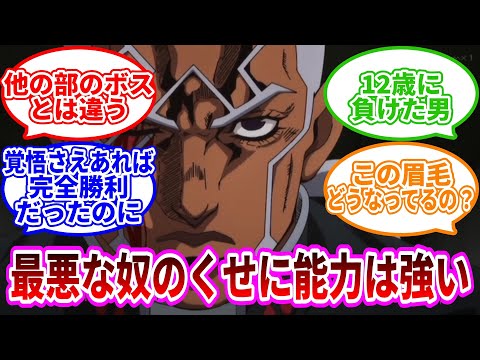
- Divided Fan Reception: Viewers are split between those who find Pucci’s undignified death satisfying and those who feel the scene lacks dramatic impact, reflecting different interpretations of the character’s thematic purpose.
Comparative Analysis: Pucci Among JoJo Antagonists
| Antagonist | Part | Self-Awareness | Final State |
|---|---|---|---|
| Dio Brando | Part 1 | Complete denial of weakness | Dies confident in absolute superiority |
| Kars | Part 2 | Partial recognition | Defeated by Joseph’s cunning |
| DIO (Over Heaven) | Part 3 | Complete denial of weakness | Dies while maintaining absolute dominance through time stop |
| Yoshikage Kira | Part 4 | Partial recognition | Exposed desire for quiet life becomes evident |
| Diavolo | Part 5 | Partial recognition | Trapped in infinite loop of eternal defeat |
| Pucci Emporio | Part 6 | Complete denial without self-awareness | Dies while proving his own lack of resolve |
The Deception of “Resolve”
A critical distinction emerges when examining Pucci’s repeated invocation of the word “resolve.” In JoJo Part 5: Golden Wind, resolve represents the willingness to proceed on an unseen path guided by personal conviction. Pucci’s conception of resolve, however, is fundamentally different. His “resolve” is actually resignation—the belief that fate cannot be changed, which allows him to externalize responsibility for his actions onto cosmic destiny. This inversion represents the antithesis of true resolve as defined by the series.
The moment where Pucci should have demonstrated genuine resolve was when he chose to spare Emporio. Had he accepted that his new world might face retribution from Emporio, he would have embodied authentic resolve. Instead, his inability to tolerate this possibility reveals that his entire philosophy was constructed to escape accountability for his sister’s death—a trauma he cannot acknowledge as his responsibility.
Production and Performance Analysis
David Production’s decision to alter Pucci’s death sequence from the manga carries significant thematic weight. The shift from a visually dramatic demise to a slow, humiliating crushing emphasizes that Pucci is fundamentally a small-minded antagonist rather than a grand villain. This directorial choice reflects a deliberate interpretation: Pucci’s grandiose ideology masks profound insignificance.
Voice actor Ono Daisuke’s performance reinforces this characterization through increasingly evident desperation and instability. Unlike Dio’s unshakeable malevolent charisma, Pucci’s voice conveys constant anxiety and self-justification, suggesting a character perpetually struggling to maintain his constructed worldview.
Thematic Parallels in Contemporary Anime
Pucci represents a broader trend in recent anime: the rise of the “small-scale final antagonist”—not weak in power, but incapable of recognizing personal weakness. This archetype appears in works such as Code Geass (Lelouch), Attack on Titan (Eren Yeager), and Jujutsu Kaisen, where powerful characters harbor fundamental contradictions they cannot acknowledge. Pucci exemplifies this pattern: his Stand ability is formidable, yet its application remains enslaved to his unrecognized trauma.
Perspectives
Positive Reception: Many viewers find satisfaction in Pucci’s undignified death, viewing it as thematically appropriate punishment for his self-deception. The scene’s emphasis on Pucci’s inability to recognize his own weakness—even as he dies—resonates as a fitting conclusion to his character arc. Comments such as “He thinks he’s right until the very end, but he’s just running from his weakness” reflect appreciation for the psychological accuracy of his defeat.
Critical Reception: Other viewers criticize the scene for lacking dramatic impact, describing it as anticlimactic. The “quiet” nature of Pucci’s death, rather than a climactic confrontation, strikes some as narratively unsatisfying. This perspective values visual spectacle and escalating tension over thematic coherence.
Analytical Reception: A third perspective recognizes the scene’s deliberate construction as commentary on self-deception. The irony that Pucci dies while proving his own lack of resolve—the very concept he spent the entire arc promoting—is viewed as sophisticated character writing that rewards careful analysis.
Insights
Pucci Emporio stands as the most profoundly human antagonist in the JoJo series. While previous villains possessed recognizable motivations—Dio’s hunger for domination, Kira’s desire for normalcy, Diavolo’s fear—Pucci’s defining characteristic is his inability to acknowledge his own weakness. This makes him simultaneously the most relatable and most cautionary of the series’ antagonists.
His defeat carries a broader message: the refusal to acknowledge personal responsibility inevitably leads to self-destruction. By externalizing his sister’s death as “fate,” Pucci constructed an elaborate philosophical system designed to escape accountability. Yet this very system becomes his undoing—his inability to tolerate Emporio’s existence forces him to abandon his grand plan, proving that his supposed acceptance of destiny was illusory.
The introduction of Emporio in the new world as an “anomaly” outside predetermined fate suggests that resistance to self-deception—represented by Emporio’s survival—creates possibilities that rigid fatalism cannot accommodate. This implies that genuine resolve, unlike Pucci’s false version, emerges from acknowledging rather than denying personal weakness.
Ultimately, Pucci’s character serves as a mirror for viewers, prompting self-examination: Do we, like Pucci, sometimes attribute our failures to external forces while refusing to acknowledge our own role? The discomfort many feel watching Pucci’s death may stem from recognizing elements of his self-deception within ourselves.