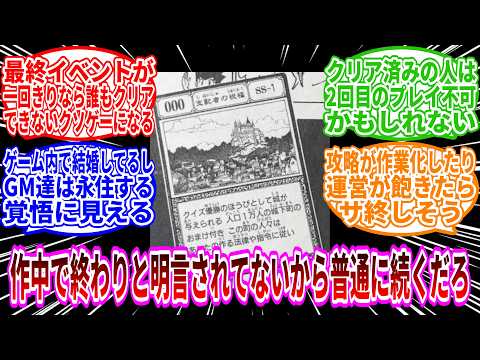
▶ Watch the original YouTube video
How Greed Island Continues After Gon Clears It: A 15-Year Analysis of Hunter x Hunter’s Game System
A deep dive into one of anime’s most overlooked questions: what happens to Greed Island after Gon and his friends clear it? This analysis examines the game’s operational mechanics, the constraints binding game masters and players, and the possibility of seasonal updates—drawing on 15 years of Hunter x Hunter scholarship and comparisons to similar game-world narratives.
What Happened
Greed Island, the game-within-a-game arc of Hunter x Hunter, presents a narrative puzzle that has lingered in fans’ minds for over 15 years: after Gon and his companions clear the game by collecting 100 designated cards and obtaining the final event “Ruler’s Blessing,” what becomes of Greed Island itself? The series never explicitly addresses the game’s operational status post-clearance, leaving room for extensive fan speculation and critical analysis.
Why It Matters
This question extends beyond casual curiosity. It touches on fundamental worldbuilding consistency—a hallmark of quality storytelling. How a fictional game world sustains itself after its primary objective is achieved reveals the author’s depth of thought regarding system design, economic viability, and narrative logic. Greed Island’s ambiguity on this point reflects a broader trend in modern anime and manga: the exploration of game-world governance and continuity. Understanding Greed Island’s post-clear mechanics offers insight into creator Yoshihiro Togashi’s approach to constraint-based storytelling, a central pillar of Hunter x Hunter’s philosophy.
Background
Greed Island is a Nen-based card game created by billionaire Battera and operated by game masters including the notorious convict Razor. Players must collect 100 designated cards to clear the game and access the final event. The game exists in a physical location—an island—where players can be killed, though death carries no permanent penalty. Cards obtained in Greed Island retain their effects in the real world, creating a bridge between the game world and reality. Battera’s motivations for creating and maintaining the game remain partially obscured, and the series never clarifies whether he worries about the game being cleared or what contingencies exist for that scenario.
Key Points
- Post-Clear Continuity: The game likely continues after Gon’s clearance through card effect variations and reset mechanics, rather than terminating entirely.
- One-Time Final Event: “Ruler’s Blessing” appears to be a single-instance reward, suggesting deliberate difficulty scaling rather than a game-ending condition.
- Game Master Constraints: Razor and other game masters may be bound by Nen-based constraints preventing them from leaving the island, effectively creating permanent employment.
- Card Export Limits: Players may be restricted to carrying only three cards into the real world, balancing game power with reality-world stability.
- Seasonal Model Potential: Future seasons with new card effects and unlocked areas represent a plausible operational model aligned with modern online game design.
- Economic Sustainability: Continuous funding from Battera or an automated system must sustain game master salaries and island operations indefinitely.
Timeline
- Early 2000s: Greed Island arc serializes in Weekly Shonen Jump; readers first encounter the game-world concept.
- Series Present: Gon and companions clear Greed Island; final event “Ruler’s Blessing” is obtained.
- Post-Clear (Unspecified): Game status remains narratively unaddressed; fan speculation intensifies.
- Dark Continent Arc (Later): Potential for Greed Island to function as a “beginner-tier” game relative to stronger artifacts in the Dark Continent.
Perspectives
The Continuity Argument: The most prevalent fan interpretation holds that Greed Island continues operating post-clearance. Evidence includes Battera’s apparent lack of concern about clearance, the permanent residence of game masters on the island, and the constant influx of new players. This view aligns with Togashi’s tendency to avoid narrative inconsistencies—if the game were designed to end upon clearance, he would likely have addressed this explicitly.
The One-Time Event Problem: A counterargument notes that if “Ruler’s Blessing” is truly a one-time event, subsequent players would find the game unwinnable, contradicting its function as a playable game. This raises questions about whether the event respawns, whether multiple instances exist simultaneously, or whether the game’s victory condition changes after initial clearance.
The Constraint-Based Model: Drawing from Hunter x Hunter’s core mechanic—the “Vow and Covenant” system—some analysts propose that game masters operate under Nen-enforced constraints. Razor, a death row inmate, may be bound to the island through a contract preventing departure. This would explain both his permanent residence and his apparent acceptance of indefinite employment.
The Economic Sustainability Question: Practical analysis reveals that continuous game operation requires sustained funding. If Battera dies or withdraws support, an automated system or alternative revenue model must exist. This suggests either that the game generates its own income (through player fees, card sales, or other mechanisms) or that Togashi intentionally left this detail vague for future narrative development.
Comparative Analysis with Similar Works: The .hack series presents game worlds where NPCs possess independent agency and the digital realm persists regardless of player actions. Sword Art Online enforces game continuity through lethal stakes. Greed Island differs by offering no death penalty and leaving operational motivations ambiguous—a unique narrative choice that prioritizes mystery over explicit mechanics.
Insights
Greed Island represents a sophisticated exploration of game-world governance that predates the current anime industry trend toward isekai and game-system narratives. Togashi’s deliberate ambiguity regarding post-clear operations is not a narrative oversight but a deliberate design choice reflecting his broader storytelling philosophy: constraints and vows form the backbone of meaning in Hunter x Hunter’s universe.
The game’s sustainability likely depends on a multi-layered system: game masters bound by Nen constraints, players limited in card exports, and a seasonal or cyclical structure that refreshes objectives without negating previous clearances. This model mirrors modern live-service gaming while remaining faithful to Hunter x Hunter’s emphasis on binding agreements and supernatural limitations.
The unresolved nature of Greed Island’s post-clear status serves a narrative function beyond mere mystery. It invites readers to apply the series’ core logic—that all power and freedom derive from constraints willingly accepted—to a seemingly straightforward game scenario. In doing so, Togashi elevates a side arc into a meditation on the nature of systems, obligation, and the price of ambition.
For viewers encountering Greed Island for the first time, attention to Battera’s lack of concern about clearance and Razor’s choice to remain on the island reveals that Togashi has embedded the answers within the narrative itself. The game continues not because it must, but because the constraints binding all parties—creator, operators, and players—ensure its perpetuation.