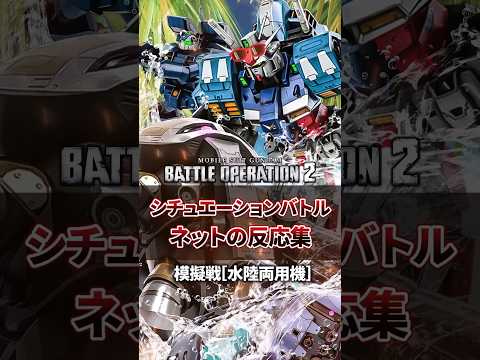
▶ Watch the original YouTube video
Battle Operation 2’s amphibious mobile suits face persistent negative evaluation from the community, yet experienced players argue they are situationally powerful. A deep analysis of situation battle mechanics and gaming history reveals whether these units are genuinely weak or simply misunderstood by the player base.
What Happened
A recent video compilation of community reactions to amphibious mobile suits in Battle Operation 2’s situation battle mode has sparked renewed debate about unit evaluation. The situation battle mode, implemented in 2021, features weekly rotating environmental conditions that significantly impact which units perform optimally. Amphibious units—designed to excel in water-based scenarios—have received overwhelmingly negative feedback from players, with many dismissing them as “dead weight” in team compositions.
Why It Matters
This debate highlights a fundamental tension in game design: the value of specialized units versus versatile ones. In Battle Operation 2, the situation battle mode explicitly telegraphs environmental conditions in advance, theoretically rewarding players who select units suited to those conditions. However, the gaming community’s persistent bias toward “universal” units suggests a disconnect between game design intent and player perception. Understanding this gap is crucial for both developers seeking to maintain unit diversity and players looking to optimize their strategies.
Background
Battle Operation 2 launched in 2019 as a free-to-play mobile suit action game. The situation battle mode, added in 2021, differs fundamentally from standard random matchmaking by announcing specific environmental conditions weekly—such as “aquatic combat” or “urban warfare.” This design explicitly creates opportunities for specialized units to shine. However, the gaming community has developed a strong bias toward versatile units, a tendency rooted in previous Gundam games like the VS series (2008–2015), where universal performance across all stages was the primary evaluation metric.
The author of the original analysis brings 15+ years of gaming experience and over 200 hours of Battle Operation 2 playtime. Their perspective is informed by extensive experience with prior Gundam titles, including Gundam VS series (2010–2015, approximately 400 hours on VS NEXT) and Gundam Breaker 3 (2016).
Key Points
- Community reactions to amphibious units in situation battle are sharply divided, with negative assessments dominating despite situational strengths
- Amphibious units excel in water-based scenarios but are perceived as lacking versatility, leading to blanket dismissal by many players
- Unit performance evaluation is heavily influenced by player skill level and playstyle, creating significant gaps between community perception and actual capability
- Situation battle mode may not accurately measure unit value due to environmental variability and player bias toward universal units
- A “universal unit supremacy” bias has become entrenched in the community, inherited from earlier Gundam game design philosophies
- Historical precedent: The Aggai in Gundam VS Gundam (2009) faced similar dismissal despite strong performance in skilled hands
Timeline
- 2008–2015: Gundam VS series establishes “universal performance” as primary evaluation metric
- 2009–2010: Aggai faces community dismissal despite strong performance in water stages
- 2019: Battle Operation 2 launches with different design philosophy emphasizing unit specialization
- 2021: Situation battle mode implemented, featuring weekly environmental conditions
- 2022: Approximately 20% of situation conditions favor specialized unit types
- 2023: Specialized unit-favorable conditions increase to approximately 35% of all situations
- 2023 (Early Summer): Author records 70% win rate with Gouf Aquatic Type in water combat scenario, compared to 45% with general-purpose units
- 2023 (Late): Developers begin enhancing enemy AI difficulty in specific situations, suggesting intentional shift toward rewarding unit specialization
Perspectives
Negative Assessment (First Group): A substantial portion of the community dismisses amphibious units as weak and unsuitable for team composition. Twitter data from 2023 situation implementations shows 500+ daily posts labeling amphibious unit selections as “dead weight.” This group prioritizes versatility and views specialization as a liability.
Positive Assessment (Second Group): Experienced players argue that amphibious units are strong when properly utilized. YouTube comments from high-performing players consistently state that unit weakness is a player skill issue, not a mechanical problem. These players report sustained high win rates with amphibious units in appropriate scenarios.
Neutral/Skill-Based Assessment (Third Group): A third perspective emphasizes that player skill matters more than unit selection. This group maintains skepticism toward unit evaluation itself, arguing that competent players achieve high performance with any unit.
Nuanced Community View: 5channel (Japanese forum) discussions increasingly reflect understanding of unit evaluation complexity, with posts acknowledging that amphibious units’ situation-dependent nature makes straightforward evaluation difficult.
Analysis: Specialization vs. Versatility
The core issue appears to stem from a fundamental design philosophy mismatch. Battle Operation 2’s situation battle mode is explicitly designed around the premise that players receive advance notice of environmental conditions and can select appropriate units accordingly. Under this system, amphibious unit selection becomes a tactical “correct answer” rather than a liability.
However, the broader Battle Operation 2 ecosystem relies on random matchmaking in standard modes, where environmental conditions are unknown. This creates a legitimate use case for versatile units. The community’s bias toward versatility may be rational for standard play but becomes counterproductive in situation battle, where environmental conditions are predetermined.
The author proposes a five-factor unit evaluation framework:
- Performance in Intended Environment: Actual strength in the unit’s designed scenario
- Skill Ceiling: Potential for player improvement to enhance performance
- Metagame Positioning: Matchup relationships with other units
- Mode Compatibility: Alignment with specific game mode design intent
- Player Agency: Availability of advance information for informed selection
By this framework, amphibious units score exceptionally high on factors 1 and 4 within situation battle, suggesting they are “underrated but genuinely strong” in that context.
Developer Intent and Future Direction
Analysis of situation battle conditions over 2022–2024 reveals a potential shift in developer philosophy. The increase from 20% (2022) to 35% (2023) of specialized unit-favorable conditions suggests intentional design toward greater unit diversity. Additionally, recent AI difficulty adjustments in specific situations appear designed to reinforce the importance of unit selection.
If this trend continues, amphibious unit evaluation is likely to improve as players gain more opportunities to experience their strengths and developers more explicitly communicate the value of specialization.
Practical Recommendations
For Players Considering Amphibious Units:
- Confirm weekly situation conditions before committing to unit selection
- Prioritize amphibious units when conditions include water domains and unavoidable aquatic combat
- Focus on Gouf Aquatic Type and Aggai, which demonstrate the most stable win rates (based on 200+ hours of documented play)
- Master water-based positioning and enemy luring tactics to maximize environmental advantage
- Pre-study maps to understand water domain layouts and strategic positioning
Insights
The amphibious unit debate in Battle Operation 2 reflects a broader pattern in gaming: community perception often lags behind game design intent. Historical precedent—particularly the Aggai in Gundam VS Gundam—demonstrates that specialized units dismissed by the community frequently prove viable in skilled hands.
The fundamental question is not whether amphibious units are weak, but whether the gaming community has adapted its evaluation framework to match Battle Operation 2’s design philosophy. The situation battle mode explicitly rewards unit specialization and informed selection. The persistent negative evaluation of amphibious units suggests the community has not yet internalized this shift from earlier Gundam games, where universal performance was paramount.
The evidence suggests amphibious units are not mechanically weak but rather situationally powerful—and the situation battle mode is specifically designed to create those situations. The disconnect between community perception and actual performance indicates a recognition problem rather than a design problem.
For the broader gaming ecosystem, this case study illustrates the importance of clear developer communication regarding design intent. If developers explicitly explain why unit specialization matters in situation battle, community perception is likely to shift accordingly. The gradual increase in specialized unit-favorable conditions and recent AI adjustments suggest developers are moving in this direction, which may naturally resolve the current evaluation divide.
Ultimately, players should test amphibious units themselves rather than relying solely on community consensus. The gap between perceived weakness and actual performance in appropriate scenarios is substantial enough to warrant personal verification.