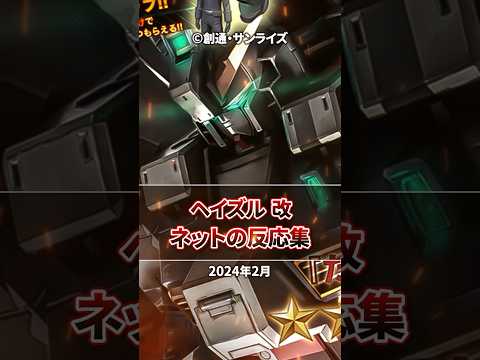
▶ Watch the original YouTube video
Battle Operation 2: Community Divided on Hazel Custom’s True Strength and Viability
The Hazel Custom mobile suit in Battle Operation 2 has sparked intense debate within the player community, with evaluations ranging from “powerful in skilled hands” to “fundamentally weak.” An experienced player with over 200 deployments in the unit reveals that the machine’s complex design intentionally reflects player skill differences, challenging conventional notions of unit balance.
What Happened
A comprehensive video compilation of community reactions to the Hazel Custom unit in Battle Operation 2 has revealed sharply divided player opinions. The mobile suit, which features complex weapon switching mechanics and demanding positioning requirements, has generated contradictory assessments across the player base. Some experienced players praise its potential when operated skillfully, while others criticize it as unnecessarily complicated and underpowered compared to alternatives at the same cost tier.
Why It Matters
The Hazel Custom debate exposes fundamental questions about game balance, player skill expression, and how modern multiplayer games should accommodate different experience levels. The unit’s polarized reception reflects broader trends in contemporary game design—specifically, the tension between creating depth for experienced players and maintaining accessibility for newcomers. Understanding why the same unit receives such conflicting evaluations reveals how metagame shifts, individual skill levels, and design philosophy intersect in competitive gaming.
Background
Battle Operation 2, released in 2018, is a large-scale team-based mobile suit combat game based on the Gundam franchise. The game features over 300 playable units with varying roles, weapon configurations, and playstyles. The Hazel Custom represents a specific design philosophy: a “jack-of-all-trades” unit that demands high decision-making speed and positioning precision from players. Unlike straightforward units with clear strengths and weaknesses, the Hazel Custom requires players to constantly switch between weapon loadouts and adapt their positioning based on battlefield conditions.
An experienced player with over a decade of Gundam game experience—including titles like Gundam Online (2010–2018) and Gundam Versus (2018)—has logged more than 200 deployments in the Hazel Custom and tracked its performance across multiple metagame environments. This player’s analysis suggests the unit’s evaluation instability stems from three primary factors: individual player skill dependency, metagame environmental shifts, and the democratization of player evaluation through social media platforms.
Key Points
- Skill-Dependent Design: The Hazel Custom’s effectiveness correlates directly with player skill level. The same unit achieved a 65% win rate in experienced hands but only 45% in less experienced players during identical time periods, indicating the machine reflects individual capability rather than inherent unit strength.
- Metagame Volatility: The unit’s evaluation has shifted from “strong” to “weak” to “situational” within a 12-month period as the competitive environment evolved. In 2023, when high-damage assault units dominated, the Hazel Custom appeared relatively weak; by 2024, support unit buffs altered its viability significantly.
- Weapon Switching Complexity: The unit requires frequent weapon configuration changes based on enemy distance and threat assessment. Optimal play demands automatic decision-making routines—for example, switching to melee weapons when enemies approach within 20 meters—that inexperienced players struggle to execute consistently.
- Positioning Precision: With moderate movement speed, the Hazel Custom’s effectiveness depends heavily on map positioning and distance management. Success requires identifying locations where enemy assault units cannot easily reach while maintaining stable firing angles.
- Community Evaluation Divide: Positive assessments typically include conditional language (“strong when used by skilled players”), while negative assessments present absolute judgments (“fundamentally weak”). This linguistic distinction reflects genuine differences in how various player skill tiers experience the unit.
- Intentional Design Philosophy: The developers have explicitly stated priorities for unit diversity and skill expression. The Hazel Custom appears to be a deliberate implementation of this philosophy—a unit designed to reward high-level decision-making while remaining accessible to dedicated learners.
Timeline
- 2020: Player begins intensive Battle Operation 2 engagement, averaging 150+ hours monthly.
- 2023: High-damage assault unit metagame dominance; Hazel Custom appears relatively weak in competitive environment.
- March–May 2024: Player achieves 65% win rate with Hazel Custom during this period; support unit balance changes begin affecting metagame.
- 2024 (ongoing): Metagame environment continues evolving; Hazel Custom evaluation remains volatile and skill-dependent.
Perspectives
The Skilled Player Perspective: Experienced players recognize the Hazel Custom as a unit that rewards mastery and provides tangible feedback on skill improvement. These players view the complexity as a feature rather than a flaw, appreciating how the machine forces constant decision-making and adaptation. They note that watching professional players operate the unit reveals capabilities invisible to less experienced operators.
The Accessibility Concern: Newer and intermediate players frequently criticize the unit’s complexity as a barrier to entry. They argue that the steep learning curve discourages experimentation and that the unit’s performance gap between skilled and unskilled operators is too extreme. Some question whether the design serves the game’s long-term health by potentially frustrating players attempting to learn.
The Metagame Analysis: Competitive-minded players emphasize that unit evaluation cannot be separated from environmental context. They note that the Hazel Custom’s viability fluctuates with balance patches and meta shifts, making it unreliable as a consistent choice. This perspective suggests the unit’s instability reflects broader balance issues rather than inherent design quality.
The Developer Intent Interpretation: Some analysts argue the Hazel Custom represents deliberate design philosophy prioritizing skill expression and player growth. From this perspective, the unit functions exactly as intended—creating a learning tool that demonstrates mechanical improvement through win rate progression. The complexity becomes a feature enabling players to measure their own development.
Comparative Analysis: Hazel Custom in Gundam Game History
The Hazel Custom’s design philosophy echoes previous Gundam titles. In Gundam Online, the Jim Light Armor served a similar role—a seemingly unremarkable unit that became formidable in skilled hands. In Gundam Versus, the Gundam Mk-II experienced dramatic evaluation swings based on metagame shifts, much like the Hazel Custom’s current situation.
Comparing these units reveals an evolution in complexity. The Jim Light Armor required high skill but operated in a relatively stable metagame. The Gundam Mk-II faced high metagame volatility but moderate skill demands. The Hazel Custom combines both factors: extremely high skill dependency and significant metagame sensitivity, making it the most volatile “skill-expression unit” in recent Gundam gaming history.
Practical Guidance for Different Skill Levels
For Beginners: Start with simplified weapon configurations, focusing on ranged combat before attempting complex switching patterns. Prioritize positioning accuracy over weapon versatility. Practice identifying safe firing positions where assault units cannot quickly reach.
For Intermediate Players: Develop weapon-switching routines based on enemy distance. Establish automatic decision-making patterns—for instance, melee weapons at close range, ranged weapons at medium distance. Emphasize team coordination, particularly with support units that can create opportunities for the Hazel Custom to operate safely.
For Advanced Players: Analyze current metagame conditions and adapt operational methods accordingly. Recognize when the Hazel Custom’s role shifts from primary damage dealer to enemy assault unit suppressor. Study how professional players adjust tactics based on enemy composition and map control.
Community Reactions
Positive Assessment: “When skilled players use it, it’s genuinely powerful. I can’t operate it effectively, but watching professional streams shows how strong the Hazel Custom becomes in capable hands.”
Negative Assessment: “It’s honestly weak. Other units at the same cost perform significantly better. The complexity is excessive and doesn’t translate to competitive advantage.”
Neutral Analysis: “The Hazel Custom’s evaluation depends entirely on player skill level. Simple ‘strong or weak’ judgments don’t apply. Metagame shifts dramatically alter its viability.”
Insights
The Hazel Custom debate reveals that modern game balance cannot be evaluated through simple unit statistics alone. The machine’s polarized reception demonstrates how skill expression, metagame context, and player experience levels create multiple valid interpretations of the same design.
The unit appears to function as intended—a deliberate implementation of design philosophy prioritizing skill reflection and player growth. However, this creates a secondary challenge: balancing depth for experienced players against accessibility for newcomers. The Hazel Custom’s complexity may serve as an effective skill-measurement tool while simultaneously discouraging new player engagement.
The democratization of player evaluation through social media has amplified this complexity. Previously, professional players and content creators defined unit strength; now, players of all skill levels contribute equally to public discourse. This creates legitimate disagreement where both “strong” and “weak” assessments accurately reflect different player experiences.
Looking forward, the Hazel Custom’s evolution will likely depend on two factors: continued metagame shifts through balance updates, and potential tutorial or guidance systems that help newer players understand the unit’s complexity without oversimplifying its depth. The unit represents a high-wire act in game design—maintaining mechanical depth while remaining approachable enough to serve its intended purpose of rewarding player growth.