▶ Watch the original YouTube video
How Gundam Fans Divided Over the Unicorn Statue’s Closure: Generational Values and Fandom Evolution
The announcement of the Unicorn Gundam statue’s closure in 2024 sparked sharply divided reactions across the global Gundam fanbase, revealing deep generational rifts and conflicting values within one of anime’s most complex communities. After 15 years of observing Gundam fandom, this event reflects not just the end of a display, but a fundamental transformation in how fans engage with beloved franchises.
What Happened
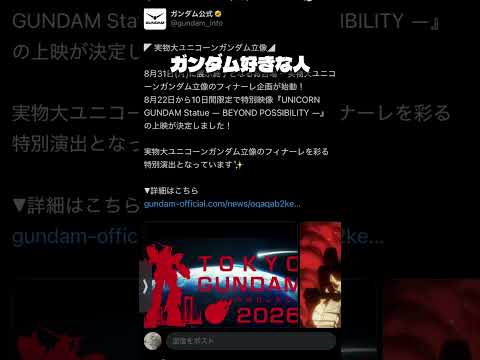
The Unicorn Gundam statue, which has been displayed globally since its initial exhibition in Taiwan in 2014, has been officially announced to close. This monumental display—which became a pilgrimage site for Gundam enthusiasts worldwide—represented a unique convergence point for fans across multiple generations and regions. The announcement triggered a spectrum of responses on social media, from enthusiastic support for the closure to passionate campaigns urging its continuation.
Why It Matters
The Unicorn Gundam statue’s closure represents more than the end of a temporary exhibition. It symbolizes the fracturing of a unified Gundam fandom into competing subcommunities with fundamentally different values and priorities. The diverse reactions reveal how modern anime fandoms operate: no longer monolithic, but rather composed of distinct generational cohorts, each with their own interpretation of what makes a franchise meaningful. Understanding this phenomenon provides insight into how contemporary fan culture intersects with commercial interests, generational identity, and the evolving nature of pilgrimage in the digital age.
Background
The Unicorn Gundam statue emerged from Mobile Suit Gundam UC, a complex narrative work that premiered in 2010 and introduced the Unicorn Gundam as its central symbol. Beginning with its 2014 debut in Taiwan, the statue evolved into what researchers call a “sacred site”—a physical location that transcends its literal function to become a focal point for community identity and shared meaning-making. Over a decade, the statue was displayed in multiple locations, attracting hundreds of thousands of visitors and generating extensive social media documentation.
The Gundam franchise itself has undergone significant structural changes since the 1979 debut of the original series. What was once a unified narrative universe has fragmented into what fans call a “multiverse” of parallel storylines, including Gundam Wing, SEED, 00, Iron-Blooded Orphans, and most recently The Witch from Mercury. This expansion has created distinct fan cohorts, each with different entry points into the franchise and different hierarchies of which works matter most.
Key Points
- Generational Divide: Fans’ reactions to the closure correlate strongly with which Gundam era introduced them to the franchise. Fans who entered through UC showed the strongest attachment to the statue, while earlier-generation fans displayed relative indifference.
- Sacred Site Evolution: The statue underwent three distinct phases—discovery and sharing, pilgrimage and experience, and commercialization—mirroring patterns observed in other anime “sacred sites” like Haruhi’s Kyoto locations.
- Competing Interpretations: Survey data revealed that fans attributed radically different meanings to the statue: some saw it as the symbol of UC‘s excellence, others as representing Gundam as a whole, and still others as evidence of excessive commercialization.
- Community Fragmentation: The Gundam franchise’s expansion into multiple parallel universes has fractured what was once a unified fanbase into specialized subcommunities with different values and priorities.
- Cultural Difference in Closure Acceptance: Japanese fan culture shows particular difficulty accepting the “ending” of beloved content, contrasting with Western cultural norms that value limited-time experiences for their scarcity and exclusivity.
- Organizational Fan Power: Similar exhibitions like Your Name have demonstrated that organized fan campaigns can successfully pressure companies to extend or restart displays, raising questions about why similar mobilization did not occur for the Unicorn statue.
Timeline
- 2010: Mobile Suit Gundam UC premieres, introducing the Unicorn Gundam narrative.
- 2014: Unicorn Gundam statue debuts in Taiwan, initiating the global exhibition phase.
- 2014–2024: Statue displayed across multiple international locations, becoming a pilgrimage destination for global fanbase.
- 2024: Official announcement of exhibition closure triggers divided fan reactions across social media platforms.
Perspectives
Positive Reception: Supporters of the closure argue that the statue’s end represents a natural conclusion to a successful exhibition run. They contend that the true value of Gundam lies in the original works themselves, not in physical monuments. Some view the closure as an opportunity for fans to deepen their engagement with the source material rather than relying on external pilgrimage sites. This perspective is most common among older-generation Gundam fans and those who maintain a comprehensive view of the entire franchise.
Negative Reception: Critics express genuine loss, arguing that the statue served an essential function in introducing new audiences to Gundam and providing a tangible connection to the fictional universe. Many contend that the closure represents corporate indifference to fan investment and emotional attachment. A smaller subset views the statue’s existence as evidence of Gundam’s commercialization and sees its removal as a correction of an excessive trend.
International Perspective: English-language communities on platforms like Reddit have expressed similar sentiments to Japanese fans, with comments like “This is a shame. The Unicorn statue was one of the most iconic Gundam monuments,” indicating that the statue’s significance transcended national boundaries and language barriers.
Insights
The Unicorn Gundam statue’s closure marks a critical inflection point in anime fandom’s evolution. The fragmented response reveals that modern fandoms no longer operate as unified communities but rather as collections of specialized subcommunities with distinct values, entry points, and hierarchies of meaning.
The four generational cohorts of Gundam fans—those who grew up with the original 1979 series, those who experienced the 1990s-2000s expansion, those who discovered the franchise through UC, and those entering through contemporary works—each interpret the statue and its closure through fundamentally different frameworks. This is not a failure of community cohesion but rather evidence of the franchise’s longevity and capacity to generate meaning across decades.
Notably, Japanese fan culture demonstrates particular difficulty accepting the finality of beloved content, contrasting with Western cultural norms that value scarcity and temporal limitation. This cultural difference may explain why organized fan campaigns—which successfully extended exhibitions like Your Name—did not materialize with equivalent force for the Unicorn statue.
The closure also reflects a broader structural challenge: as the Gundam franchise has expanded into multiple parallel universes, the possibility of a unified “sacred site” has become increasingly untenable. The statue functioned as a rare point of convergence for disparate fan communities, but the franchise’s continued fragmentation suggests that such unified symbols may become rarer in the future.
Rather than viewing this as the end of Gundam fan culture, the closure might be understood as a transition point. Fan communities have historically responded to the loss of official pilgrimage sites by creating their own alternative forms of engagement—curated maps, social media documentation, and fan-generated experiences. The Unicorn statue’s closure may catalyze a shift toward more decentralized, fan-driven forms of community building, ultimately enriching rather than diminishing the ecosystem of Gundam fandom.