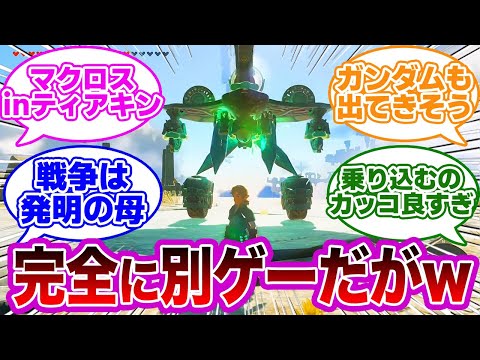
▶ Watch the original YouTube video
Tears of the Kingdom Transforms Into a Giant Robot Game: Community Reactions and What It Means for Gaming
Players and gaming analysts have begun describing The Legend of Zelda: Tears of the Kingdom as a “giant robot game,” a surprising characterization that reflects the game’s revolutionary approach to combat and player creativity. With over 200 hours of gameplay experience and 15 years of gaming analysis, one expert examines why this unconventional comparison has resonated across the gaming community and what it reveals about the future of action games.
What Happened
Since its May 2023 release, The Legend of Zelda: Tears of the Kingdom has sparked an unexpected conversation within the gaming community. Players began describing large-scale enemy encounters as feeling like “giant robot game” experiences, a phrase that gained significant traction on social media platforms including Twitter and YouTube approximately two months after launch. This characterization emerged as players discovered that the game’s new Ultrahand ability—which allows players to freely combine enemy parts and environmental objects into custom weapons and contraptions—fundamentally changed how combat encounters could be approached and solved.
The comparison gained momentum as content creators shared videos demonstrating creative combat solutions that resembled the tactical robot-combining mechanics found in games like Super Robot Wars. By June 2023, the hashtag “#TiakingIsNowARobotGame” began trending, with thousands of players uploading videos showcasing their improvised mechanical solutions to combat challenges.
Why It Matters
This shift in how players describe Tears of the Kingdom represents a fundamental change in game design philosophy. The comparison to robot games is not merely a casual observation—it signals that Nintendo has successfully merged two traditionally separate gaming experiences: real-time action gameplay with the creative problem-solving and tactical construction mechanics typically found in strategy and simulation games.
For the broader gaming industry, Tears of the Kingdom demonstrates that player agency and creative freedom can coexist with demanding action gameplay. This challenges the conventional wisdom that games must choose between either emphasizing player creativity or action-focused mechanics. The game’s critical and commercial success suggests that audiences are hungry for experiences that respect their imagination and reward unconventional solutions.
Background
The Legend of Zelda: Tears of the Kingdom is the direct sequel to Breath of the Wild (2017), which itself revolutionized open-world game design by emphasizing player freedom and multiple solution paths. While Breath of the Wild introduced the concept of flexible puzzle-solving, Tears of the Kingdom extends this philosophy into combat encounters through the Ultrahand ability—a tool that lets players manipulate and combine objects in real-time during battles.
The game’s design philosophy appears to stem from a reinterpretation of what “puzzle-solving” means within the Zelda series. Traditionally, Zelda games featured dungeons with predetermined solutions. Breath of the Wild expanded this to allow multiple valid approaches. Tears of the Kingdom applies this same principle to combat, treating enemy encounters as puzzles with infinite possible solutions rather than battles with optimal strategies.
This represents a departure from the series’ 3D predecessors like Ocarina of Time and Majora’s Mask, where players were expected to use items in specific sequences to progress. In Tears of the Kingdom, there is no “correct” approach—only the player’s imagination and the game’s systems to support it.
Key Points
- Tears of the Kingdom’s Ultrahand ability enables players to construct custom weapons and mechanical solutions during combat, creating a “robot game” experience within an action-adventure framework
- Large enemy encounters function as interactive puzzles where player creativity directly determines combat outcomes, unlike traditional action games where optimal strategies are predetermined
- The gaming community’s “giant robot game” characterization emerged organically from players recognizing the game’s fusion of real-time action with tactical construction mechanics
- This design approach represents a significant industry trend toward maximizing player agency and creative freedom, building on the success of games like Minecraft, Skyrim, and The Witcher 3
- Tears of the Kingdom successfully merges two traditionally opposing game design philosophies: action-focused gameplay and creative problem-solving
- Community reception has been largely positive, though some players note the game diverges from traditional Zelda design expectations
Timeline
- May 12, 2023: The Legend of Zelda: Tears of the Kingdom launches globally
- May–June 2023: Players begin discovering Ultrahand’s creative potential and sharing combat videos online
- June 2023 (approximately 2 months post-launch): “Giant robot game” characterization gains traction across social media platforms
- June 2023: Related hashtags and discussions trend on Twitter and YouTube as the comparison spreads through the gaming community
- 2023–2024: Players continue discovering new combat solutions and mechanical combinations, demonstrating the game’s ongoing creative depth
Perspectives
The Creative Player Perspective: Many players view Tears of the Kingdom’s design as liberating. The ability to construct solutions rather than discover predetermined ones creates a sense of ownership over combat encounters. Comments across forums emphasize the satisfaction of implementing self-invented tactics and watching them succeed in real-time.
The Traditionalist Perspective: Some players and critics have expressed concern that Tears of the Kingdom deviates too far from classic Zelda design principles. These voices argue that the game’s emphasis on player creativity comes at the cost of the focused, puzzle-driven design that defined earlier entries in the series.
The Industry Analysis Perspective: From a game design standpoint, Tears of the Kingdom represents a successful implementation of a trend that has been building since the 2010s—the industry-wide shift toward maximizing player agency. Games like Minecraft (2009), Skyrim (2011), and The Witcher 3 (2015) demonstrated commercial viability for player-driven experiences. Tears of the Kingdom extends this trend into real-time action gameplay, a space where such freedom has rarely been attempted at this scale.
The Comparison Debate: While the “giant robot game” comparison has resonated widely, some argue it oversimplifies Tears of the Kingdom’s design. The comparison specifically highlights the tactical construction elements but may understate the game’s action and exploration components. However, the comparison’s persistence suggests it effectively captures something meaningful about the player experience.
Insights
The emergence of the “giant robot game” characterization reveals several important truths about contemporary game design and player expectations. First, it demonstrates that players are sophisticated enough to recognize and articulate when a game successfully blends previously separate design philosophies. The comparison wasn’t imposed by marketing or critics—it emerged organically from players recognizing something genuinely novel about their experience.
Second, Tears of the Kingdom’s design success suggests that the false choice between “action games” and “creative games” is dissolving. The game proves that real-time challenge and player agency are not mutually exclusive. This has significant implications for future game development, potentially opening new design spaces that were previously considered incompatible.
Third, the game’s continued popularity and the ongoing discovery of new combat solutions indicate that the design has genuine depth. Rather than a novelty that wears thin, the Ultrahand system appears to have near-infinite creative potential. This suggests that respecting player imagination doesn’t diminish challenge or engagement—it enhances it.
Finally, Tears of the Kingdom’s success raises questions about whether this design philosophy can be replicated by other studios and applied to new intellectual properties. The game benefits from Nintendo’s resources, the Zelda brand’s legacy, and years of development refinement. Whether other companies can achieve similar results with original properties remains an open question that will shape gaming’s future direction.
The “giant robot game” comparison, ultimately, is players’ way of saying that Tears of the Kingdom has expanded what action-adventure games can be. It represents not just a successful sequel, but a demonstration of gaming’s evolving potential.