▶ Watch the original YouTube video
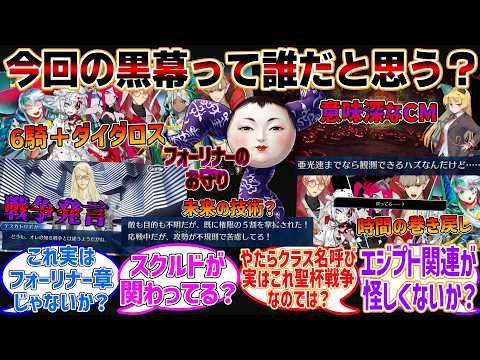
Fate/Grand Order Fans’ Halloween Event Villain Theories Are Remarkably Complex—Here’s Why
Fate/Grand Order’s latest Halloween event has sparked an explosion of intricate villain theories from the gaming community, with fans demonstrating sophisticated narrative analysis skills. After nearly a decade of increasingly complex storytelling, FGO players have evolved into expert story analysts, uncovering multiple layers of conspiracy and hidden motivations that rival professional screenwriting.
What Happened
The FGO community has generated multiple competing theories about the true antagonist behind the current Halloween event, with thread discussions showcasing remarkably detailed textual analysis. Rather than a single consensus, fans have identified several plausible villain scenarios that simultaneously hold narrative weight, suggesting either intentional ambiguity by the writers or exceptionally layered storytelling. These theories go beyond surface-level plot speculation, examining character psychology, dialogue patterns, and narrative inconsistencies to construct evidence-based predictions.
Why It Matters
This phenomenon reflects a significant evolution in how gaming communities engage with narrative content. FGO’s increasingly sophisticated storytelling has trained its audience to think like literary analysts, identifying foreshadowing, character motivations, and structural patterns. The quality and depth of fan theories now rival professional criticism, demonstrating that mobile games have matured into a legitimate narrative medium. Additionally, the existence of multiple valid interpretations suggests that modern game design is intentionally creating “open” narratives that reward deep engagement from players.
Background
Fate/Grand Order launched in July 2015 and has evolved from a straightforward mobile game into a complex narrative experience. Early FGO events featured relatively simple antagonistic structures, but since 2018, the game has progressively incorporated multi-layered conspiracy plots, unreliable narrators, and morally ambiguous characters. Scenario writer Yuichiro Higashide, known for his work on Fate/Zero, has established a pattern of weaving long-term foreshadowing across multiple events and story arcs. The game’s narrative complexity has grown in tandem with its audience’s analytical sophistication, creating a feedback loop where increasingly engaged fans demand more intricate storytelling.
Key Points
- Multiple villain theories coexist: Rather than a single dominant theory, the community has identified several plausible antagonists, each supported by textual evidence from previous events and character dialogue.
- Evidence-based analysis: Fan theories are grounded in close reading of character behavior, dialogue repetition, narrative inconsistencies, and psychological motivation rather than speculation.
- Long-form foreshadowing: Clues are scattered across years of previous events, requiring players to maintain encyclopedic knowledge of FGO’s narrative history.
- Character psychology focus: Theories emphasize why characters behave in seemingly unnatural ways, suggesting hidden agendas or external control.
- Intentional narrative ambiguity: The existence of multiple valid interpretations suggests writers deliberately constructed the story to support multiple readings.
- Community-driven analysis: Fans have collectively identified patterns that individual players might miss, demonstrating the power of collaborative interpretation.
Timeline
- 2015: FGO launches with relatively straightforward event narratives.
- 2016-2017: Simple antagonistic structures dominate event stories; fan discussion remains moderate.
- 2018-2019: Multiple factions and competing interests begin appearing in events; fan analysis becomes more active.
- 2020-Present: Multi-layered villain structures become standard; fan discussion reaches peak intensity with sophisticated textual analysis.
Perspectives
Fan Community Perspective: Players view the complex villain theories as evidence of FGO’s narrative maturity and their own evolved analytical capabilities. Many express pride in the community’s ability to identify subtle foreshadowing and psychological patterns. Social media reactions emphasize that fan analysis sometimes exceeds official materials in depth.
Narrative Design Perspective: The existence of multiple valid theories suggests intentional design choices by the writing team. Rather than a single “correct” answer, the scenario writers may have deliberately constructed the narrative to support multiple interpretations, rewarding different analytical approaches and encouraging ongoing community discussion.
Accessibility Concern: Some community members worry that increasing narrative complexity creates barriers for new players. The requirement to understand years of previous events and maintain detailed character knowledge may discourage fresh engagement with the game.
Insights
The sophistication of FGO’s Halloween event theories demonstrates that mobile games have evolved into a legitimate narrative medium capable of supporting complex, multi-layered storytelling. The community’s analytical response shows that engaged gaming audiences are no longer passive consumers but active interpreters who apply literary analysis techniques to interactive narratives.
This phenomenon also reveals a broader industry trend: successful story-driven games increasingly employ multi-layered villain structures and intentional narrative ambiguity. Games like Persona 5, Steins;Gate, and Final Fantasy VII Remake have normalized the concept of multiple valid interpretations, where surface-level antagonists mask deeper conspiracies. FGO represents the culmination of this trend in the mobile gaming space.
However, the rising complexity presents a potential challenge: as narratives become more intricate, the entry barrier for new players increases. Future game design may need to balance sophisticated storytelling with accessibility, perhaps by offering multiple difficulty levels of narrative comprehension or providing optional deep-dive materials for players seeking maximum interpretive depth.
Ultimately, the quality of fan theories surrounding the Halloween event reflects a mature relationship between creators and audience. The writers craft deliberately ambiguous narratives, and the community responds with rigorous analysis, creating a collaborative storytelling experience that extends far beyond the game’s official content. This dynamic represents the future of narrative-driven gaming.