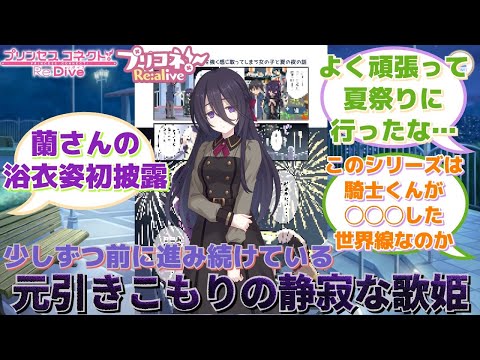
▶ Watch the original YouTube video
How a Single Line of Dialogue Revealed the Depth of Princess Connect’s Ranfa Character
A seemingly dismissive comment from the character Ranfa during a summer festival date scene in Princess Connect! Re:Dive has sparked widespread discussion among players. The brief line “Huh, a summer festival date?” has become a focal point for analyzing the game’s sophisticated approach to character psychology and emotional nuance.
What Happened
In a recent story sequence of Princess Connect! Re:Dive, the character Ranfa responds to a summer festival date invitation with the understated remark “Huh, a summer festival date?” (へぇー夏祭りデートかよ). This seemingly casual line has generated significant discussion across social media and gaming communities, with players analyzing the layers of emotion hidden beneath the surface-level dialogue.
Why It Matters
This moment exemplifies the current trend in narrative-driven games toward depicting complex, mixed emotions rather than straightforward character reactions. The scene demonstrates how skilled game writing can convey psychological depth through minimal dialogue, requiring players to engage their interpretive skills. For the broader gaming industry, this represents a shift toward more sophisticated emotional storytelling that mirrors real human interaction.
Background
Princess Connect! Re:Dive is a social RPG that has gained recognition not merely as a character collection game, but as a narrative experience with carefully developed character psychology. Ranfa, the character in question, is typically portrayed as expressionless and emotionally reserved. However, her character arc reveals a more complex interior life beneath this stoic exterior. The game’s scenario writers, some of whom have worked on acclaimed titles like the Fate series, are known for their precision in depicting subtle emotional shifts.
The summer festival date scene occurs within the game’s main story progression and represents a moment where Ranfa’s carefully maintained emotional composure appears to crack slightly, revealing vulnerability beneath her typical detachment.
Key Points
- Ranfa’s response “Huh, a summer festival date?” contains multiple layers of emotion: disappointment at unmet expectations, suppressed joy, and emotional restraint
- The line exemplifies how game narratives can convey complex psychology through minimal dialogue, requiring player interpretation
- Player reactions have been overwhelmingly positive, with many analyzing the psychological subtext rather than dismissing the comment as indifference
- The scene demonstrates Princess Connect’s narrative sophistication compared to similar titles in the genre
- The moment reveals Ranfa as a character whose emotional suppression functions as a psychological defense mechanism
- Social media discussion has focused on both the character’s appeal and the broader implications for game storytelling
Perspectives
Multiple interpretations of this scene have emerged from the gaming community. The dominant reading suggests that Ranfa’s comment masks genuine pleasure beneath apparent indifference—a reflection of her tendency to suppress emotional expression. Some players connect this to their own experiences with romantic partners whose reserved responses conceal deeper feelings, creating a sense of emotional authenticity.
From a narrative design perspective, the scene represents a deliberate choice to trust the player’s ability to read subtext. Rather than explicitly stating Ranfa’s internal conflict between expectation and reality, the writers embed this tension within a single line of dialogue. This approach contrasts with games that more directly communicate character emotions through extended dialogue or visual cues.
Comparisons to other narrative-driven games reveal Princess Connect’s distinctive approach. While titles like Fate/stay night and Persona 5 also feature emotionally reserved characters, Princess Connect achieves similar psychological depth with greater economy of language, relying on players to infer emotional complexity from minimal textual information.
Insights
This moment illustrates a broader evolution in game narrative design toward depicting authentic human psychology. Rather than portraying emotions as discrete, easily identifiable states, modern narrative games increasingly represent the simultaneous presence of conflicting feelings—hope and disappointment, joy and restraint, desire and self-protection.
Ranfa’s character embodies what might be termed an “emotional defense mechanism,” where her expressionless demeanor functions not as the absence of feeling but as protection against vulnerability. The summer festival scene suggests that her relationship with the protagonist may be gradually eroding this defensive barrier, allowing glimpses of her underlying emotional complexity.
The widespread positive reception of this scene indicates that contemporary players possess the interpretive sophistication to appreciate subtle emotional storytelling. Rather than requiring explicit exposition, players demonstrate capacity to construct meaning from minimal cues, suggesting that game narratives can achieve greater depth by trusting audience intelligence.
For the future of Princess Connect, this scene establishes narrative momentum toward deeper exploration of Ranfa’s psychological background. The writers have signaled that her emotional restraint has roots in her character history, implying that future story developments will gradually reveal the origins of her defensive emotional patterns and potentially chart her gradual emotional opening.