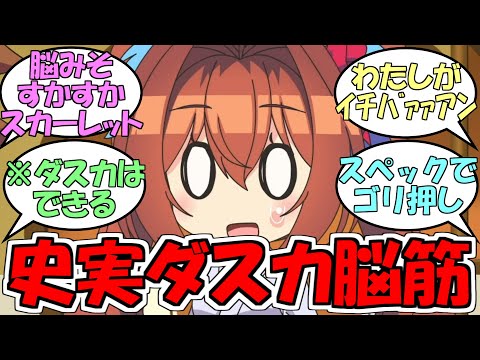
▶ Watch the original YouTube video
How Uma Musume Players Reacted to the “Dasuka Has an Empty Head” Meme
A creative meme about the character Dasuka in Uma Musume Pretty Derby has sparked widespread discussion within the gaming community, highlighting the gap between historical racing facts and in-game character design. The meme demonstrates how mature gaming communities blend external knowledge with game lore to create intellectually sophisticated humor.
What Happened
Within the Uma Musume Pretty Derby community, a meme emerged comparing the character Dasuka to the phrase “empty-headed scarlet.” The meme plays on the character’s name while critiquing the perceived disconnect between the historical racehorse Dasuka and the character’s in-game personality. This wordplay-based critique has spread across social media platforms, generating numerous variations and sparking broader discussions about character design choices in the game.
Why It Matters
This meme exemplifies how modern gaming communities engage with source material at multiple levels simultaneously. Uma Musume players combine knowledge of actual racing history with in-game character settings, creating a unique form of community discourse. The phenomenon reveals how mature gaming communities express complex emotions—criticism paired with genuine affection—through humor rather than direct complaint. Understanding this dynamic provides insight into how fan communities maintain engagement and creativity around their favorite titles.
Background
Uma Musume Pretty Derby is a mobile game that adapts real historical racehorses into anime-style characters. The game’s premise creates an inherent tension: each character is based on an actual horse with documented racing history, yet the game developers have creative freedom to design personalities and story arcs. Dasuka, a racehorse that competed in the 1990s, received a character design in the game that some players felt diverged significantly from what they understood about the historical horse’s characteristics. This gap between historical fact and fictional interpretation became the foundation for community commentary.
Key Points
- The meme critiques the disconnect between historical racehorse Dasuka and the character’s in-game personality design
- “Empty-headed scarlet” combines wordplay on the character’s name with commentary on perceived character traits
- The meme has evolved into multiple variations and inspired similar critiques of other characters
- Community reception blends criticism with affection, demonstrating mature fan engagement
- The meme’s sophistication reflects the Uma Musume community’s high knowledge base combining racing history and game lore
- The phenomenon highlights how external knowledge enriches gaming community culture compared to other game franchises
Community Response Patterns
Initial Adoption and Spread
The meme gained traction when prominent streamers and established players began referencing it on social media platforms. Initial adoption was driven by players who found the wordplay amusing and began sharing it across Twitter, YouTube comments, and gaming forums.
Creative Variations
Following the meme’s initial spread, the community generated numerous variations and applications. Players adapted the format to other characters and contexts, demonstrating creative engagement beyond simple repetition. This evolution indicates active community participation rather than passive consumption of humor.
Coexistence of Criticism and Affection
Notably, players using this meme frequently accompanied their posts with expressions of genuine fondness for the character. This pattern reveals a sophisticated emotional dynamic where criticism and love coexist, a hallmark of mature fan communities that have moved beyond binary approval or rejection.
Linguistic and Structural Analysis
The meme operates on multiple linguistic levels. First, it employs phonetic wordplay, extracting “suka” (empty) from “Dasuka” while maintaining the character’s name recognition. Second, it incorporates semantic critique, with “empty-headed” functioning as character commentary. Third, the addition of “scarlet” introduces visual and aesthetic dimensions, elevating the expression beyond simple mockery to something more artistically considered.
This multilayered construction distinguishes the meme from simpler forms of fan criticism found in other gaming communities. The intellectual sophistication suggests that Uma Musume’s player base possesses higher baseline knowledge and creative capacity than some comparable gaming communities.
Comparative Context
Monster Hunter Series
Monster Hunter communities generate memes about specific monsters and game systems, but these typically remain grounded in in-game mechanics and lore. Uma Musume memes uniquely incorporate external historical knowledge, creating an additional layer of meaning unavailable to communities based on fictional game worlds.
Fate Series
While Fate also adapts historical figures into character form, the source material (ancient and medieval history) maintains greater temporal and cultural distance. Uma Musume’s foundation in contemporary horse racing creates more immediate and recognizable gaps between historical fact and fictional interpretation.
Pokémon
Pokémon communities engage with character design criticism, but the absence of real-world source material eliminates the “historical accuracy” dimension entirely. This fundamental difference makes Uma Musume’s meme culture uniquely positioned between pure fiction and documented reality.
Player Psychology and Meme Function
The meme serves multiple psychological functions within the community. First, it provides a constructive outlet for expressing the cognitive dissonance between expected and actual character design. Rather than direct complaint, humor allows players to voice concerns while maintaining community cohesion.
Second, the meme functions as a knowledge-sharing mechanism. Understanding the reference requires familiarity with both in-game character design and historical racing knowledge, creating an implicit community of informed players. This shared understanding reinforces group identity and belonging.
Third, the meme enables expression of complex emotional states. Players can simultaneously criticize design choices and express affection for characters, a nuance that direct language often fails to capture. Humor becomes the vehicle for emotional sophistication.
Broader Implications for Gaming Communities
The emergence and evolution of this meme indicates several positive indicators for the Uma Musume community’s long-term health. The sustained creativity in meme variation suggests community engagement remains active and intellectually engaged rather than declining into repetitive patterns. The ability to maintain criticism alongside affection demonstrates emotional maturity and investment in the game’s continued development.
However, potential risks exist. Repeated meme usage could calcify into fixed character perceptions, limiting players’ ability to appreciate character development or alternative interpretations. The challenge for the community lies in maintaining creative diversity while preventing any single meme from becoming the definitive community narrative about a character.
Future Outlook
The trajectory of this meme and similar community creations will likely indicate the Uma Musume community’s continued vitality. Key indicators to monitor include whether meme culture continues to diversify or becomes formulaic, whether historical racing knowledge integration deepens or plateaus, and whether critical perspectives ultimately enhance or limit character appreciation.
The most positive outcome would involve the community maintaining its current balance: generating creative, knowledge-informed humor while simultaneously deepening understanding of both historical racing and character design philosophy. This would position Uma Musume’s community as a model for how gaming communities can engage with source material at multiple levels of sophistication.
Conclusion
The “empty-headed scarlet” meme represents far more than simple character mockery. It demonstrates how contemporary gaming communities leverage external knowledge, creative language, and sophisticated humor to engage with their favorite games. The meme’s persistence and evolution reflect a community that has achieved maturity in balancing critical perspective with genuine affection for the work. As Uma Musume continues to evolve, the community’s ability to generate such intellectually rich discourse will remain central to its cultural significance and player retention.