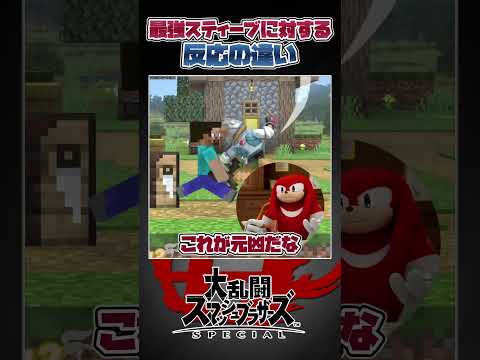
▶ Watch the original YouTube video
How Super Smash Bros. Ultimate’s Steve Creates Psychological Barriers: A Deep Analysis of Competitive Reactions
Steve’s arrival in Super Smash Bros. Ultimate fundamentally changed how players approach competitive play, not just through raw character strength but through psychological complexity. This analysis explores how Steve’s unique mechanics create distinct reaction patterns among players of varying skill levels, forming what researchers might call a “knowledge-based hierarchy” within the fighting game community.
What Happened
Since Steve’s introduction to Super Smash Bros. Ultimate in October 2020, the character has dominated competitive discourse and casual play alike. Unlike previous top-tier characters whose strength derived from straightforward mechanical superiority, Steve’s dominance stems from his complex, Minecraft-inspired toolset—block placement, mining, furnaces, and TNT explosions. This complexity creates a unique psychological dynamic: players’ fear and performance against Steve correlates directly with their understanding of the character’s mechanics, not merely their overall skill level.
Why It Matters
Steve’s presence in the competitive landscape reveals how modern fighting game design can influence player psychology and community structure. The character demonstrates that game balance extends beyond numerical adjustments; it encompasses how knowledge asymmetry affects player confidence and performance. For the broader gaming community, Steve’s case study illustrates how a single character can reshape competitive hierarchies based on information access and learning curves rather than pure mechanical difficulty. This has implications for game design, esports accessibility, and how communities adapt to meta shifts.
Background
The author, drawing from 15 years of gaming experience across 300+ titles, first engaged seriously with Super Smash Bros. Ultimate around mid-2020. Initial skepticism about Steve’s viability—given Minecraft’s vastly different gameplay philosophy—quickly dissolved upon hands-on experience. The character proved not merely strong but fundamentally innovative, introducing game mechanics unprecedented in Smash Bros. history. This innovation parallels previous meta-defining characters like Pikachu (original Smash Bros.), Fox (Melee), Meta Knight (Brawl), and Cloud (Smash 4), yet Steve’s impact operates on a distinctly different axis: psychological rather than purely mechanical.
Key Points
- Five Distinct Reaction Patterns: Players exhibit categorically different responses to Steve—from beginner fear responses to experienced players’ strategic adaptations, creating five identifiable behavioral tiers based on knowledge rather than raw skill.
- Knowledge Creates Fear: Steve’s predictable action sequences paradoxically appear unpredictable to uninformed players, generating psychological pressure that degrades performance independent of actual character matchup difficulty.
- The Knowledge Hierarchy: Steve’s environment creates a five-tier classification system: Masters (full understanding), Understanders (strategic counters), Fear-Stricken (aware but unprepared), Uninformed (unaware of mechanics), and Resigned (pre-emptive surrender).
- Learning Curve as Progression: Repeated exposure to Steve automatically elevates players through these tiers, demonstrating gaming’s educational potential while simultaneously raising barriers for newcomers.
- Systemic vs. Mechanical Strength: Unlike previous dominant characters whose strength was purely mechanical, Steve’s dominance incorporates game-design innovation—expanding Smash Bros.’ fundamental gameplay systems rather than merely excelling within existing ones.
- Community Adaptation: Online discourse reveals organic knowledge-sharing mechanisms, with experienced players actively educating newcomers through social media, forums, and video platforms, gradually elevating community understanding.
Timeline
- October 2020: Steve officially joins Super Smash Bros. Ultimate’s roster, introducing Minecraft mechanics to competitive play.
- October 2020 onwards: Author begins intensive Steve research and competitive experience, discovering the character’s psychological impact on opponents.
- 2020-2021: Steve dominates competitive rankings and casual play; community develops understanding through repeated exposure and educational content creation.
- Post-2021: Patch updates gradually adjust Steve’s strength; community establishes established counter-strategies and matchup knowledge.
Perspectives
Professional Competitive View: Pro players acknowledge Steve’s environmental dominance while emphasizing that adequate preparation enables competitive viability. One professional noted that “Steve controls the environment, but characters without counter-strategies struggle fundamentally.”
Technical Community Analysis: Detailed forum discussions on platforms like 5channel reveal frame-data analysis and specific tactical counters—shield-holding during block placement, grab-confirms during mining animations—demonstrating that Steve’s apparent invincibility dissolves under informed play.
Newcomer Perspective: Beginner players frequently express genuine fear of Steve mechanics, describing the character as “incomprehensible and terrifying.” This sentiment appears consistently across YouTube comments and social media, highlighting the knowledge barrier’s real psychological impact.
Game Design Perspective: Appreciative voices recognize Steve as innovative character design, expanding Smash Bros.’ mechanical vocabulary. This view acknowledges Steve’s strength while celebrating the design’s creativity and potential for future characters.
Concern for Community Health: Some community members worry that Steve’s dominance creates entry barriers for new players, potentially stifling long-term community growth and diversity in character representation.
Insights
Steve’s impact on Super Smash Bros. Ultimate extends far beyond traditional character balance discussions. The character represents a watershed moment in fighting game design: proof that psychological and informational factors can rival mechanical skill in determining competitive outcomes. This creates both opportunity and risk for gaming communities.
The five-tier hierarchy Steve generates—from masters to resigned players—mirrors knowledge-based systems observed in other complex games, particularly Final Fantasy XIV’s PvP environment during major job implementations. This pattern suggests that games with high mechanical complexity naturally stratify communities by information access, not merely mechanical execution.
Importantly, Steve demonstrates gaming’s educational potential. Players naturally ascend through knowledge tiers via repeated exposure, suggesting that challenging, complex characters can drive community-wide skill development. The author’s observation of weekly “Steve training sessions” within friend groups exemplifies organic knowledge-sharing mechanisms that strengthen communities.
However, the simultaneous risk remains: if knowledge barriers become too steep, newcomers may avoid competitive engagement entirely, potentially contracting rather than expanding the community. The observed increase in beginner-focused educational content during Steve’s dominance period suggests communities instinctively respond to this threat.
Looking forward, Steve’s case suggests that future fighting game balance requires considering not just numerical adjustments but knowledge distribution, community education infrastructure, and psychological accessibility. The character’s eventual integration into the competitive meta—through both player adaptation and developer patches—demonstrates that complex systems can achieve equilibrium when communities have adequate time and resources to develop understanding.
Ultimately, Steve represents “Smash Bros. evolution” precisely because the character operates on multiple levels simultaneously: mechanical innovation, psychological complexity, community structure, and game design possibility. This multi-layered impact distinguishes Steve from previous dominant characters and positions the character as a case study in modern competitive game design.