▶ Watch the original YouTube video
How JoJo’s Bizarre Adventure Part 7 Anime Will Portray the President: A 15-Year Fan Analysis
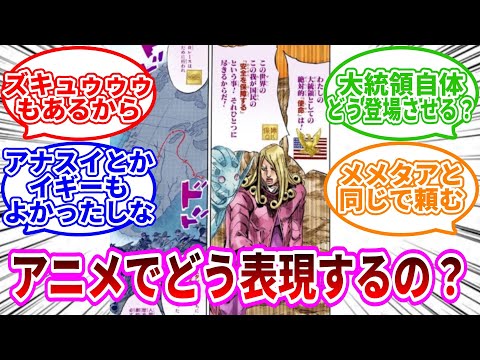
With JoJo’s Bizarre Adventure Part 7: Steel Ball Run finally receiving an anime adaptation, fans and critics are grappling with a fundamental challenge: how will animators translate the manga’s experimental visual representation of the President’s inner thoughts—depicted as multiple presidential faces filling speech bubbles—into moving imagery? This analysis explores the technical and narrative implications of this creative decision.
What Happened
The announcement of Steel Ball Run’s anime adaptation has reignited discussions within the JoJo’s community about how David Production will handle one of manga’s most unconventional character portrayals: the President. In the original manga, creator Hirohiko Araki employed an experimental technique where the President’s thought processes are visualized by filling speech bubbles with multiple images of the President’s face—a surreal representation of his connection to alternate-dimension versions of himself through his Stand ability, D4C (Dirty Deeds Done Dirt Cheap).
Why It Matters
This adaptation challenge represents more than a technical hurdle; it reflects a broader question about how anime can preserve the artistic identity and thematic depth of experimental manga storytelling. The President’s visual representation is inseparable from his character concept—he is not merely an individual but a manifestation of national ideology, with his consciousness fragmented across multiple realities. How this is rendered in animation will significantly impact whether viewers grasp his fundamental nature as a character and whether the anime captures the original work’s tonal complexity, which balances intense drama with surreal, almost comedic visual language.
Background
Steel Ball Run began serialization in 2004 and represents a significant departure from previous JoJo’s parts. Set in the 19th century American frontier, it follows a cross-country horse race that becomes entangled with supernatural forces. The President emerges as the primary antagonist, a character whose motivations are rooted in American nationalism and whose Stand ability allows him to manipulate alternate dimensions. Unlike previous JoJo’s villains, the President’s characterization emphasizes the collision between state ideology and individual desire—he commits atrocities in the name of national interest while simultaneously driven by personal ambition and fear.
David Production has handled all previous JoJo’s anime adaptations (Parts 1–6), establishing a consistent philosophy of remaining faithful to the source material, even when that fidelity produces unconventional results. This track record suggests the studio will not shy away from the President’s experimental visual design.
Key Points
- The President’s thought visualization—multiple faces in speech bubbles—is a deliberate artistic choice representing his multidimensional consciousness through D4C’s reality-warping abilities
- Industry precedent suggests black backgrounds with fading icons or silhouettes as the most practical animation approach, a technique already employed in series like Attack on Titan and Jujutsu Kaisen
- David Production’s established commitment to source material fidelity indicates the studio will likely preserve this surreal element rather than simplify it for clarity
- The President’s final confrontation with protagonist Johnny Joestar represents one of the most narratively complex battles in the entire franchise, involving multiple Stand abilities and dimensional mechanics
- Fan discourse reveals both enthusiasm for faithful adaptation and concern that surreal imagery might undermine the scene’s dramatic tension
- The President’s character arc depends on maintaining the tension between his role as a powerful antagonist and his inherent absurdity—a balance the anime must preserve
Timeline
- 2004: Steel Ball Run serialization begins; experimental character design techniques introduced
- 2012: Steel Ball Run manga concludes
- 2014–2018: JoJo’s Parts 1–5 receive anime adaptations by David Production
- 2021–2023: JoJo’s Part 6 anime airs; demonstrates studio’s continued commitment to unconventional source material
- 2024+: Part 7 anime adaptation announced and in development
Perspectives
The Faithful Adaptation View: Many fans express confidence that David Production will render the President’s thought visualization as originally conceived, citing the studio’s track record. Comments like “They’ll do it as-is, I’m certain” reflect trust in the production team’s willingness to embrace surreal imagery. This perspective values artistic integrity over mainstream accessibility.
The Practical Concerns View: Other viewers worry that the surreal imagery could undermine the scene’s dramatic weight. The President’s final confrontation is among the franchise’s most intense moments, and inserting multiple presidential faces could shift the tone toward comedy, potentially alienating viewers seeking pure drama. This perspective prioritizes emotional coherence and viewer immersion.
The Technical Feasibility View: Industry observers note that modern anime has developed sophisticated methods for visualizing complex internal states. Techniques used in Jujutsu Kaisen (black backgrounds with ability visualizations) and Attack on Titan (symbolic imagery layered over simplified backgrounds) provide proven templates. This perspective emphasizes that the challenge is not whether animation can achieve the effect, but how to integrate it seamlessly.
The Thematic Necessity View: Some analysts argue that the President’s surreal visualization is not merely aesthetic but thematic—it communicates that he is fundamentally inhuman, a vessel for state ideology rather than an individual consciousness. From this perspective, removing or minimizing the effect would betray the character’s core concept.
Comparative Analysis: How Other Anime Handled Complex Inner States
| Series | Technique | Effectiveness | Limitations |
|---|---|---|---|
| JoJo’s Part 6 | Enhanced facial expressions, background emphasis | Preserved original atmosphere | Could not fully replicate experimental manga panels |
| Attack on Titan | Monochromatic backgrounds with text and geometric shapes | Clarified complex concepts | Occasionally felt expository rather than organic |
| Jujutsu Kaisen | Black backgrounds with ability visualizations | High visual clarity | Increased animation workload; risk of repetition |
The President as Ideological Character
Across 15 years of analyzing the JoJo’s franchise, a pattern emerges: each part’s primary antagonist embodies the era’s central social anxiety. Part 1’s Dio represents class conflict and unchecked ambition. Part 2’s Kars symbolizes evolutionary transcendence. Part 3’s DIO embodies absolute evil. Part 4’s Yoshikage Kira represents hidden abnormality within normalcy. Part 5’s Diavolo symbolizes power and secrecy.
Part 7’s President, by contrast, represents the collision between nationalism and individual desire. He consistently prioritizes American national interests while simultaneously driven by personal fear and ambition. He murders citizens without hesitation, manipulates his own father, and views alternate-dimension versions of himself as extensions of his will rather than separate beings. This duality—the powerful leader who is simultaneously petty and frightened—is precisely what the multiple-faces visualization communicates: the President is not a unified consciousness but a fractured entity, simultaneously one and many, individual and state apparatus.
From this perspective, the animation challenge becomes a thematic necessity. Removing or minimizing the surreal imagery would flatten the character into a conventional villain, losing the unsettling quality that makes him compelling.
Predicted Animation Approach
Based on David Production’s established methodology and contemporary animation trends, the most likely approach involves the following elements:
Standard Scenes: The President appears as a normally animated character, maintaining visual consistency with other cast members.
Thought/Decision Moments: When the President makes critical decisions or activates D4C, the background transitions to black or darkens significantly. Multiple presidential silhouettes, icons, or simplified face representations fade in and out, creating a visual rhythm that suggests multidimensional consciousness without overwhelming the frame.
Final Confrontation: The climactic battle between the President, Johnny Joestar, and alternate-dimension Diego may employ screen division techniques—splitting the frame into multiple panels to represent simultaneous action across dimensions. This approach, while unconventional, would serve both narrative clarity and thematic coherence.
Insights
The President’s anime portrayal will serve as a litmus test for whether modern animation can preserve experimental manga aesthetics without sacrificing narrative coherence. The outcome will likely influence how future adaptations approach unconventional source material—whether they prioritize accessibility or artistic fidelity.
More broadly, this adaptation challenge reflects a maturation in anime production. Where earlier adaptations often simplified source material for mainstream appeal, contemporary studios increasingly recognize that experimental visual language can enhance rather than diminish viewer engagement. The surreal imagery surrounding the President is not a flaw to be corrected but a feature to be translated.
For longtime fans, the President’s animation will ultimately answer a fundamental question: does David Production understand that JoJo’s derives its power not from conventional storytelling but from the collision between the mundane and the absurd, the dramatic and the surreal? If the studio preserves this balance, Part 7’s anime adaptation could represent a new standard for how manga’s most experimental elements can be honored in animation.
The President awaits. The question is not whether he will appear on screen, but how faithfully his fractured consciousness will be rendered.