▶ Watch the original YouTube video
Kamen Rider Fans Reveal Their Most Wanted CSM Transformation Belts: A 15-Year Retrospective
A comprehensive analysis of fan desires surrounding Bandai’s Complete Selection Modification (CSM) product line reveals deep psychological motivations beyond simple nostalgia. Drawing from 15 years of Kamen Rider fandom experience, this article examines why fans continue to demand high-quality reproductions of specific transformation belts and what this trend reveals about the collector market and franchise strategy.
What Happened
A YouTube video compilation has aggregated fan responses regarding which Kamen Rider transformation belts should receive CSM (Complete Selection Modification) treatment—Bandai’s premium collector-focused product line. The video catalogs diverse fan requests spanning multiple eras of the franchise, from classic Heisei-era riders to contemporary Reiwa-era designs. Key demands include the Wizard Driver, Fourze Driver, Drive Driver, and newer items like the Gamer Driver, with fans articulating both their desires and realistic concerns about production complexity and pricing.
Why It Matters
The CSM phenomenon represents a significant shift in how major toy manufacturers approach legacy intellectual property. Rather than treating transformation belts as disposable children’s toys, Bandai has successfully established a premium collector market targeting adults aged 30-40 who experienced these series during their childhood. This strategy reveals broader industry trends: the monetization of nostalgia through quality reproduction, the economic power of adult fan bases, and the strategic importance of understanding fan psychology in product development. For the Kamen Rider franchise specifically, CSM success directly influences brand perception and long-term revenue sustainability.
Background
The Kamen Rider franchise spans over 50 years, with the Heisei era (1999-2019) producing iconic series including Kuuga, Agito, Ryuki, 555, Blade, Hibiki, Kiva, Den-O, Kamen Rider, W, OOO, Fourze, Wizard, Gaim, Drive, Ghost, Ex-Aid, Build, and Zero-One. The Reiwa era (2019-present) continues with Zi-O, Zero-One, Saber, Revice, and beyond. Prior to CSM, high-quality transformation belts were limited to DX (Deluxe) versions and occasional premium releases. CSM launched as a dedicated premium line in 2019, initially focusing on iconic Heisei-era belts. The success of early releases—particularly the Kuuga Arcle and Agito Driver—demonstrated substantial adult collector demand, prompting Bandai to expand the line significantly.
Key Points
- Wizard Driver demand is strongest—Fans emphasize superior design aesthetics and high-quality voice acting reproduction as essential features for CSM treatment
- Fourze Driver requires strategic pricing—The extensive switch variety (40+ variants) creates concerns about prohibitive costs; fans request a basic version with optional expansion packs
- Prop sizing matters significantly—Previous oversized Deluxe and Consolé versions of the Hibiki Onsa prop proved impractical; palm-sized “my prop” scale offers optimal display and collection flexibility
- Drive Driver maintains persistent demand—Despite production complexity, fans recognize Drive as a late-Heisei masterpiece worthy of premium treatment despite anticipated high pricing (potentially exceeding ¥20,000)
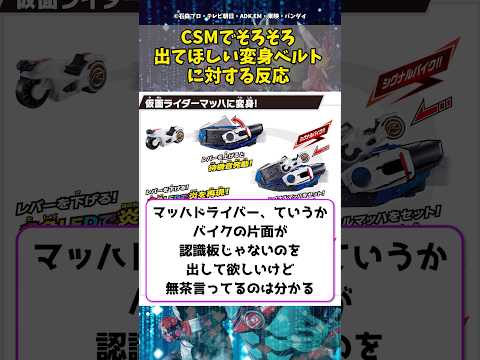
- Complex mechanisms present real challenges—Requests for Mach Driver and other mechanically intricate belts acknowledge manufacturing difficulty while expressing genuine desire for complete reproductions
- Reiwa-era CSM expansion is accelerating—Gamer Driver and related Zero-One items represent emerging demand from newer fan demographics, signaling franchise evolution beyond nostalgic reproduction
Timeline
- 2009—Author begins intensive Kamen Rider fandom during Decade broadcast era
- 2019-2020—CSM launches with iconic Heisei-era belts (Kuuga, Agito, Ryuki); establishes adult collector market viability
- 2021—Author first experiences CSM product (555 Orphenochs Driver); recognizes quality exceeds original DX standards
- 2021-2022—CSM expands to more specialized titles (555, Blade, Hibiki); demonstrates market depth beyond flagship series
- 2023-2024—Reiwa-era CSM expansion begins; newer fan demographics emerge alongside traditional collectors
Perspectives
The Collector’s Perspective: Adult fans aged 30-40 possess both disposable income and deep emotional investment in specific series from their childhood. For these collectors, CSM products represent more than merchandise—they constitute physical manifestations of formative experiences. The willingness to pay premium prices (¥15,000-¥20,000+) reflects genuine demand rather than casual interest.
The Business Strategy Perspective: Bandai’s CSM expansion demonstrates sophisticated market segmentation. By targeting adult collectors rather than children, the company achieves higher profit margins while simultaneously elevating brand prestige. The strategic progression from iconic belts to increasingly specialized items suggests data-driven decision-making based on sales performance, social media engagement, and related merchandise performance (Blu-ray sales, supplementary goods).
The Realism Perspective: Fan discussions reveal mature understanding of production constraints. Comments acknowledging that “Fourze would be too expensive as a complete set” or “Mach Driver’s complexity is unrealistic” demonstrate sophisticated awareness of manufacturing economics. This suggests fans are not making frivolous demands but rather engaging in constructive dialogue about feasibility.
The Franchise Evolution Perspective: The emergence of Reiwa-era CSM requests indicates the franchise is transitioning from “nostalgia-driven” to “continuous engagement” model. Younger fans requesting Gamer Driver and other recent items suggest CSM is becoming standard expectation rather than special exception, fundamentally altering fan relationship with the franchise.
Insights
Three-Layer Fan Psychology: Fan desires for CSM products operate on three distinct psychological levels: (1) Nostalgia—recreating childhood experiences; (2) Completion—achieving comprehensive ownership of beloved series elements; (3) Identity—physically expressing fandom and personal connection to specific works. These layers combine to create powerful purchasing motivation that transcends simple product desire.
Market Maturation Signal: The sophistication of fan discourse around CSM products indicates the collector market has matured beyond impulse purchasing. Discussions about pricing strategy, production feasibility, and phased release approaches suggest fans understand business economics and are engaging as informed consumers rather than passive buyers.
Franchise Sustainability: CSM success directly correlates with franchise longevity. By monetizing adult nostalgia while simultaneously attracting new younger fans through Reiwa-era releases, Bandai has created a sustainable revenue model that benefits the entire Kamen Rider ecosystem. Related merchandise (Blu-rays, supplementary goods, collectibles) experiences sales increases when CSM products generate renewed interest in specific series.
The Infinite Desire Paradox: As one commenter noted, “human desire is infinitely visible.” However, this observation contains deeper truth: while individual desires may be infinite, the underlying motivations are finite and comprehensible. Understanding these motivations—nostalgia, completion, identity expression—allows manufacturers to anticipate and strategically fulfill demand rather than react passively to it.
New vs. Legacy Balance: The franchise faces a strategic decision point: prioritize completing Heisei-era CSM coverage or accelerate Reiwa-era expansion to capture new audiences. Current evidence suggests a hybrid approach is optimal—maintaining legacy product development while simultaneously establishing Reiwa-era CSM as standard practice. This prevents longtime fans from feeling abandoned while ensuring new generations experience CSM as normal franchise practice.
Strategic Recommendations for Fan Advocacy
Fans seeking CSM treatment for specific belts should understand that Bandai’s product decisions rely on three measurable factors: (1) Social media mention volume and consistency; (2) Sustained community engagement (not temporary trends); (3) Related merchandise sales performance (particularly Blu-ray and supplementary goods). Effective advocacy requires comprehensive franchise support—purchasing Blu-rays, acquiring related merchandise, and maintaining consistent social media presence—rather than isolated demands for specific products.
For complex-mechanism belts like Fourze Driver, realistic expectations should acknowledge that simplified versions or phased release strategies (basic set plus expansion packs) represent more viable paths than complete reproduction. This approach mirrors successful precedents like Build Bottle CSM, which offered both core and expansion configurations.
Community Response
Online fan communities demonstrate remarkable sophistication in CSM discussions. Twitter conversations under hashtags like #CSM化してほしい (“CSM I want”) reveal ongoing debates about prioritization strategies, with some fans advocating for complete Heisei-era coverage before Reiwa expansion, while others argue that accelerating newer-era CSM is essential for new fan acquisition. 5channel Kamen Rider threads feature detailed technical discussions about production feasibility, with participants analyzing specific mechanical challenges and proposing solutions.
YouTube comments reveal direct appeals to Bandai, framed not as emotional pleas but as business arguments: “This much demand exists—this is viable as a product.” This represents evolution from traditional fan culture toward sophisticated consumer advocacy.
Personal Reflection
Kamen Rider Drive represents a particularly compelling case study in fan attachment. As a series experienced during adulthood rather than childhood, Drive created what might be termed “intellectual nostalgia”—appreciation based on narrative sophistication, character psychology, and thematic depth rather than simple childhood memory. The prospect of Drive Driver CSM treatment carries ritualistic significance: the opportunity for an adult self to physically reconnect with a work that shaped mature understanding of storytelling and meaning-making.
The broader CSM phenomenon ultimately reflects a fundamental truth about fan culture: the desire for transformation belt CSM reproduction is not frivolous materialism but rather a meaningful attempt to preserve and honor formative experiences. Each requested belt represents a specific intersection of personal history and shared cultural moment—a tangible anchor connecting past self to present identity.
The question facing Bandai and the Kamen Rider franchise is not whether to fulfill these desires, but how to do so strategically and sustainably. The answer will determine not merely product sales figures, but the franchise’s ability to maintain meaningful connection with both legacy and emerging fan communities for decades to come.