▶ Watch the original YouTube video
Orfevre’s Signature Kick: How a Triple Crown Horse Reveals the Psychology of Selective Affection
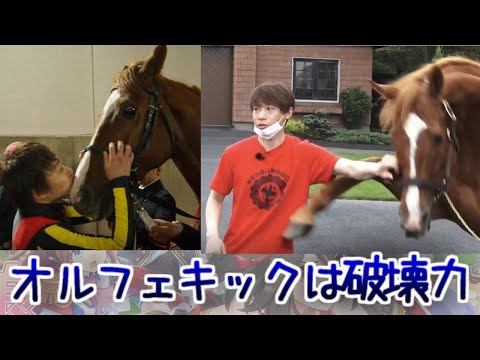
A viral video of Orfevre, Japan’s legendary triple crown racehorse, repeatedly kicking jockey Ikizoe Kenichi has sparked widespread debate about whether the behavior represents genuine aggression or playful communication. Through analysis of the horse’s ear position, kick velocity, and selective targeting, experts and fans suggest the kicks are actually a form of affectionate “tsundere” behavior—a psychological pattern more commonly associated with anime characters.
What Happened
A video compilation has circulated online showing Orfevre, one of Japan’s most celebrated racehorses, repeatedly kicking at jockey Ikizoe Kenichi both during their racing career and in retirement. The footage reveals a consistent pattern: the horse extends a single foreleg toward the jockey in what appears to be an aggressive gesture, yet the jockey consistently avoids the kicks with minimal effort. The behavior has become a defining characteristic of their relationship, occurring repeatedly across multiple encounters spanning years.
Why It Matters
The video challenges conventional assumptions about animal behavior and human-animal relationships. Rather than dismissing Orfevre as a dangerous or temperamental horse, the footage and accompanying expert commentary suggest that complex emotional expression exists in animals beyond simple aggression or submission. This reframes how we understand communication between humans and animals, and raises questions about personality, trust, and selective affection in non-human creatures. The phenomenon has resonated with audiences because it mirrors psychological patterns typically associated with fictional characters, suggesting that emotional complexity may be more universal across species than previously recognized.
Background
Orfevre won Japan’s Triple Crown in 2011, becoming one of the nation’s most celebrated racehorses. Known for his temperamental nature, he was ridden primarily by Ikizoe Kenichi, one of Japan’s most skilled jockeys, particularly renowned for his ability to handle difficult horses. Horses with strong personalities are classified in racing terminology as “癖馬” (kuseguma)—literally “horses with quirks.” Ikizoe has built his reputation on understanding and working effectively with such animals, including the notoriously aggressive Goldship, which was known to kick stones. Following his retirement, Orfevre has remained in regular contact with Ikizoe, and the kicking behavior has persisted, suggesting it is a fundamental aspect of their relationship rather than a stress response to racing.
Key Points
- Orfevre’s foreleg kicks are delivered at a speed and angle that allows Ikizoe to avoid them easily, suggesting they are not intended as serious attacks
- Analysis of the horse’s ear position—a key indicator of emotional state in horses—shows the ears are not pinned back in anger, but rather in a relaxed or playful position
- The behavior is selective: Orfevre displays this kicking pattern exclusively with Ikizoe and not with other handlers, indicating targeted, relationship-specific communication
- Inside the stable, Orfevre allows himself to be petted and handled gently, contrasting sharply with his “tsundere” (hot-and-cold) behavior in public settings
- The kicking pattern has remained consistent throughout retirement, occurring during regular visits years after the horse’s racing career ended
- Ikizoe has successfully raced multiple temperamentally difficult horses and achieved strong results, suggesting his ability to interpret and work with their behavior contributes to competitive success
Timeline
- 2011: Orfevre wins Japan’s Triple Crown under jockey Ikizoe Kenichi
- 2011-2013: Orfevre’s racing career continues; kicking behavior toward Ikizoe becomes a noted characteristic
- Post-retirement: Orfevre enters retirement but maintains regular contact with Ikizoe; kicking behavior persists during visits
- Recent: Video compilation of the kicking behavior circulates online, sparking widespread analysis and discussion
Perspectives
The Playful Affection Interpretation: Video commenters and racing enthusiasts argue that Orfevre’s behavior represents a form of playful communication or “tsundere” personality—a psychological pattern where an individual acts cold or aggressive on the surface while harboring genuine affection underneath. This interpretation is supported by the horse’s relaxed ear position, the avoidable speed of the kicks, and the fact that the behavior is exclusive to Ikizoe. Under this view, the kicking is comparable to a child playfully pestering a parent they trust deeply.
The Temperament and Habit Interpretation: Others suggest that while the kicks may not be genuinely dangerous, they reflect Orfevre’s naturally difficult temperament and have become habitual behavior in his interaction with Ikizoe. This perspective acknowledges that the horse has learned Ikizoe will tolerate and avoid the kicks, creating a repeated behavioral pattern that is neither purely aggressive nor purely affectionate, but rather a stable feature of their established dynamic.
The Safety Concern Perspective: Some commenters express concern that despite the apparent playfulness, the behavior carries genuine risk. They note that accidents can happen, and that Ikizoe’s physical toll from managing such a horse over many years should not be overlooked. This view emphasizes that even if the kicks are not intended as serious attacks, their unpredictability and repetition pose real hazards.
Insights
The Orfevre phenomenon reveals that emotional and behavioral complexity in animals may be far more nuanced than traditional frameworks allow. The widespread comparison of Orfevre’s behavior to “tsundere” anime characters—a pattern of selective affection and hot-and-cold emotional expression—suggests that humans recognize similar psychological patterns across species boundaries. This indicates that personality traits like selective trust, playful aggression, and relationship-specific behavior may be more universal in the animal kingdom than previously acknowledged.
The video also highlights the critical role of individual human expertise in understanding animal behavior. Ikizoe’s success with multiple temperamentally difficult horses suggests that what appears to be mere “quirk” or “temperament” in an animal may actually be sophisticated communication that requires specific knowledge and trust to interpret correctly. This reframes the concept of “difficult” animals: rather than being defective or dangerous, they may simply require handlers capable of reading their specific behavioral language.
Furthermore, the enduring nature of Orfevre’s behavior in retirement—years after competitive pressures have ended—suggests that the kicking pattern is not a stress response but rather a fundamental aspect of his personality and his relationship with Ikizoe. This challenges the assumption that problematic animal behavior is always situational and can be resolved through changed circumstances. Instead, it suggests that some animals, like some humans, maintain consistent personality traits and relationship patterns throughout their lives.
The broader cultural resonance of this story reflects a shift in how society values individuality and complexity. Where Orfevre might once have been dismissed as simply a “difficult horse,” he is now celebrated as a complex individual with distinctive personality traits. This mirrors broader cultural trends toward appreciating and valuing uniqueness rather than conformity, even in contexts far removed from entertainment or human society.