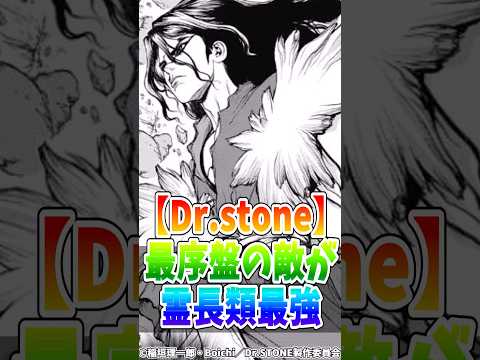
▶ Watch the original YouTube video
Why Senku’s Antagonist Shishio Is Considered the Perfect Villain in Dr. STONE
Shishio, the early antagonist in the anime Dr. STONE, has garnered widespread praise from viewers as one of anime’s most compelling villains—not because he is purely evil, but because he represents a fundamentally different worldview that challenges the protagonist’s ideals. An analysis of online reactions and character design reveals how Shishio transcends the typical “early-stage obstacle” archetype to become a philosophical counterpoint that defines the entire narrative.
What Happened
Shishio emerges early in Dr. STONE as the primary antagonist to protagonist Senku Ishigami. Rather than being a conventional villain motivated by personal revenge or madness, Shishio presents a coherent philosophical position: he believes the petrified world offers humanity a chance to reset civilization and eliminate the knowledge-based hierarchies and inequality that plague modern society. His conviction that a world rebuilt from scratch could be more equitable directly opposes Senku’s vision of using science to advance human progress.
Despite his early departure from the narrative, Shishio’s ideology continues to influence the story’s direction, spawning rival factions and forcing Senku to confront uncomfortable truths about the systems he seeks to rebuild. Online communities have extensively discussed Shishio’s character, with many viewers noting that his arguments possess a disturbing logical consistency that makes him difficult to dismiss as simply “wrong.”
Why It Matters
Shishio represents a significant evolution in antagonist design within contemporary anime. Rather than embodying absolute evil, he forces viewers to grapple with genuine moral ambiguity. The character demonstrates how effective storytelling can present competing ideologies without reducing either to caricature. This approach elevates Dr. STONE beyond a straightforward science-adventure narrative into philosophical territory, prompting audiences to question fundamental assumptions about civilization, progress, and justice.
The widespread positive reception of Shishio’s character also reflects broader trends in late 2010s anime production, where complex antagonists capable of articulating their worldviews have become increasingly valued. His success illustrates how a character’s thematic importance can outweigh screen time, with early-stage villains potentially leaving lasting impressions through ideological weight rather than narrative longevity.
Background
Dr. STONE, which premiered in summer 2019, follows humanity’s awakening after thousands of years of mysterious petrification. Senku, a brilliant young scientist, dedicates himself to rebuilding civilization through scientific advancement. Shishio, a physically powerful and intellectually formidable antagonist, opposes this vision on philosophical grounds. His character was designed by original creator Inagaki Riichiro and artist Boichi as a deliberate counterpoint rather than a conventional obstacle—a choice that aligns with industry trends toward morally complex villains seen in works like Re:Zero, Demon Slayer, and Attack on Titan.
Voice actor Suzuki Tatsuhisa’s performance proved instrumental in bringing Shishio to life, balancing cold determination with idealistic conviction. Suzuki’s experience portraying complex antagonists in other series—including Zeke Yeager in Attack on Titan and Geto Suguru in Jujutsu Kaisen—contributed significantly to the character’s resonance with audiences.
Key Points
- Philosophical Consistency: Shishio’s opposition to Senku stems from a coherent critique of knowledge-based hierarchies in modern society, making his position intellectually defensible rather than arbitrary.
- Moral Ambiguity: Unlike conventional villains, Shishio is not portrayed as evil but as someone with a fundamentally different value system, forcing viewers to question which ideology is genuinely superior.
- Lasting Narrative Impact: Despite his early exit, Shishio’s ideology shapes subsequent plot developments, rival factions, and Senku’s strategic decisions throughout the series.
- Voice Acting Excellence: Suzuki Tatsuhisa’s nuanced performance captures both Shishio’s ruthlessness and his genuine conviction, elevating the character’s complexity.
- Thematic Centrality: Shishio embodies the series’ core question—”What is civilization?”—transforming the narrative from a simple adventure into philosophical inquiry.
- Audience Engagement: Online discussions reveal that viewers find themselves sympathizing with Shishio’s critique of inequality, even while opposing his methods, demonstrating the character’s effectiveness in generating meaningful debate.
Character Analysis: Shishio in Context
Shishio’s character design invites comparison with other complex antagonists. Unlike Eren Yeager from Attack on Titan, who gradually becomes morally compromised as the narrative progresses, Shishio remains ideologically consistent from introduction to conclusion. His conviction in his worldview never wavers, distinguishing him from antagonists driven by personal vengeance or psychological instability.
Compared to Lelouch from Code Geass, who pursues personal revenge masked by grand rhetoric, Shishio genuinely believes in his cause. He seeks not individual power but systemic transformation. This distinction—between personal ambition and ideological commitment—makes Shishio simultaneously more sympathetic and more dangerous. His lack of supernatural abilities further grounds him in human reality, eliminating the distance that superhuman powers create between villain and audience.
The core conflict between Shishio and Senku transcends personal rivalry. Shishio argues that modern civilization inevitably produces inequality through knowledge concentration: those with scientific understanding dominate those without. His proposal to reset civilization and rebuild it more equitably contains logical force. Senku’s counterargument—that science itself can improve human welfare—contains an internal contradiction: scientific knowledge, like all knowledge, creates hierarchies. This unresolved tension defines the series’ philosophical depth.
Online Reception and Viewer Reactions
Analysis of social media discussions reveals consistent patterns in how audiences respond to Shishio. The most frequent observation is: “I understand Shishio’s argument, even though I disagree with his methods.” This reaction indicates successful character design—the antagonist has achieved the rare feat of making viewers intellectually comprehend his position while maintaining narrative opposition.
Viewers frequently note that Shishio’s continued influence on the narrative after his early departure distinguishes him from typical early-stage villains. His ideology spawns subsequent conflicts and shapes the world Senku must navigate, elevating him from mere obstacle to thematic anchor. Comments praising Suzuki Tatsuhisa’s vocal performance appear consistently, with viewers highlighting how the actor conveys both cold rationality and passionate conviction simultaneously.
Some criticism exists, with viewers arguing that Shishio’s position is inherently authoritarian or that Senku’s vision is clearly superior. The existence of this disagreement itself validates Shishio’s effectiveness—genuine philosophical opposition generates genuine debate among audiences, transforming passive viewing into active interpretation.
Thematic Significance
Shishio’s character embodies the series’ central inquiry into the nature of civilization. His critique of knowledge-based inequality reflects real-world concerns: educational disparities, economic stratification, and information asymmetries genuinely exist in contemporary society. By presenting these critiques through an antagonist, Dr. STONE avoids didacticism while maintaining intellectual seriousness.
The Shishio-Senku dichotomy mirrors real ideological conflicts: capitalism versus socialism, individualism versus collectivism, progress versus stability. Neither position is presented as obviously correct. Senku’s science-based advancement risks reproducing the hierarchies Shishio opposes. Shishio’s reset risks destroying accumulated human knowledge and capability. The series’ refusal to resolve this tension in favor of either protagonist represents sophisticated storytelling—real conflicts rarely admit simple solutions.
Narrative Implications and Future Developments
Shishio’s influence extends throughout the series’ progression. The emergence of rival factions and the formation of competing societies all trace back to ideological positions Shishio articulated. His younger brother’s subsequent role in the narrative reopens questions about whether Shishio’s critique was fundamentally flawed or merely his methods.
As Senku constructs his scientific civilization, he increasingly confronts the precise problem Shishio identified: knowledge concentration creates power imbalances. The series appears positioned to explore whether Senku can build a system that avoids the hierarchical reproduction Shishio warned against. A potential resolution might involve synthesis rather than victory—incorporating elements of both visions into a new social framework where Shishio functions as a philosophical catalyst rather than a defeated enemy.
Insights
Shishio’s reception demonstrates that contemporary audiences value antagonists who articulate coherent worldviews over those who embody pure malevolence. His character proves that early narrative departure need not diminish thematic importance—ideological weight can sustain influence across an entire series. The widespread viewer sympathy for Shishio’s critique, even among those who oppose his methods, indicates that audiences recognize legitimate problems in the systems protagonists seek to rebuild.
The character also illustrates how voice acting, character design, and thematic positioning combine to create memorable antagonists. Shishio succeeds not through shock value or supernatural threat, but through intellectual coherence and philosophical consistency. His humanity—the absence of superhuman abilities—paradoxically makes him more threatening because his arguments cannot be dismissed as the ravings of an inhuman force.
Ultimately, Shishio represents a maturation in antagonist design: the recognition that the most effective villains are those who force protagonists and audiences alike to question their foundational assumptions. By embodying a legitimate critique of knowledge-based inequality, Shishio transforms Dr. STONE from a celebration of scientific progress into a genuine philosophical inquiry into civilization’s nature and purpose.