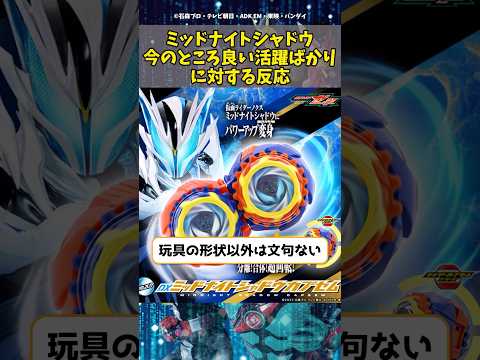
▶ Watch the original YouTube video
Why Midnight Shadow Deserves Its Acclaim: The Revolutionary Role of Secondary Riders in Kamen Rider ZZ
Midnight Shadow, the secondary rider form in Kamen Rider ZZ, has garnered unprecedented praise from fans and critics alike, challenging decades of convention about how secondary riders are portrayed in the franchise. Unlike traditional secondary riders relegated to supporting roles, Midnight Shadow operates as an independent warrior with exceptional combat opportunities and a remarkable boss-defeat rate that rivals the primary protagonist.
What Happened
Kamen Rider ZZ introduced Midnight Shadow as a secondary rider form that fundamentally breaks from the traditional archetype established across both Heisei and Reiwa eras of the franchise. Rather than serving as a supporting character or rival to the protagonist, Midnight Shadow operates with remarkable independence, appearing throughout the film with consistent screen time and participating in the defeat of the final boss as an equal partner rather than a subordinate ally. This departure from convention has resonated strongly with viewers, who consistently praise the form’s combat sequences, visual design, and narrative positioning.
Why It Matters
The treatment of Midnight Shadow signals a significant shift in how the Kamen Rider franchise conceptualizes secondary riders. For over two decades, secondary riders have typically been confined to specific narrative functions: serving as rivals to the protagonist, providing support during critical moments, or representing obstacles to the hero’s growth. Midnight Shadow’s success demonstrates that audiences are receptive to—and actively prefer—secondary riders who operate with greater autonomy and narrative weight. This evolution reflects broader changes in the Reiwa era of Kamen Rider, where traditional hierarchies between primary and secondary characters are being deliberately dismantled in favor of ensemble storytelling approaches.
Background
The Kamen Rider franchise has a long history of secondary rider characterization. In Kamen Rider 555, the secondary rider Kaiser remained subordinate to protagonist Takumi Kiba despite acquiring multiple forms. Kamen Rider Kiba’s secondary rider Wataru Kurenai similarly experienced diminishing screen time and narrative relevance as the series progressed—a pattern repeated across numerous Heisei-era productions. Even in Kamen Rider Ryuki, the secondary rider Knight (Ren Akiyama) participated in the final confrontation but maintained a clearly defined supporting role beneath the primary protagonist.
The Reiwa era has begun challenging this formula. Kamen Rider Saber introduced multiple protagonists operating with greater equality, while Kamen Rider Revice deconstructed the secondary rider concept entirely through its buddy system. Midnight Shadow represents the culmination of this trend: a secondary rider granted sufficient narrative independence and combat opportunities to achieve an exceptionally high boss-defeat rate while maintaining visual and thematic distinctiveness.
Key Points
- Midnight Shadow receives unprecedented treatment as a secondary rider form, with consistent film appearances and equal partnership status in defeating the final antagonist
- Viewer commentary consistently identifies Midnight Shadow as “the strongest secondary rider form” across both Heisei and Reiwa eras, indicating objective rather than subjective assessment
- Combat sequences maintain consistently high production quality, with visual design praised as exceptional and visually striking when positioned alongside other forms
- The secondary rider’s independent narrative positioning directly correlates with increased combat opportunities and an unusually high boss-defeat rate
- Ambiguous ability definitions—summarized as “darkness allows it”—paradoxically enhance rather than diminish viewer satisfaction by enabling creative interpretation
- Kamen Rider ZZ demonstrates a broader franchise trend toward ensemble storytelling, where multiple riders operate with greater autonomy rather than strict hierarchical coordination
Comparative Analysis: Secondary Rider Evolution
| Aspect | Kamen Rider Ryuki (Knight) | Kamen Rider ZZ (Midnight Shadow) |
|---|---|---|
| Narrative Position | Rival and antagonist to protagonist | Independent warrior operating in parallel |
| Story Integration | Obstacle to protagonist’s growth | Autonomous narrative arc |
| Combat Role | Primarily confronts protagonist | Engages diverse adversaries |
| Final Boss Participation | Participates but remains subordinate | Equal partner in defeat |
| Viewer Reception | Appreciated as rival character | Celebrated as strongest form with overwhelming support |
Perspectives
Viewer commentary reveals multiple layers of appreciation for Midnight Shadow’s design and execution. The assessment “the form is treated exceptionally well” reflects recognition that production decisions—from narrative positioning to visual effects—have been deliberately optimized. The observation that “this secondary rider’s boss-defeat rate is remarkable” highlights how narrative structure directly enables character prominence. Comments noting “the design is exceptional” and “it looks great alongside other forms” indicate that visual distinctiveness contributes meaningfully to the character’s reception.
The phrase “darkness allows it, but it actually works” captures viewer recognition that Midnight Shadow’s vague ability definitions, rather than representing narrative weakness, function as deliberate creative choice. This ambiguity permits flexible combat applications without requiring explicit explanation, allowing visual storytelling to supersede technical exposition. The comment “this secondary rider’s freedom of action feels fresh” suggests that viewers actively prefer autonomous secondary characters over rigidly defined support roles.
Notably, critical commentary is almost entirely absent. While most acclaimed characters attract some dissenting opinions, Midnight Shadow’s only substantive criticism concerns toy design constraints—a production limitation rather than narrative or character flaw. This near-universal approval suggests comprehensive success across design, narrative, and visual execution.
Insights
Midnight Shadow’s success reflects a fundamental shift in how contemporary audiences engage with secondary characters. The Heisei era established secondary riders as narrative tools serving specific functions within protagonist-centered stories. The Reiwa era, exemplified by Midnight Shadow, reconceptualizes secondary riders as autonomous narrative entities whose value derives from independent capability rather than supportive function.
This evolution carries significant implications. First, it demonstrates that audiences have moved beyond expecting hierarchical character structures and actively prefer ensemble approaches where multiple characters operate with genuine agency. Second, it suggests that narrative flexibility—allowing secondary characters to pursue independent objectives rather than serving predetermined roles—generates greater creative satisfaction for both creators and viewers. Third, it indicates that the franchise’s traditional formula, while effective for decades, had reached a point of diminishing returns that audiences recognized and desired to transcend.
The broader significance lies in how Midnight Shadow’s treatment may influence future secondary rider conceptualization. Rather than establishing a new rigid formula where all secondary riders must operate independently, the ideal outcome would be flexible positioning that responds to each series’ specific narrative requirements. Midnight Shadow succeeds precisely because its independence serves the story rather than contradicting it. The challenge for future productions will be maintaining this flexibility while avoiding the formalization of independence as a new constraint.
For long-term franchise health, Midnight Shadow’s reception suggests that audiences are prepared for more sophisticated secondary character treatment. This opens creative possibilities: secondary riders could function as antagonists, allies, independent operators, or hybrid roles depending on narrative needs. The key insight is that audiences respond positively to intentional design choices, whether those choices emphasize independence, rivalry, or support. Midnight Shadow succeeds because its independent positioning is clearly deliberate and narratively justified, not because independence is inherently superior to other approaches.