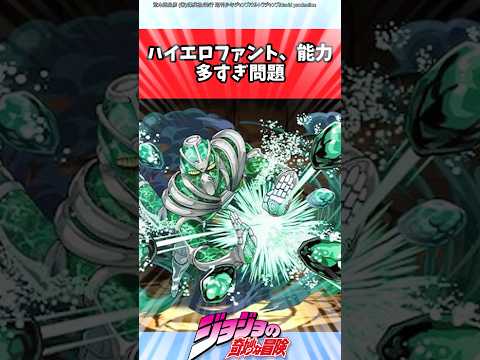
▶ Watch the original YouTube video
Why Hierophant Green Has Too Many Abilities: A 15-Year JoJo Fan’s Deep Analysis
Hierophant Green, Shigekiyo Yangu’s Stand from JoJo’s Bizarre Adventure Part 3, has long puzzled fans with its seemingly endless array of powers—from tentacle projection to parasitic possession to cellular division. This analysis explores whether the Stand’s bloated ability set represents a creative misstep or a fascinating window into the manga’s serialization process.
What Happened
Hierophant Green, the Stand ability wielded by Shigekiyo Yangu in JoJo’s Bizarre Adventure Part 3: Stardust Crusaders, exhibits a remarkably extensive arsenal of powers that has sparked ongoing debate within the fan community. The Stand’s abilities include tentacle projection and manipulation, parasitic possession of human hosts, cellular division and multiplication, nutrient absorption and regeneration, viscous fluid secretion for restraint, and shared visual perception across divided segments. This collection of seemingly disparate powers stands in stark contrast to other Stands in the series, which typically feature more cohesive and unified ability sets.
Why It Matters
Hierophant Green serves as a crucial case study in manga serialization and creative problem-solving under deadline pressure. The Stand’s evolution reflects broader patterns in 1980s shonen manga, where character abilities frequently expanded in response to narrative demands. Understanding why Hierophant Green accumulated so many powers illuminates the creative process behind one of manga’s most influential series and demonstrates how weekly serialization constraints shape storytelling decisions. For contemporary creators and fans, this analysis reveals the tension between narrative momentum and internal consistency in long-form serialized fiction.
Background
JoJo’s Bizarre Adventure began serialization in Weekly Shonen Jump in 1987, operating under the intense weekly publication schedule that defined the magazine’s editorial approach. Part 3, Stardust Crusaders, introduced the Stand system—spiritual manifestations of fighting power that would become the series’ defining mechanic. Shigekiyo Yangu, a minor antagonist, appeared relatively early in the narrative arc as a mid-tier threat rather than a major boss character. His Stand, Hierophant Green, initially presented as a straightforward tentacle-based ability, gradually accumulated additional powers as the battle sequence extended beyond initial expectations.
The 1980s shonen manga landscape featured several concurrent series—Dragon Ball, Saint Seiya, Fist of the North Star—that shared a common creative pattern: character abilities expanded systematically as stories progressed. This industry-wide trend reflected both the demands of weekly serialization and audience expectations for escalating stakes and power levels. Hierophant Green emerged from this specific historical and commercial context.
Key Points
- Documented Abilities: Hierophant Green possesses at least six distinct powers: tentacle projection and control, parasitic neural hijacking, cellular division, nutrient absorption, viscous secretion, and distributed sensory awareness—an unusually large arsenal compared to other Stands.
- Inconsistent Internal Logic: Unlike Stands such as The Hand (deletion and spatial manipulation) or King Crimson (time erasure and prediction), Hierophant Green’s abilities lack a unified conceptual framework, suggesting incremental addition rather than integrated design.
- Serialization Pressure Theory: The Stand’s ability expansion correlates with the extended duration of Shigekiyo’s battle sequence, suggesting abilities were introduced to maintain narrative tension and reader engagement rather than following a predetermined design.
- Character Development Parallel: The Stand’s power growth mirrors Shigekiyo’s own development within the narrative, potentially reflecting the protagonist’s increasing threat perception rather than inconsistent writing.
- Industry Context: The pattern of ability expansion was standard practice in 1980s shonen manga, indicating Hierophant Green represents a typical rather than anomalous creative approach for its era.
- Fan Reception: Online communities consistently raise questions about Hierophant Green’s ability set, with discussions appearing regularly on Twitter, Reddit, and YouTube, indicating sustained reader confusion about the Stand’s actual capabilities.
Timeline
- Initial Appearance: Shigekiyo introduces Hierophant Green as a tentacle-based Stand with basic projection and manipulation capabilities.
- Mid-Battle Escalation: Cellular division ability emerges during extended combat, expanding the Stand’s tactical options and threat level.
- Late-Stage Revelation: Parasitic possession and neural hijacking abilities surface as the battle reaches critical intensity, fundamentally altering the combat dynamic.
- Final Confrontation: Nutrient absorption and regeneration capabilities demonstrate themselves in the climactic phase, showcasing the Stand’s full power spectrum.
- Post-Series Analysis: Subsequent JoJo parts feature increasingly systematic and conceptually unified Stand designs, suggesting Hierophant Green represented an evolutionary stage in the author’s approach to ability design.
Perspectives
The Serialization Explanation: The most compelling interpretation frames Hierophant Green’s ability accumulation as a direct consequence of weekly manga production. When Shigekiyo’s battle extended beyond anticipated length, author Hirohiko Araki faced a creative challenge: maintain reader engagement without concluding the arc prematurely. Introducing new abilities served multiple functions simultaneously—raising the antagonist’s perceived threat level, creating new tactical problems for protagonists to solve, and generating reader surprise and speculation. This approach mirrors documented practices in other long-running serialized works, including Hunter x Hunter’s evolving Nen system.
The Character Growth Interpretation: An alternative reading suggests Hierophant Green’s expanding power set reflects Shigekiyo’s psychological and spiritual development. Rather than authorial inconsistency, the ability additions represent the Stand’s evolution in response to its user’s growing confidence and ambition. This perspective reframes the “problem” as intentional characterization, with the Stand’s apparent chaos mirroring the protagonist’s chaotic nature.
The Design Failure Perspective: Some analysts argue Hierophant Green represents a genuine creative misstep—that the Stand would have benefited from a more unified conceptual framework. Compared to later Stands with clearer thematic coherence, Hierophant Green appears scattered and unfocused. This view emphasizes that the Stand’s abilities lack the elegant interconnection present in superior designs.
The Historical Context View: Placing Hierophant Green within 1980s shonen manga conventions suggests the Stand represents standard rather than exceptional practice. Dragon Ball’s escalating power levels, Saint Seiya’s expanding techniques, and similar series all featured ability expansion tied to narrative progression. From this perspective, Hierophant Green exemplifies rather than deviates from its era’s creative norms.
Insights
Hierophant Green illuminates the fundamental tension between serialized storytelling and narrative coherence. Weekly publication schedules create immediate pressure to maintain reader engagement, often necessitating creative decisions that prioritize short-term narrative momentum over long-term internal consistency. The Stand’s accumulated abilities represent not failure but adaptation—a pragmatic response to real production constraints.
The Stand also demonstrates how creative evolution occurs through iteration rather than planning. Araki’s later works, particularly Part 5’s Golden Wind, feature substantially more systematized Stand designs, suggesting Hierophant Green occupied a developmental stage in the author’s conceptual approach. The “problem” of excessive abilities thus becomes evidence of artistic growth—a visible record of creative learning.
Furthermore, Hierophant Green’s reception among fans reveals how audiences interpret authorial intent. The Stand’s apparent chaos generates persistent discussion and analysis, creating engagement that a more straightforward design might not inspire. The very confusion surrounding its abilities has paradoxically made it memorable and analytically significant.
Finally, Hierophant Green exemplifies how constraints shape creativity. Rather than viewing serialization pressure as purely limiting, the Stand’s design demonstrates how external demands can drive creative problem-solving and unexpected artistic results. The Stand exists as it does not despite but because of the conditions that produced it.