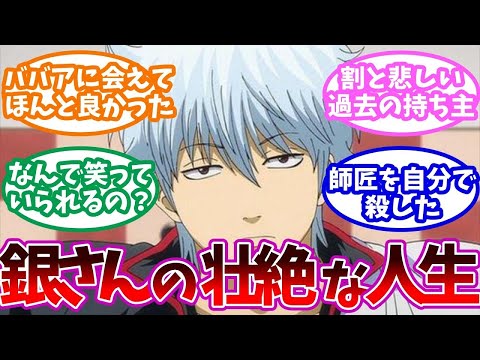
▶ Watch the original YouTube video
Gintoki Sakata from the anime Gintama is one of Jump’s most unconventional protagonists, masking a devastating past behind comedy and irreverence. After 15 years of fandom and analyzing over 300 anime titles, this deep dive explores the psychological mechanisms behind his humor, his traumatic experiences during the Joui War, and why his character represents a fundamental evolution in how anime portrays complex, damaged protagonists.
What Happened
Gintoki Sakata, the protagonist of Gintama, presents a striking contradiction: he appears as a lazy, joke-loving freelancer who skips rent payments and prioritizes sweets over responsibility. However, beneath this comedic exterior lies a profoundly tragic past. He is a former soldier who committed murders during the Joui War, lost his beloved teacher Yoshida Shoyo, and has attempted suicide. This article examines why Gintoki maintains his comedic facade despite carrying such psychological weight, and what this reveals about his character’s depth.
Why It Matters
Gintoki represents a watershed moment in anime protagonist design. Unlike Luffy’s forward-looking optimism or Naruto’s belief in bonds, Gintoki embodies a fundamentally different approach to trauma: he doesn’t overcome his past through determination or friendship alone—he escapes it through humor and deflection. Understanding Gintoki’s psychology offers insights into how modern anime portrays mental health, coping mechanisms, and the complexity of adult characters in what was traditionally a medium for youth. His character has influenced subsequent protagonists in series like Attack on Titan, Jujutsu Kaisen, and Chainsaw Man, making him a crucial figure in anime’s evolution.
Background
Gintama began serialization in 2004, predating the “adult protagonist” trend that would dominate anime from the 2010s onward. Gintoki is presented as a man in his late twenties, working as a freelancer in the Odd Jobs business rather than pursuing grand ambitions. His past is gradually revealed throughout the series: he served as a soldier under Yoshida Shoyo during the Joui War, killed numerous enemies, and witnessed his teacher’s death. These experiences left him psychologically fractured. The series explores how Gintoki copes with this trauma through comedy, his relationships with characters like Shinachou Otose (the landlady), and his complicated bonds with former comrades Takasugi Shinsuke and Sakamoto Tatsuma. The Future Arc (depicted in the film Gintama THE FINAL) presents a darker timeline where Gintoki confronts the ultimate consequences of his choices.
Key Points
- Gintoki’s comedy functions as a psychological defense mechanism — His humor represents a form of sublimation, converting trauma and fear of death into socially acceptable comedy rather than destructive behavior.
- Shinachou Otose (the landlady) serves as his salvation — Without her unconditional acceptance and support, Gintoki would have died long ago, making her presence essential to his continued existence.
- Teacher-related topics trigger his deepest trauma — References to Yoshida Shoyo’s death represent Gintoki’s greatest psychological trigger, stripping away his comedic defenses and exposing his vulnerability.
- Gintoki’s relationship with Takasugi represents a fork in the road — Both men share identical trauma and loss, but chose different paths: Gintoki toward passive escape, Takasugi toward active revolution, illustrating how the same past can produce radically different outcomes.
- Romance is psychologically impossible for him — Unlike other Jump protagonists, Gintoki’s status as a murderer, suicide survivor, and social outcast makes healthy romantic relationships fundamentally incompatible with his psychological state.
- The Future Arc represents his psychological endpoint — By choosing to erase his own existence through timeline alteration, Gintoki demonstrates the ultimate failure of his defense mechanisms and the limits of humor as a coping strategy.
Timeline
- 2004: Gintama serialization begins, introducing Gintoki as an unconventional protagonist ahead of the “adult protagonist” trend.
- 2008: Anime adaptation begins airing during the early era of late-night anime, establishing Gintoki as a counterpoint to contemporaries like Code Geass and Macross Frontier.
- Early series: Gintoki’s basic character traits are established; his comedic nature masks deeper complexity.
- Mid-series (Shogun Assassination Arc): Gintoki’s past is first seriously explored, revealing his trauma and the depth beneath his humor.
- Shinsengumi Rebellion Arc: Gintoki displays his most emotionally raw moments, demonstrating what truly matters to him.
- Future Arc (Gintama THE FINAL film): Gintoki confronts the ultimate consequences of his choices and opts for psychological erasure through timeline alteration.
Perspectives
The Defense Mechanism Interpretation: Gintoki’s comedy functions as a form of psychological sublimation—converting repressed emotions related to murder, death, and loss into humor. This parallels how other traumatized characters in anime (such as Eren from Attack on Titan) transform their pain into different outlets. However, unlike Eren who channels trauma into rage and action, Gintoki channels it into laughter and deflection, representing a more passive coping strategy.
The Salvation Through Connection Perspective: Gintoki’s survival depends entirely on his relationship with Shinachou Otose. Unlike protagonists such as Edward Elric from Fullmetal Alchemist, whose relationships are complicated by mutual culpability, Otose offers unconditional acceptance. This suggests that Gintoki’s continued existence is not a product of his own strength but of external grace—a fundamentally different narrative from typical Jump protagonists who overcome adversity through personal determination.
The Comparative Trauma Analysis: Gintoki, Takasugi, and Sakamoto represent three different responses to identical trauma. Gintoki responds defensively through humor, Takasugi responds aggressively through revolution, and Sakamoto responds hedonistically through freedom-seeking. This suggests that trauma itself does not determine outcome; rather, individual psychology and choice determine how trauma is processed and expressed.
The Impossibility of Redemption View: Some interpretations suggest that Gintoki’s choice to erase himself in the Future Arc represents not failure but acceptance. As a murderer and social outcast, perhaps genuine redemption is impossible, and erasure is the only honest resolution. This perspective challenges the typical Jump narrative of overcoming one’s past through effort and friendship.
Insights
Gintoki Sakata represents a fundamental evolution in how anime portrays protagonists. Rather than embodying the traditional Jump archetype—a young person with a tragic past who overcomes adversity through determination, friendship, and belief in the future—Gintoki is a broken adult who has given up on traditional success. His comedy is not mere entertainment but a survival mechanism, a way to continue existing when genuine healing seems impossible.
The genius of Gintoki’s character lies in this contradiction: he is simultaneously the least and most “human” protagonist in anime. He is least human in his willingness to abandon responsibility and indulge in frivolity. Yet he is most human in his psychological complexity, his inability to simply “move forward” like other protagonists, and his reliance on others for survival rather than on his own strength.
Gintoki’s influence on subsequent anime cannot be overstated. The “adult protagonist” trend that emerged in the 2010s and 2020s—seen in Attack on Titan’s Eren, Jujutsu Kaisen’s Yuji, and Chainsaw Man’s Denji—all owe a debt to Gintoki’s template. He proved that a protagonist need not be optimistic, goal-oriented, or morally uncomplicated to be compelling. Instead, complexity, contradiction, and psychological depth could drive narrative engagement.
However, Gintoki’s ultimate choice in the Future Arc—to erase himself rather than continue living—suggests a darker conclusion: that humor and external relationships, while necessary for survival, may ultimately be insufficient for genuine healing. The tragedy of Gintoki is not that he suffered trauma, but that he never found a way to truly move beyond it. His comedy was a bridge to continued existence, not a path to genuine recovery. This makes Gintama not merely a comedy-action series, but a profound meditation on the limits of human resilience and the question of whether some damage can ever truly be repaired.
Recommended Viewing Guide
For those new to Gintama, understanding Gintoki requires experiencing the contrast between comedy and tragedy. Key arcs include:
Benizakura Arc (Episodes 1-6): Establishes Gintoki’s fundamental character—his ability to act with sincerity while maintaining a comedic facade.
Shogun Assassination Arc (Episodes 1-9 of Season 2): First serious exploration of Gintoki’s past and the depth beneath his humor.
Shinsengumi Rebellion Arc (Episodes 1-7 of Season 3): Displays Gintoki’s most emotionally raw moments, revealing what truly matters to him.
Future Arc (Gintama THE FINAL film): Presents Gintoki’s psychological endpoint and the ultimate consequences of his choices.
The key to appreciating Gintama is reading the seriousness within the comedy. The series constantly juxtaposes jokes with genuine trauma, and this layering is essential to understanding Gintoki’s character. Related works such as Attack on Titan, Code Geass, and Fullmetal Alchemist offer useful comparisons for understanding how different protagonists process trauma and past trauma.
Fan Perspectives
Online communities have identified several key insights about Gintoki’s character. One frequently cited observation is that “Gintoki paying rent is unimaginable”—a comment that underscores his social death and lack of conventional ambition. Another widely shared sentiment is “Without the landlady, Gintoki would definitely have died somewhere,” emphasizing the salvific role of Shinachou Otose in his continued existence.
Fans have also noted that “teacher-related topics are genuinely a landmine,” recognizing that references to Yoshida Shoyo strip away Gintoki’s comedic defenses and expose his deepest wounds. Across social media, the observation that “Gintoki’s comedy is a defense mechanism” has gained traction, suggesting that the fanbase appreciates not just the humor but the psychological complexity underlying it.
These reactions demonstrate that Gintama’s audience engages with the series on a deeper level than surface-level comedy. Fans recognize Gintoki not as a simple comedic character but as a complex, damaged adult attempting to survive through humor—a portrayal that resonates with modern audiences seeking psychological realism in their entertainment.
Conclusion
Gintoki Sakata stands as one of anime’s most significant protagonists precisely because he defies the traditional Jump formula. He is not a young dreamer pursuing grand ambitions, but a broken adult seeking merely to survive the present moment. His comedy is not entertainment but therapy; his relationships are not bonds of mutual growth but lifelines to continued existence.
The tragedy of Gintoki is not that he suffered—many anime protagonists endure trauma. Rather, it is that despite possessing genuine connections with Shinachou Otose, Shinpachi, Kagura, and Sakamoto, he ultimately chooses erasure over continued existence. This suggests that some psychological wounds run too deep for even love and friendship to heal, a conclusion far darker than the typical anime narrative.
Yet this darkness is precisely what makes Gintama a masterpiece. By refusing to offer easy redemption or simple recovery, the series presents a more honest portrait of human complexity. Gintoki remains, 15 years after his introduction, anime’s most authentically human protagonist—flawed, broken, and struggling not toward triumph but merely toward the next day.