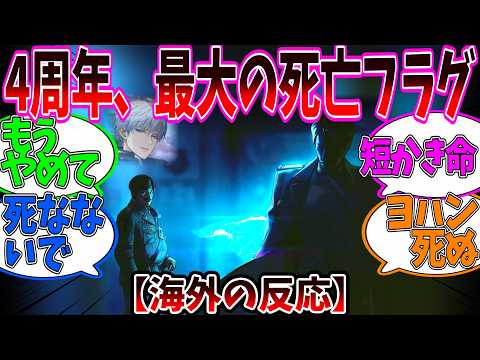
▶ Watch the original YouTube video
Why NIKKE’s “Anderson Cannot Escape” Story Arc Is a Masterclass in Psychological Game Design
Chapters 47 and 48 of the mobile game Goddess of Victory: NIKKE introduce a pivotal narrative moment titled “Anderson Cannot Escape,” which strips away player agency and forces characters into an inescapable situation. This story development has sparked widespread discussion in gaming communities for its sophisticated use of game mechanics as narrative tools.
What Happened
In chapters 47 and 48 of NIKKE, the narrative presents a scenario titled “Anderson Cannot Escape,” in which the character Anderson—previously portrayed as a tactical leader with decisive authority—becomes trapped in a situation with no viable options. The story unfolds across two consecutive chapters, deliberately extending the psychological pressure on players as they progress through the narrative. This development marks a significant turning point where Anderson’s established character traits and strategic capabilities become entirely ineffective.
Why It Matters
This narrative moment is significant because it demonstrates how game developers can weaponize the fundamental mechanics of interactive media to enhance emotional impact. Unlike traditional narrative media such as film or anime, games operate on the principle of player choice and agency. By explicitly removing these choices, NIKKE creates a unique form of psychological tension that would be impossible to achieve through passive media. The story development has resonated strongly with players because it subverts their core expectations about how games function, making the characters’ desperation feel immediate and inescapable rather than distant and observational.
Background
NIKKE is a tower defense mobile game that has gained recognition not only for its gameplay mechanics but also for its surprisingly complex narrative structure. Throughout the early chapters, Anderson has been established as a competent, commanding figure whose tactical decisions and emotional restraint drive much of the plot. The game’s story unfolds across numerous chapters, each building toward larger narrative arcs. By chapter 47, players have invested significant time understanding Anderson’s character, his motivations, and his role as a decision-maker within the story world. This investment makes the sudden removal of his agency—and by extension, the player’s agency—far more impactful than it would be for a newly introduced character.
Key Points
- Reversal of Character Position: Anderson transitions from a commanding, authoritative figure to someone completely trapped by circumstances, inverting player expectations about his role in the narrative.
- Elimination of Player Choice: The explicit title “Anderson Cannot Escape” removes the illusion of player agency that typically defines game experiences, creating psychological pressure through mechanical limitation.
- Testing Character Relationships: The extreme circumstances force other characters to confront their trust in and dependence on Anderson, fundamentally questioning established relationships.
- Narrative Point of No Return: The chapters signal that the story has entered an irreversible phase, with consequences that cannot be undone or circumvented through typical gameplay mechanics.
- Direct Emotional Transmission: The desperation and hopelessness of characters within the story are conveyed directly to players through the removal of their typical control mechanisms.
- Two-Chapter Structure: By extending the scenario across chapters 47 and 48, the developers deliberately prolong player anxiety, deepening the psychological impact beyond what a single chapter could achieve.
How This Compares to Other Games
The “choice elimination” narrative device has appeared in other acclaimed titles, but NIKKE’s execution differs in important ways. In Persona 5 (2017), players experience temporary system dysfunction that creates a sense of helplessness, but this is presented as an anomaly within the game’s normal rules. In Doki Doki Literature Club (2021), the game explicitly breaks its own mechanics to create meta-textual horror. NIKKE’s approach is more direct: it announces through its title that escape is impossible, then forces players to experience that impossibility as part of the narrative progression.
Unlike Attack on Titan, which depicts humanity’s inescapable struggle against titans but allows viewers to maintain emotional distance, NIKKE places players directly into the position of experiencing inescapability. The difference is fundamental: in passive media, audiences observe characters facing impossible situations; in NIKKE, players themselves face the impossibility.
Community Response
The release of chapters 47 and 48 generated substantial discussion across gaming platforms. On Twitter, players noted that the title alone conveyed a sense of despair, with comments emphasizing the psychological weight of having no options. Discussions on forums like 5channel focused on analytical questions: why the two-chapter structure, how Anderson’s psychological state evolves, and what the scenario reveals about the broader narrative arc.
YouTube comments frequently referenced the effectiveness of the “psychological manipulation,” with players noting that their emotional response to Anderson’s character had fundamentally shifted. Interestingly, while positive reactions dominated, some critical voices argued that the development felt inconsistent with Anderson’s established character. These critical responses may actually indicate the scenario’s success—strong emotional reactions, whether positive or negative, suggest the intended psychological impact was achieved.
Narrative Structure and Intent
The placement of this scenario at chapters 47-48 suggests deliberate structural planning. In classical three-act story structure, the second act typically concludes with protagonists facing their greatest challenge, setting up the third act’s confrontation. NIKKE appears to follow this pattern, with “Anderson Cannot Escape” functioning as the second-act climax. By positioning this moment at this specific point, the developers signal to players that the narrative is entering its final, most consequential phase.
The choice to focus on Anderson—a character previously defined by his ability to make decisions and maintain control—amplifies the thematic impact. His loss of agency becomes a loss of identity, mirroring the power dynamics shift seen in works like Game of Thrones, where powerful characters unexpectedly lose their advantage.
Insights
NIKKE’s chapters 47-48 represent a sophisticated understanding of how game mechanics and narrative can be unified to create emotional experiences impossible in other media. By removing player choice—the fundamental element that distinguishes games from passive storytelling—the developers create a unique form of tension. Players cannot simply observe Anderson’s predicament; they must experience the helplessness directly.
This approach demonstrates that game design excellence extends beyond mechanical systems to encompass how those systems interact with narrative. The scenario’s effectiveness lies not in the story itself, but in how the story weaponizes the player’s expectations about how games function. When players expect to have options and discover they do not, the psychological impact is immediate and visceral.
The broader implication is that future game narratives may increasingly exploit the unique properties of interactive media rather than simply adapting techniques from film and literature. NIKKE suggests a maturing industry that understands how to leverage player agency—and its removal—as a narrative tool. Whether subsequent chapters reveal Anderson’s escape as a possibility or confirm his fate as truly inescapable, the psychological groundwork has been laid. The scenario’s success indicates that players are ready for narratives that challenge their fundamental assumptions about how games work.