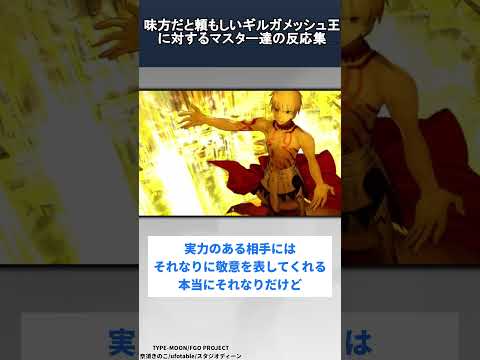
▶ Watch the original YouTube video
Why Players Trust Gilgamesh as an Ally in Fate/Grand Order: A Deep Dive into Game Psychology
A viral video compilation showcasing Fate/Grand Order players’ reactions to Gilgamesh as a playable ally has sparked widespread discussion about how the same character can inspire fear as an enemy and confidence as a teammate. This phenomenon reveals fundamental principles of game psychology and emotional investment in narrative-driven games.
What Happened
A video compilation has circulated among the FGO community featuring reactions from Masters (players) upon acquiring Gilgamesh as a playable Servant. The footage captures overwhelmingly positive responses, with players expressing relief and confidence at having the legendary king on their side. Comments consistently reference the sentiment “With the king here, we’ll be fine,” reflecting a shared psychological shift from fear to trust.
Why It Matters
This reaction pattern illustrates a critical principle in game design: how a character’s narrative role fundamentally shapes player perception and emotional response. The contrast between Gilgamesh as an antagonist in Fate/stay night and as an ally in FGO demonstrates that player trust is not solely determined by mechanical strength, but by psychological factors including familiarity, narrative context, and character consistency. Understanding this dynamic has implications for how developers design character arcs and player progression systems.
Background
Gilgamesh is one of the most iconic characters in the Fate franchise, originating from Fate/stay night where he serves as a formidable antagonist. In that narrative context, his overwhelming power and arrogant demeanor instilled fear in players. When Fate/Grand Order implemented him as a recruitable Servant, the same character traits that once inspired dread became sources of reassurance. This 180-degree shift in perception occurred without any fundamental change to the character himself—only his allegiance changed.
The phenomenon reflects what game psychologists term “enemy conversion,” where a previously antagonistic character gains immediate trust upon joining the player’s team. With Gilgamesh, this effect is particularly pronounced due to his established reputation for overwhelming power and his distinctive personality traits.
Key Points
- Players experienced a dramatic emotional reversal when Gilgamesh transitioned from enemy to ally, with fear transforming into confidence
- The character’s arrogance, which was threatening as an antagonist, becomes psychologically reassuring as an ally—players interpret it as unwavering certainty in victory
- Gilgamesh’s known strength from previous encounters creates immediate trust; players already understand his capabilities firsthand
- The FGO community has developed a collective understanding that “having the king” guarantees success in difficult content
- This psychological mechanism extends beyond mere mechanical advantage; it represents emotional satisfaction derived from narrative role reversal
- Similar patterns appear in other games like Persona 5 and Final Fantasy VII, but Gilgamesh’s effect is notably more pronounced
The Psychology of Enemy-to-Ally Conversion
The core mechanism at work here is what game psychologists call “enemy conversion.” When a player encounters a powerful antagonist, they develop a clear understanding of that character’s capabilities through direct conflict. This creates what researchers term “known strength.” When that same character becomes an ally, the player’s existing knowledge of their power immediately translates into trust.
For Gilgamesh specifically, his arrogance plays a crucial role in this conversion. His dismissive attitude toward opponents—expressed through lines like “All things are dust before my treasury”—functions as a psychological anchor. When directed at enemies, this arrogance is threatening. When directed at the player’s behalf, it becomes a source of confidence. The player unconsciously interprets the character’s unwavering self-belief as a guarantee of victory.
This differs from characters who gain player trust through vulnerability or shared secrets. Gilgamesh’s trust is built on demonstrated dominance and consistent personality. His refusal to acknowledge the possibility of defeat becomes, paradoxically, the source of player reassurance.
Comparative Analysis with Other Characters
Examining similar character arcs across gaming reveals that Gilgamesh’s effect is unusually powerful. In Persona 5, the character Akechi undergoes a dramatic conversion from antagonist to ally, and while this generates significant player satisfaction, it relies on emotional revelation and shared secrets. In Final Fantasy VII, Sephiroth’s transition is far more ambiguous and psychologically complex, generating less straightforward trust.
Gilgamesh’s advantage lies in the combination of three factors: his established overwhelming power, his consistent personality, and his refusal to soften or apologize for his nature. Players don’t need to forgive him or understand his pain—they simply need to redirect his existing confidence toward their objectives.
Community Response and Shared Understanding
Across social media platforms, FGO players have developed a consistent narrative around Gilgamesh. On Twitter, the phrase “王様がいれば大丈夫” (“With the king here, we’ll be fine”) has become a community meme and genuine expression of confidence. In forum discussions and Reddit threads, players consistently recommend Gilgamesh for difficult content, not merely because of his mechanical damage output, but because his presence provides psychological reassurance.
This collective understanding represents more than individual player preference—it reflects a shared emotional framework within the community. New players learn from veterans that Gilgamesh represents a form of security, and this cultural knowledge amplifies the psychological effect beyond what the character’s stats alone would suggest.
Design Intent and Industry Trends
The decision to implement Gilgamesh as a playable Servant appears strategically deliberate. FGO’s development team likely recognized that converting the franchise’s most iconic antagonist into a player resource would generate maximum emotional satisfaction. This strategy aligns with broader industry trends toward “enemy conversion” mechanics, where antagonists become allies to deepen player investment.
From a practical standpoint, Gilgamesh’s overwhelming damage output addresses the need for high-difficulty content solutions. But the psychological satisfaction extends far beyond mechanical necessity. The ability to command the character players once feared represents a form of narrative closure and emotional catharsis.
Practical Applications for Players
For FGO players seeking to maximize Gilgamesh’s effectiveness, several strategies emerge from his character design. His Noble Phantasm generates significant damage, and his NP gain mechanics allow for consecutive activations when properly supported. Optimal team compositions pair him with support Servants like Merlin, whose abilities amplify his damage output and enable rapid Noble Phantasm cycling.
Beyond mechanical optimization, players report that experiencing Gilgamesh’s character development throughout FGO’s main story deepens their emotional investment. His gradual opening to the protagonist and his moments of vulnerability, while maintaining his essential arrogance, create a complex character arc that sustains player interest across extended gameplay.
Future Narrative Possibilities
As FGO’s narrative continues to develop, questions remain about how Gilgamesh’s character will evolve. Three potential trajectories exist: his arrogance could remain a permanent character trait, serving as his psychological anchor; it could gradually soften through his relationship with the protagonist; or it could be recontextualized as the player gains deeper understanding of his motivations.
Each trajectory carries different implications for player psychology. Maintained arrogance would preserve the current reassurance mechanism. Softening arrogance might deepen emotional connection but risk reducing the psychological certainty players currently experience. Recontextualization could add narrative complexity while preserving the trust dynamic.
Insights
The Gilgamesh phenomenon demonstrates that player trust and confidence are not purely mechanical phenomena. A character’s narrative role, personality consistency, and established reputation create psychological frameworks that shape how players interpret their capabilities. The same attack that inspires terror when directed at the player becomes a source of hope when directed by the player.
This reveals a fundamental principle of game design: emotional investment follows narrative logic more than mechanical logic. Players don’t trust Gilgamesh primarily because his damage numbers are highest—they trust him because his character arc from antagonist to ally satisfies a deep narrative need. The psychological satisfaction of commanding a character you once feared represents one of gaming’s most powerful emotional experiences.
For developers, this suggests that character implementation strategies should prioritize narrative context and emotional resonance alongside mechanical balance. The most successful characters are those whose personality and history create psychological certainty independent of their statistical advantages.