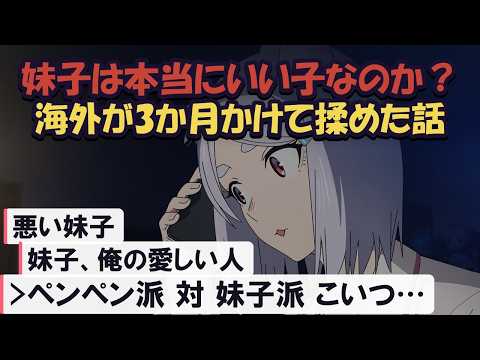
▶ Watch the original YouTube video
International anime fans have identified a troubling psychological pattern in the character Moko from “Yani Cat’s Little Sister Moko.” Through episodes 1-6, viewers have shifted from viewing her as an idealized younger sister to recognizing signs of codependency and a savior complex—revealing how perfectionism can mask deeper emotional dysfunction.
What Happened
A viral video analyzing international fan reactions to “Yani Cat’s Little Sister Moko” has sparked widespread discussion about the true nature of the protagonist’s younger sister. Initially praised as a responsible, well-adjusted character, Moko’s behavior has been reinterpreted by overseas audiences as potentially manipulative and self-serving. The shift in perception became particularly pronounced after episode 5, where fan communities on Reddit, Twitter, and YouTube began applying psychological frameworks—specifically the concept of “I’ll Fix Him” syndrome—to understand her actions.
Why It Matters
This analysis reflects a broader trend in modern anime criticism: moving beyond surface-level character appreciation toward psychological and sociological depth. The discussion matters because it demonstrates how viewers are increasingly applying real-world psychological concepts to fictional narratives, particularly around themes of addiction, codependency, and family dysfunction. For creators and audiences alike, this represents a maturation of anime discourse that mirrors the industry’s own shift toward addressing serious social issues rather than relying on convenient character archetypes.
Background
“Yani Cat’s Little Sister Moko” centers on a family dynamic where the older sister struggles with nicotine and alcohol dependency, while the younger sister appears to be the responsible caregiver. The series deliberately explores how addiction affects family relationships, positioning itself within a recent wave of anime that tackle genuine social problems. The work builds on a trend that began in the 2020s, where series like “The Quintessential Quintuplets” (2019) and “Oshi no Ko” (2023) abandoned the trope of one-dimensional “perfect” characters in favor of psychologically complex, flawed individuals.
Key Points
- International audiences initially perceived Moko as an idealized younger sister but shifted their interpretation after episode 5, viewing her as potentially self-centered and dependent on her role as caregiver.
- Fan communities applied the psychological concept of “I’ll Fix Him” syndrome—a real-world phenomenon where individuals seek to fix or control others to maintain their own sense of purpose and value.
- Moko demonstrates a pattern of perfectionism in social settings while maintaining a savior role at home, suggesting she derives her identity from being needed rather than from genuine self-actualization.
- The character’s rejection of a “too serious” romantic interest in episode 5 is interpreted as evidence that she unconsciously seeks partners she can “fix,” mirroring her relationship with her sister.
- Episode 6 reveals contradictions in Moko’s identity: she prioritizes human friendships while simultaneously being a cat, suggesting deeper confusion about her core values and authenticity.
- International fans drew parallels to “Breaking Bad,” noting that both works explore how individuals justify self-serving behavior through noble-sounding rationales.
Timeline
- Episodes 1-3: Overwhelmingly positive reception of Moko as a responsible, caring younger sister. Social media filled with praise using hashtags like #YaniBigSisterSmallSister.
- Episode 4: First subtle signs of critical reinterpretation emerge as viewers begin questioning Moko’s motivations.
- Episode 5: Critical turning point. The rejection scene sparks widespread psychological analysis. Reddit’s r/anime community launches major discussion thread titled “Actually, Imoko might be the problem here,” accumulating thousands of comments.
- Episode 6: Identity contradictions become apparent, further fueling debate about Moko’s authenticity and psychological health.
- Post-Episode 6: International fan communities increasingly reference psychological terminology and real-world experiences, with comments like “This is literally my sister” and “My family is exactly like this” becoming common.
Perspectives
The Psychological Interpretation: International fans argue that Moko exhibits classic signs of codependency and savior complex. Her perfectionism—excellent grades, abstinence from substances, dedicated caregiving—functions as a defense mechanism that allows her to avoid confronting her own psychological needs. By maintaining the role of rescuer, she ensures her own relevance and avoids the vulnerability of genuine human connection. This interpretation suggests that Moko’s “perfection” is actually a symptom of dysfunction, not evidence of health.
The Generational Cycle Theory: Some analysts predict that Moko will eventually develop the same dependencies as her sister, following what psychologists call “intergenerational transmission of trauma.” Rather than breaking the cycle, her current coping mechanisms—perfectionism and caretaking—may simply delay her own crisis until the support structure collapses.
The Narrative Intent Perspective: The series appears deliberately constructed to challenge viewers’ initial assumptions. The creators seem aware that audiences would initially celebrate Moko as a moral counterpoint to her sister, only to gradually reveal that both characters are trapped in the same dysfunctional system, albeit in different ways.
Comparative Analysis
The work stands apart from similar narratives in its unflinching examination of family codependency:
| Series | Central Theme | Supporting Character Role | Dependency Portrayal |
|---|---|---|---|
| Monogatari Series | Supernatural phenomena and psychology | Supports the protagonist | Surface-level, fantastical |
| Saekano: How to Raise a Boring Girlfriend | Creative collaboration and relationships | Depends on protagonist | Romantic and emotional |
| Yani Cat’s Little Sister Moko | Addiction and family dysfunction | Views sister as a project to fix | Psychological and sociological |
Insights
The international response to “Yani Cat’s Little Sister Moko” reveals several important truths about contemporary anime criticism and audience psychology. First, viewers have developed sophisticated frameworks for analyzing character motivation, moving beyond simple moral judgments to examine unconscious psychological patterns. Second, the series demonstrates that perfectionism and responsibility—traditionally coded as virtuous—can mask profound dysfunction when they serve as identity anchors rather than genuine values. Third, the work’s resonance with international audiences suggests that family addiction and codependency are universal human experiences that transcend cultural boundaries.
The shift in fan perception from episodes 1-3 to episodes 5-6 illustrates how narrative complexity can gradually destabilize viewer assumptions. Rather than presenting Moko as either wholly good or wholly bad, the series invites audiences to recognize that both sisters are victims of the same system, responding to it in different ways. This nuance reflects the anime industry’s broader maturation toward psychological realism.
Looking forward, the central question remains unresolved: Will the series offer Moko a path toward genuine self-awareness and recovery, or will it depict the tragic continuation of intergenerational dysfunction? The answer will determine whether the work functions as a cautionary tale or as a more hopeful exploration of breaking destructive family patterns. Regardless, the international fan response demonstrates that audiences are ready for anime that treats serious psychological themes with the complexity they deserve.