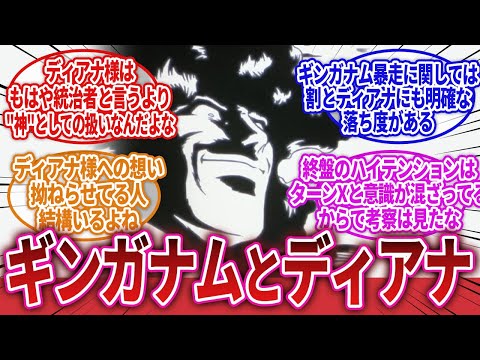
▶ Watch the original YouTube video
Why Gim Ginganam and Diana Sorel Remain Beloved: A Deep Analysis of ∀ Gundam’s Most Complex Relationship
The relationship between Gim Ginganam and Diana Sorel in ∀ Gundam represents one of anime’s most nuanced explorations of loyalty, ideology, and human conflict. Over a decade after its initial broadcast, this character pairing continues to gain recognition for its philosophical depth and emotional complexity, influencing how modern anime portrays antagonistic relationships.
What Happened
∀ Gundam, directed by Yoshiyuki Tomino, presents a unique dynamic between two central figures: Gim Ginganam, a devoted military commander from the Moon, and Diana Sorel, the Moon’s ruling authority. Rather than a straightforward hero-versus-villain narrative, the series explores their relationship as one defined by conflicting ideologies, mutual respect, and tragic inevitability. Ginganam remains loyal to Diana while simultaneously questioning her idealistic approach to governance, creating a tension that drives much of the series’ philosophical inquiry.
Why It Matters
The Ginganam-Diana relationship has become increasingly relevant as modern anime shifts toward depicting complex, morally ambiguous character dynamics. Works like Attack on Titan, Demon Slayer, and Jujutsu Kaisen now employ similar narrative strategies that reject simplistic enemy classifications. ∀ Gundam pioneered this approach within the Gundam franchise, establishing a template for portraying antagonists as fully realized human beings rather than one-dimensional obstacles. This evolution reflects broader changes in how storytelling addresses power structures, organizational loyalty, and individual agency within hierarchical systems.
Background
∀ Gundam aired in 1999 and initially received mixed reception, with many viewers struggling to understand its philosophical complexity and unconventional narrative structure. The series is set in a distant future where humanity has regressed technologically, and two factions—one from Earth and one from the Moon—clash over planetary dominion. Diana Sorel leads the Moon’s forces with idealistic goals of peaceful unification, while Ginganam serves as her military commander, implementing more pragmatic and aggressive strategies. Their relationship encapsulates the central tension of the series: the conflict between idealism and pragmatism, between unified vision and individual judgment.
Key Points
- Dual Nature of Loyalty: Ginganam embodies a paradox—he maintains absolute loyalty to Diana while simultaneously pursuing independent judgment and questioning her policies, creating genuine internal conflict rather than simple obedience.
- Idealism vs. Pragmatism: Diana represents idealistic peace-building, while Ginganam advocates for realistic military solutions. Neither perspective is presented as entirely correct, forcing viewers to grapple with moral relativism.
- Organizational Psychology: Their dynamic mirrors real-world hierarchical relationships where subordinates respect authority figures while disagreeing with their decisions—a universally relatable tension.
- Mutual Interdependence: Diana requires Ginganam’s military capability to achieve her goals, while Ginganam seeks validation through Diana’s ideals, creating a complex co-dependent relationship.
- Irreversible Tragedy: The series concludes with their relationship reaching a tragic breaking point, emphasizing the inevitability of their conflict and the impossibility of reconciliation.
- Contemporary Reappraisal: Social media platforms including Twitter, Reddit, and YouTube have driven significant reevaluation of the series, with viewers recognizing its philosophical sophistication and emotional depth.
Character Comparison with Other Gundam Antagonists
| Series | Antagonist Characteristics | Relationship to Authority | Psychological Complexity |
|---|---|---|---|
| Mobile Suit Gundam (Char Aznable) |
Ideologically-driven opponent | Serves Degwin Zeon but pursues independent agenda | Moderate—ideology and ambition conflict, but relatively clear motivations |
| Mobile Suit Z Gundam (Paptimus Scirocco) |
Charismatic dictator | Independent leader of Titans faction | High—complex ambition and tactical thinking interweave |
| ∀ Gundam (Gim Ginganam) |
Subordinate with conflicting convictions | Absolutely serves Diana while making independent decisions | Exceptionally high—respect and doubt, loyalty and resistance coexist simultaneously |
Perspectives
The Idealist’s View: Diana Sorel’s perspective emphasizes peaceful coexistence and the possibility of unified governance. Her idealism, while sometimes impractical, represents a moral vision that transcends immediate military advantage. She seeks legitimacy through consent rather than conquest.
The Pragmatist’s View: Ginganam’s approach prioritizes the Moon’s survival and security through decisive military action. From his standpoint, the Moon’s limited resources and isolated position necessitate aggressive expansion. His logic is internally consistent within his worldview, even if it conflicts with Diana’s principles.
The Relativist Interpretation: The series deliberately avoids positioning either character as objectively correct. Both operate rationally within their respective frameworks. This moral ambiguity challenges viewers to recognize that antagonists are not inherently wrong—they simply operate from different premises and priorities.
Online Fan Perspective: Social media discussions reveal that viewers increasingly appreciate the relationship’s nuance. Comments on YouTube and Twitter frequently note that adult viewers, reflecting on their own organizational experiences, find Ginganam’s internal conflict deeply resonant. The “inconsistency” some critics cite is actually the authentic representation of human contradiction.
Why This Relationship Endures
Universal Organizational Tension: Ginganam’s experience—respecting authority while questioning its judgment—mirrors situations most adults encounter in workplaces, educational institutions, and social hierarchies. This psychological authenticity creates lasting emotional investment.
Idealism-Reality Gap: The conflict between Diana’s aspirational vision and Ginganam’s ground-level realism reflects a fundamental human dilemma. Few works present this tension with such philosophical rigor and emotional honesty.
Identity Within Systems: Ginganam cannot abandon his individuality despite organizational pressure, nor can he fully reject his loyalty. This irresolvable tension mirrors contemporary discussions about personal authenticity within institutional constraints.
Irreversible Consequences: Unlike many anime that resolve conflicts through redemption or compromise, ∀ Gundam presents their relationship as fundamentally tragic. This irreversibility creates lasting emotional impact and prevents easy dismissal.
Broader Industry Influence
∀ Gundam’s approach to character relationships preceded the contemporary anime industry standard by nearly two decades. The series established that antagonists need not be villains, that organizational hierarchies create genuine psychological conflict, and that moral ambiguity enriches narrative depth. Modern acclaimed series like Attack on Titan (with its exploration of Eren and Reiner’s conflicted relationship) and Jujutsu Kaisen (with its nuanced treatment of cursed spirits and sorcerers) employ similar frameworks. This suggests that ∀ Gundam was not merely ahead of its time—it was foundational to how contemporary anime conceptualizes character conflict.
Online Reception and Current Evaluation
Twitter discussions frequently highlight Ginganam’s psychological complexity, with users noting that his coexistence of loyalty and doubt represents authentic human experience. Reddit threads in anime communities increasingly position ∀ Gundam among Tomino’s masterworks, with particular emphasis on how the series influenced subsequent Gundam character design philosophy.
5channel (Japan’s largest imageboard) Gundam threads contain analysis suggesting that Ginganam’s characterization established templates for later complex antagonists. YouTube comment sections reveal a pattern: viewers who initially found the series confusing report profound appreciation upon rewatching as adults, indicating that the work’s depth increases with life experience.
Critical perspectives do exist. Some viewers argue that Ginganam’s actions lack consistency or that his relationship with Diana remains ambiguous. However, this perceived ambiguity may represent the work’s greatest strength—the refusal to resolve genuine human contradiction into neat narrative resolution.
Insights
The enduring appeal of Ginganam and Diana’s relationship reveals fundamental truths about how audiences engage with complex narratives. First, viewers increasingly reject simplistic moral binaries in favor of psychologically authentic conflict. Second, organizational psychology—the tension between individual agency and institutional loyalty—resonates across cultural boundaries and generational cohorts. Third, works that embrace philosophical ambiguity rather than resolving it gain appreciation over time as audiences mature and encounter real-world situations that mirror the narrative’s tensions.
∀ Gundam’s achievement lies not in providing answers but in asking questions that remain perpetually relevant: How do we maintain individual integrity within hierarchical systems? Can loyalty coexist with disagreement? Is pragmatism morally defensible when idealism fails? These questions transcend anime fandom and speak to fundamental human experience.
The relationship between Ginganam and Diana demonstrates that character complexity emerges not from plot mechanics but from psychological authenticity. Their tragic arc resonates because it reflects genuine human experience—the impossibility of perfect loyalty, the burden of individual judgment within organizational constraints, and the tragic consequences of irreconcilable worldviews. As anime continues evolving toward greater narrative sophistication, ∀ Gundam’s pioneering approach to antagonist characterization becomes increasingly recognized as foundational to contemporary storytelling standards.