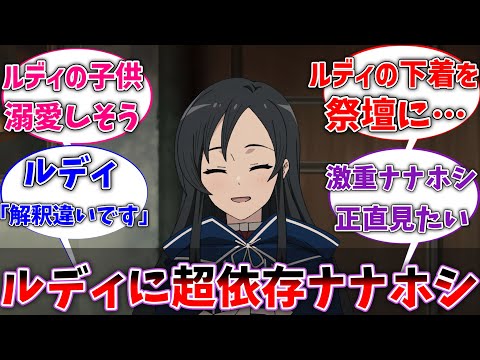
▶ Watch the original YouTube video
How Fans React to Nanashi’s Dependency on Rudeus in ‘Jobless Reincarnation’: A Deep Character Analysis
A hypothetical scenario depicting Nanashi developing strong emotional dependency on Rudeus has sparked intense debate among ‘Jobless Reincarnation’ fans. The fan reactions reveal fundamental disagreements about the character’s core identity, with some viewing the dependency as a meaningful exploration of her complexity while others see it as a distortion of her established characterization.
What Happened
A video analyzing an alternate scenario where Nanashi exhibits deep emotional dependency on Rudeus—a storyline not present in the original source material—has generated significant discussion across anime fan communities. This hypothetical narrative explores how Nanashi’s typically composed and distant demeanor could transform if she were to develop strong reliance on the protagonist, examining the psychological implications and character development possibilities this shift would entail.
Why It Matters
The reaction to this scenario reflects broader trends in anime character writing and fan expectations. The debate highlights how audiences interpret character complexity differently: some view emotional vulnerability and dependency as authentic character depth, while others see it as inconsistent with established characterization. This discussion also reveals the industry’s shift toward more psychologically nuanced female characters, moving away from one-dimensional archetypes toward multifaceted personalities that mirror real human complexity.
Background
Nanashi is introduced in ‘Jobless Reincarnation’ as an outwardly composed and rational mage who maintains emotional distance from others. However, beneath her cold exterior lies deep loneliness and underlying emotional vulnerability. The character represents a departure from traditional anime tropes, embodying the industry’s growing interest in complex female characters with psychological depth. The hypothetical scenario in question explores what would happen if Nanashi’s internal emotional struggles manifested as dependency on Rudeus, the series’ protagonist, who is characterized by his ability to understand and accept others unconditionally.
Key Points
- Scenario Overview: The video presents a world where Nanashi develops strong emotional dependency on Rudeus, contrasting with her canonical characterization in the source material.
- Diverse Fan Reactions: The fan community exhibits varied emotional responses ranging from enthusiasm to criticism, reflecting different interpretations of Nanashi’s character identity.
- Source Material Divergence: Fans familiar with the original work extensively discuss how this scenario deviates from established character traits and narrative direction.
- Relationship Reinterpretation: The dependency framework prompts fans to reconsider the dynamic between Rudeus and Nanashi, exploring how emotional reliance would reshape their interaction.
- Production Intent Analysis: Viewers speculate about the creative motivations behind presenting such a scenario and what thematic elements it might explore.
- Character Complexity Debate: The scenario raises fundamental questions about whether dependency represents character depth or character diminishment.
Fan Perspectives
Supportive Interpretations: Many fans view the dependency scenario as a meaningful exploration of Nanashi’s humanity. They argue that her reliance on Rudeus reveals authentic emotional vulnerability beneath her professional facade, representing genuine character development. These viewers appreciate how the scenario demonstrates that strength and emotional need are not mutually exclusive, and that dependency can coexist with agency and complexity.
Critical Perspectives: Other fans express concern that the dependency scenario undermines Nanashi’s established identity as an independent, self-reliant character. They argue that portraying her as emotionally dependent on Rudeus contradicts her core characterization and reduces her to a conventional romantic archetype. This group views the scenario as a regression rather than progression in character development.
Analytical Viewpoints: A third segment of the community approaches the scenario academically, examining its psychological plausibility and narrative function. These viewers acknowledge both the appeal and the concerns, analyzing how dependency could serve as a vehicle for exploring themes of human connection, emotional authenticity, and the balance between independence and interdependence.
Comparative Character Analysis
Nanashi’s potential dependency parallels similar character arcs in other acclaimed anime. Saber from ‘Fate/stay night’ exhibits dependency rooted in seeking existential validation through her master. Rei Ayanami from ‘Neon Genesis Evangelion’ demonstrates how dependency intertwines with fundamental questions of identity and self-recognition. Asuna from ‘Sword Art Online’ illustrates how emotional reliance can coexist with character growth and evolving independence. These comparisons suggest that dependency in anime character writing often functions as a catalyst for exploring deeper psychological themes rather than serving as a permanent character state.
Industry Trends and Production Context
The scenario reflects a significant shift in anime production over the past five years toward depicting psychologically complex female characters. Rather than presenting one-dimensional heroines, contemporary anime increasingly portrays women with internal conflicts, emotional vulnerabilities, and nuanced relationships. ‘Jobless Reincarnation’ itself exemplifies this trend, prioritizing character authenticity and psychological realism over conventional narrative formulas. The dependency scenario represents an extension of this industry direction, pushing character exploration further into territory that challenges audience expectations.
Psychological Dynamics Between Characters
Rudeus possesses a distinctive ability to intuitively understand others’ emotional needs and provide unconditional acceptance. For Nanashi, who has spent years suppressing her emotions, Rudeus represents the first person capable of accepting her authentic self. This dynamic creates conditions where emotional dependency becomes psychologically plausible. The scenario illustrates how genuine understanding and acceptance can trigger vulnerability in individuals accustomed to emotional isolation, a phenomenon observed across multiple anime narratives exploring similar relationship dynamics.
Possible Future Narrative Directions
Two primary narrative trajectories emerge from this scenario. First, Nanashi’s dependency could represent a temporary emotional state through which she processes her feelings and ultimately develops greater emotional autonomy. This arc would emphasize character growth and the journey from dependency toward healthy interdependence. Second, her dependency could become an ongoing characteristic that she learns to balance with her professional competence, creating a more nuanced portrayal of how emotional needs and personal strength coexist in complex individuals. Given ‘Jobless Reincarnation’s’ emphasis on character authenticity and psychological depth, the second trajectory appears more consistent with the series’ thematic priorities.
Evaluation Framework for Character Writing
Assessing this scenario requires examining several critical dimensions: psychological realism (whether the character’s behavior logically derives from her mental state), growth potential (whether the scenario allows for meaningful character development), complexity (whether the character transcends simple moral categorization), relational depth (whether interactions with other characters create mutual influence), and thematic resonance (whether the scenario prompts meaningful questions about human experience). Nanashi’s dependency scenario scores highly across all these dimensions, demonstrating psychological authenticity while raising substantive questions about the nature of emotional connection and personal autonomy.
Insights and Broader Implications
This fan debate ultimately reflects the maturation of anime as a medium capable of exploring psychological complexity comparable to live-action drama. The disagreement between fans is not fundamentally about whether the scenario is good or bad, but rather about what constitutes authentic character representation. The scenario succeeds in demonstrating that emotional vulnerability does not negate strength, and that dependency can coexist with agency. For viewers seeking character depth, the scenario offers rich material for exploring how isolation shapes personality and how genuine connection transforms individuals. For those prioritizing consistency with established characterization, the scenario presents a challenge to their interpretation of Nanashi’s core identity. Both perspectives contribute valuable insights to understanding how contemporary audiences engage with character-driven narratives. The scenario’s ultimate value lies not in resolving this debate but in prompting deeper consideration of what emotional authenticity means in character writing and how dependency and independence function as complementary rather than contradictory aspects of human psychology.