▶ Watch the original YouTube video
Bungee Gum, Hisoka’s signature ability from Hunter x Hunter, is far more than a simple offensive tool. Through 15 years of anime research and comparative analysis with other major series, this deep dive reveals why the ability functions as one of the most versatile and strategically dominant powers in one-on-one combat.
- What Happened
- Why It Matters
- Background
- Key Points
- Mechanical Analysis
- The User-Ability Synergy
- Comparative Analysis
- Online Reception and Interpretation
- Design Philosophy and Industry Influence
- Recommended Viewing Sequence for Understanding Bungee Gum
- Limitations and Matchup Weaknesses
- Insights and Broader Implications
What Happened
A comprehensive analysis of Bungee Gum’s mechanics and applications has emerged from extended study of Hunter x Hunter, revealing that the ability’s true strength lies not in raw power, but in its multifaceted design and the exceptional technical skill of its user, Hisoka. The ability, initially perceived as a simple gum-based attack, demonstrates sophisticated combat integration across offense, defense, mobility, restraint, and trap-setting functions.
Why It Matters
Understanding Bungee Gum’s design principles offers insight into modern anime ability systems and how versatility often outweighs raw power in competitive combat scenarios. The ability represents a design philosophy that has influenced subsequent major series like Jujutsu Kaisen and My Hero Academia, making it a foundational case study in how multifunctional powers create strategic dominance. For anime enthusiasts and narrative designers, this analysis demonstrates why “broken” abilities often depend equally on user skill and ability mechanics.
Background
Bungee Gum is Hisoka’s Nen ability, classified as a Transmutation-type power that allows him to create and manipulate elastic, adhesive gum. First introduced in the Hunter Examination arc, the ability initially appears limited to offensive applications. However, across subsequent story arcs—particularly Greed Island and the Chimera Ant arc—Hisoka demonstrates increasingly sophisticated applications that transform Bungee Gum from a simple attack tool into a comprehensive combat system. The ability’s true potential emerges through Hisoka’s magician background and high-level combat technique, creating a synergy between user skill and ability mechanics.
Key Points
- Multifunctional Design: Bungee Gum integrates attack, defense, speed enhancement, restraint, and trap-setting capabilities within a single ability—a rarity among Nen powers that typically specialize in one function.
- Structural Combat Advantage: Once the gum adheres to an opponent, the victim’s combat options are severely restricted, creating an immediate strategic disadvantage that often determines battle outcome.
- Efficiency and Versatility: The ability’s simplicity enables diverse applications and low Aura consumption, allowing sustained use throughout extended combat scenarios.
- User-Dependent Strength: Bungee Gum’s true power emerges from the combination of the ability itself and Hisoka’s exceptional combat technique, deceptive magician skills, and strategic thinking.
- Matchup Vulnerability: Despite its versatility, Bungee Gum shows weakness against certain ability types and combat styles, particularly absolute powers like time manipulation.
- Design Philosophy Precedent: Bungee Gum exemplifies the multifunctional ability design trend that later dominated series like Jujutsu Kaisen and My Hero Academia, suggesting Hunter x Hunter’s influence on modern anime power systems.
Mechanical Analysis
Integration of Combat Functions
Bungee Gum’s primary strength lies in its unified approach to multiple combat requirements. Traditional Nen abilities typically excel in single functions—pure offense, pure defense, or pure utility. Bungee Gum achieves all three simultaneously. The ability functions as an offensive tool through direct impact strikes, a defensive mechanism through impact absorption and barrier creation, a mobility enhancer through elastic propulsion, a restraint system through adhesive binding, and a tactical tool through trap placement. This integration means Hisoka never requires secondary abilities to address combat gaps, maintaining constant offensive and defensive capability.
Adhesion as Strategic Dominance
The moment Bungee Gum adheres to an opponent represents a critical strategic inflection point. Once attached, the opponent loses freedom of movement, must account for the gum’s restraining force during attacks and defenses, and faces escalating disadvantage as Hisoka maintains control. This mechanic parallels status-effect systems in competitive games, where a single debilitating condition can shift battle momentum irreversibly. The adhesion creates a cascading disadvantage: restricted movement leads to compromised offense and defense, which leads to increased vulnerability, which leads to further gum application.
Simplicity Enabling Efficiency
Bungee Gum’s straightforward mechanism—elastic, adhesive gum—paradoxically enables greater versatility than more complex abilities. Complex Nen powers often require specific activation conditions, lengthy casting times, or substantial Aura expenditure, limiting their practical applications. Bungee Gum’s simplicity allows rapid deployment, multiple simultaneous applications, and minimal resource consumption. This efficiency proves decisive in protracted combat, where sustained ability usage determines victory.
The User-Ability Synergy
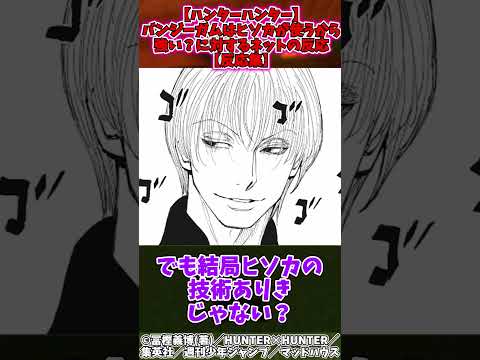
Critical to understanding Bungee Gum’s dominance is recognizing that the ability’s strength is inseparable from Hisoka’s exceptional combat technique. Hisoka’s background as a magician provides deceptive capabilities—misdirection, unexpected attack angles, and psychological manipulation—that amplify Bungee Gum’s effectiveness. A less skilled user would find Bungee Gum considerably less powerful, as the ability’s true potential emerges through high-level application. This creates the paradox observed in online discussions: Bungee Gum is simultaneously described as “broken” and “dependent on the user,” both assessments being accurate. The ability is broken when wielded by someone with Hisoka’s technical mastery, but would be merely competent in less skilled hands.
Comparative Analysis
| Series | Ability | Offensive Power | Defensive Capability | Versatility | One-on-One Combat Suitability |
|---|---|---|---|---|---|
| Hunter x Hunter | Bungee Gum | ★★★ | ★★★★ | ★★★★★ | ★★★★★ |
| Hunter x Hunter | Explosion Bomb | ★★★★★ | ★★ | ★★ | ★★★ |
| Jujutsu Kaisen | Domain Expansion | ★★★★ | ★★★★ | ★★★ | ★★★★ |
| Demon Slayer | Breathing Techniques | ★★★★ | ★★★ | ★★★ | ★★★★ |
This comparison reveals Bungee Gum’s strategic positioning: while inferior in raw offensive output to abilities like Explosion Bomb, it achieves overwhelming superiority in versatility and one-on-one combat applicability. The ability sacrifices peak damage for consistent, adaptable effectiveness—a trade-off that proves superior in actual combat scenarios.
Online Reception and Interpretation
Internet discussions surrounding Bungee Gum reveal nuanced understanding of its mechanics. Comments describing the ability as “broken” reflect recognition of its structural combat advantages—particularly the “one touch and you’re in trouble” dynamic. Simultaneously, observations that “it really depends on Hisoka’s skill” demonstrate audience awareness that ability power and user technique form an inseparable unit. The comment “Hisoka probably wouldn’t enjoy winning that way” indicates viewers considering character personality alongside mechanical analysis, recognizing that Hisoka’s preference for challenging combat influences how he deploys his ability. These varied perspectives collectively demonstrate sophisticated engagement with the series’ power system.
Design Philosophy and Industry Influence
Analysis of Jump magazine series from the past five years reveals a clear trend toward multifunctional ability design. Jujutsu Kaisen’s Domain Expansion, My Hero Academia’s Quirks, and other contemporary powers increasingly integrate multiple combat functions rather than specializing in single applications. Bungee Gum, introduced during Hunter x Hunter’s serialization in the early 2000s, appears to have pioneered this design philosophy. Mangaka Yoshihiro Togashi demonstrated early understanding that versatile, multifunctional abilities create more compelling and strategically interesting combat than specialized single-function powers. This design principle has become industry standard, suggesting Bungee Gum’s influence on modern anime power system architecture.
Recommended Viewing Sequence for Understanding Bungee Gum
Stage One: Foundational Mechanics (Hunter Examination and Heavens Arena Arcs)
Initial exposure to Bungee Gum focuses on basic application: gum projection as direct attack. These early arcs establish the ability’s fundamental mechanics without revealing its deeper potential. Viewers should observe how Hisoka deploys the ability in straightforward combat scenarios.
Stage Two: Applied Versatility (Greed Island Arc)
The Greed Island arc demonstrates expanded applications, particularly the scene where Hisoka uses Bungee Gum for self-support while falling. This moment reveals the ability’s defensive and mobility functions, shifting perception from “attack tool” to “comprehensive combat system.” Viewers should recognize Bungee Gum’s multifunctional nature during this arc.
Stage Three: Mastery and Limitations (Chimera Ant Arc)
The Chimera Ant arc showcases Bungee Gum at its highest level of application against top-tier opponents. This arc simultaneously demonstrates the ability’s peak effectiveness and its limitations against certain ability types and combat styles. Viewers gain complete understanding of both Bungee Gum’s strengths and vulnerabilities.
Limitations and Matchup Weaknesses
Despite its versatility, Bungee Gum exhibits notable weaknesses. Absolute abilities—such as time manipulation, reality warping, or instant-death powers—render Bungee Gum’s tactical advantages irrelevant. Opponents with extreme speed or teleportation capabilities can bypass the adhesion mechanic entirely. Additionally, abilities that neutralize or destroy organic matter would compromise Bungee Gum’s physical structure. The ability’s effectiveness also diminishes against opponents with superior raw power who can break adhesion through brute force. These limitations prevent Bungee Gum from being universally dominant, instead positioning it as exceptionally strong within specific matchup contexts.
Insights and Broader Implications
Bungee Gum represents a fundamental principle in combat system design: versatility and strategic positioning often prove superior to raw power. The ability’s true dominance emerges not from overwhelming offensive capability, but from forcing opponents into disadvantageous situations where their options are systematically eliminated. This principle extends beyond anime to game design, military strategy, and competitive sports—systems where controlling opponent choices often determines outcomes more decisively than direct power comparison.
The synergy between Bungee Gum and Hisoka demonstrates that ability strength cannot be evaluated in isolation from user capability. The same ability wielded by different users produces vastly different results. This insight challenges simplistic power-ranking systems that evaluate abilities without considering user skill, experience, and strategic thinking.
Bungee Gum’s influence on subsequent anime power systems suggests that Togashi’s design philosophy—favoring versatile, multifunctional abilities over specialized single-function powers—represents the industry’s evolved understanding of compelling combat mechanics. Modern series have adopted this principle, indicating Bungee Gum’s lasting impact on anime narrative design.
As Hunter x Hunter’s serialization continues, future Hisoka battles will provide additional data regarding Bungee Gum’s true limitations and matchup dynamics. These encounters will ultimately determine whether Bungee Gum maintains its position as one of anime’s most strategically sophisticated abilities or whether specific matchups reveal previously unknown vulnerabilities. Until that point, Bungee Gum remains a masterclass in ability design—simple in concept, profound in application, and inseparable from the exceptional skill of its user.