▶ Watch the original YouTube video
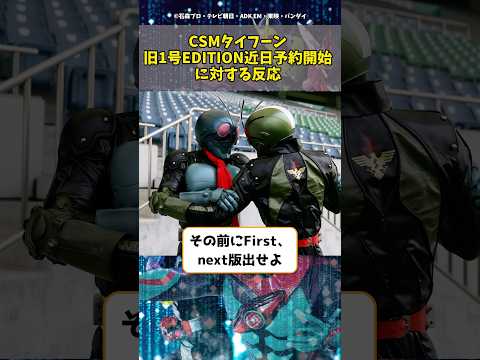
Bandai’s announcement of the CSM (Complete Selection Modification) Kamen Rider Typhoon 915 Edition pre-orders has triggered mixed reactions from longtime fans, revealing deeper concerns about the company’s product development priorities, incomplete product lines, and the growing disconnect between fan expectations and corporate strategy.
What Happened
Bandai announced the start of pre-orders for the CSM Kamen Rider Typhoon 915 Edition, a new variant of the transformation belt from the original Kamen Rider series. While the announcement initially appears to be positive news for collectors, fan reactions on social media reveal significant frustration with Bandai’s broader toy manufacturing and release strategy.
Why It Matters
This announcement exposes structural issues in how major toy manufacturers prioritize product development. The Kamen Rider franchise, now over 50 years old, commands a dedicated fanbase with sophisticated expectations about product completeness and historical accuracy. Fan dissatisfaction with Bandai’s approach—releasing new variants before completing foundational products—reflects a broader industry challenge: balancing profitability with consumer trust and long-term brand loyalty.
Background
The CSM line represents Bandai’s premium offering for adult collectors, featuring highly detailed replicas of transformation devices from the Kamen Rider series. The original Kamen Rider 1 debuted in 1971 and remains iconic within the franchise. The Typhoon 915 Edition represents a specific variant, but its release has raised questions about why foundational versions—such as the First/Next Edition—have not yet been released despite being announced or implied in development.
Bandai manages multiple major intellectual properties simultaneously, including Kamen Rider, Pretty Cure, and Ultraman. This resource allocation challenge has reportedly led to delays and incomplete product lines, with some announced items remaining unreleased for extended periods.
Key Points
- Incomplete Narrative Representation: The Typhoon 915 Edition requires the Cyclone motorcycle (Cyclone-go) for complete in-show accuracy, yet no coordinated release plan has been announced.
- Priority Concerns: Fans question why the First/Next Edition—the foundational version—has not been released before variant editions.
- Delayed Product Lines: Multiple announced products including Kaiser Gear 2.0 and Faiz Blaster remain unreleased, creating frustration about project management.
- Strategic Purchasing Behavior: Fans are adopting wait-and-see strategies, delaying purchases until after the 25th anniversary event concludes, suggesting they anticipate a major marketing shift.
- Production Rate vs. Completion Rate: Analysis shows that as Bandai increases the number of announced products annually, the percentage of completed and released items has declined from 87% (2018-2019) to 58% (2022-2023).
- Fan Sophistication: Collectors now analyze corporate strategy and predict release timelines, indicating a shift from passive consumers to informed market observers.
Timeline
- 2010s Early Period: CSM series launches with planned, methodical product releases and high completion rates.
- 2018-2019: 8 products announced; 87% completion rate; high fan satisfaction.
- 2020-2021: 12 products announced; 72% completion rate; moderate fan satisfaction begins declining.
- 2022-2023: 15 products announced; 58% completion rate; significant fan dissatisfaction emerges.
- Present: Typhoon 915 Edition pre-orders announced amid ongoing delays on previously announced products.
Perspectives
Enthusiast Collectors: Some fans express genuine excitement about the Typhoon 915 Edition, viewing it as a long-awaited product that demonstrates Bandai’s continued commitment to the original Kamen Rider 1 line. These collectors prioritize the quality of individual products and trust Bandai’s manufacturing standards.
Completionists and Series Purists: A significant faction of fans emphasizes the importance of releasing products in logical order—foundational versions before variants. They argue that Bandai should complete announced product lines before introducing new ones. This group values narrative coherence and historical accuracy in product releases.
Strategic Consumers: An increasingly visible segment of fans analyzes Bandai’s corporate strategy and makes calculated purchasing decisions. These fans predict that major releases will occur after the 25th anniversary event and deliberately postpone purchases to optimize timing and value. This represents a shift toward treating toy collecting as a strategic financial decision rather than an impulse purchase.
Fatigued Collectors: Some fans report “purchase fatigue,” having already acquired multiple Typhoon-related products and lacking motivation to purchase additional variants. This suggests that Bandai’s high-volume release strategy may be counterproductive, overwhelming rather than engaging the target audience.
Insights
The Typhoon 915 Edition announcement reveals a fundamental misalignment between Bandai’s product strategy and fan expectations. Over the past five years, Bandai has shifted from a quality-focused, methodically planned approach to a volume-focused strategy that prioritizes generating ongoing buzz and conversation. This strategy may drive short-term sales and media attention, but it appears to be eroding long-term consumer trust.
The data is telling: as the number of announced products has increased 87% (from 8 to 15 annually), the completion rate has dropped 33 percentage points. This inverse relationship suggests that Bandai is announcing products faster than it can manufacture and deliver them, creating a backlog of unfulfilled promises.
Fan behavior has evolved in response. Rather than purchasing immediately upon announcement, sophisticated collectors now wait for official release confirmations, price stabilization, and coordinated product availability. This represents a loss of the “impulse purchase” dynamic that benefits retailers and manufacturers.
The Kamen Rider franchise’s 50+ year history creates unique expectations. Fans possess deep knowledge of source material, including production variations, color inconsistencies across episodes, and the historical significance of different versions. Bandai’s manufacturing approach—based on “official” color specifications—cannot fully capture these nuances, yet fans continue to expect it. This gap between expectation and reality fuels disappointment.
The emergence of fans as “quasi-professional” analysts of corporate strategy is particularly significant. When consumers begin predicting and strategizing around a company’s behavior rather than responding to product announcements, it indicates a shift in the relationship dynamic. Trust has been replaced by calculation.
For Bandai to restore confidence, the company would need to demonstrate commitment to completing announced product lines, establishing clear release roadmaps, and prioritizing foundational products over variants. The 25th anniversary event represents a potential inflection point—if Bandai uses this milestone to reset its product strategy and deliver on backlogged commitments, fan sentiment could recover significantly.