▶ Watch the original YouTube video
Why Bertholdt Is Underrated in Attack on Titan: A 15-Year Analysis of Character Perception
Despite possessing elite combat abilities and strategic importance, Bertholdt Hoover remains one of the least appreciated characters in Attack on Titan. This analysis explores how narrative structure, character dynamics, and deliberate storytelling choices have created a perception gap between his actual competence and fan recognition.
What Happened
Throughout Attack on Titan, Bertholdt Hoover operates as a covert warrior alongside Reiner Braun within the 104th Training Corps. While objectively skilled—capable of fighting Mikasa to a standstill in human form—Bertholdt receives consistently lower fan appreciation than his peers. This disparity stems not from lack of ability, but from how the narrative frames his relationships and presence within the story.
Why It Matters
Understanding Bertholdt’s underestimation reveals fundamental principles about character perception in ensemble narratives. In large-scale stories like Attack on Titan, viewer recognition depends less on objective capability than on interpersonal depth and visible presence. This pattern appears across multiple anime and manga, affecting how audiences evaluate supporting characters. Recognizing this dynamic helps viewers appreciate nuanced character work that might otherwise go unnoticed.
Background
Bertholdt and Reiner infiltrate the Survey Corps as part of Marley’s military strategy. During their three years in the training program, they live alongside Eren and other recruits. However, while Reiner actively builds relationships—positioning himself as a mentor figure—Bertholdt maintains deliberate distance. This choice reflects his role as an observer and monitor, but creates the unintended consequence of making him forgettable to viewers who primarily experience the story through Eren’s perspective.
The original manga’s author, Hajime Isayama, has stated in interviews that he wished to develop Eren and Reiner’s relationship more extensively during the training period. This creative intent shaped how the narrative prioritized certain character interactions over others, inadvertently marginalizing Bertholdt’s presence.
Key Points
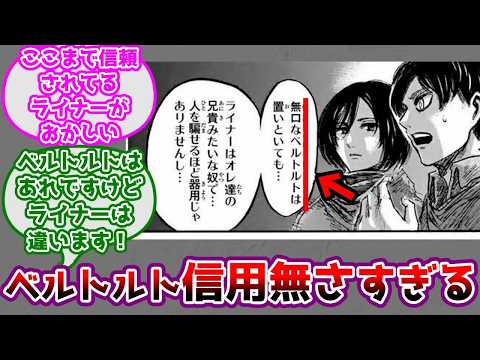
- Relationship Asymmetry: While Reiner is perceived as a trustworthy “big brother” figure to Eren, Bertholdt remains “that guy we don’t really know,” despite equal time spent together during training.
- The Silence Strategy: Bertholdt’s quiet demeanor reflects proper spy tradecraft—avoiding deep emotional bonds that could compromise the mission—but this correctness paradoxically reduces his narrative presence.
- Combat Ability vs. Recognition: Bertholdt possesses elite-level combat skills comparable to Mikasa, yet receives minimal acknowledgment for this capability within the story.
- The Colossal Titan Burden: Inheriting the Colossal Titan may impose psychological constraints that undermine Bertholdt’s confidence in his own judgment, affecting how he presents himself.
- Structural Narrative Choice: The production team deliberately limited Bertholdt’s character development to maintain story balance and preserve Reiner’s prominence as a key figure.
- Final Words Interpretation: Bertholdt’s dying plea “Help everyone” may reflect his persistent sense of camaraderie with all 104th recruits, not merely Armin, suggesting deeper emotional complexity than typically recognized.
Character Comparison Framework
| Character | Relationship Dynamic | Viewer Perception | Fan Rating |
|---|---|---|---|
| Reiner | Mentor/”Big Brother” to Eren | Trustworthy and dependable | High |
| Bertholdt | Monitor/Observer of Reiner | Unclear and distant | Low |
| Annie | Combat instructor to recruits | Memorable and distinctive | Moderate |
Narrative Structure and Character Perception
Analysis of similar characters across anime reveals a consistent pattern: character evaluation depends primarily on interpersonal interaction depth rather than objective competence. Comparing Bertholdt to Alphonse Elric from Fullmetal Alchemist illustrates this principle. Alphonse also operates in a secondary role to a more prominent character, yet viewers more readily accept his position because his relationship to Edward—one of dependency and familial bond—is explicitly clear and emotionally resonant.
Bertholdt’s relationship to Reiner lacks this clarity. Rather than emotional support, Bertholdt functions as a mission monitor—a role viewers struggle to recognize or appreciate. This fundamental misunderstanding of his purpose creates the perception of irrelevance.
The Colossal Titan Hypothesis
A significant factor in Bertholdt’s psychological profile may be the burden of the Colossal Titan itself. The destructive power of this form operates at a scale beyond individual control, potentially undermining the user’s confidence in personal judgment. Bertholdt’s characteristic indecision and self-doubt may stem not from weakness, but from the psychological weight of wielding such overwhelming force. This pattern repeats with Armin, who later inherits the same power and exhibits similar internal conflict.
Perspectives
The Production Perspective: The creative team faced a structural challenge: developing Bertholdt’s character too extensively would diminish Reiner’s prominence and disrupt narrative balance. By maintaining Bertholdt’s low profile, the story preserved the intended hierarchy of character importance.
The Spy Perspective: From an operational standpoint, Bertholdt behaves correctly. A covert operative should avoid forming deep bonds that could compromise the mission. His restraint reflects professional discipline, not indifference.
The Viewer Perspective: Audiences experience the story largely through Eren’s eyes. Since Eren forms no meaningful memories with Bertholdt, viewers inherit this same sense of disconnection, making the character feel peripheral.
The Character Perspective: Bertholdt’s final words suggest he maintained genuine camaraderie with his fellow recruits despite his operational distance. His plea for help implies he never fully accepted the role of detached spy, creating internal conflict between duty and human connection.
Fan Reception and Online Discussion
YouTube comments and social media reveal three dominant interpretations. First, many viewers note that Reiner feels like a trusted older brother while Bertholdt remains incomprehensible—a direct result of Reiner’s active relationship-building versus Bertholdt’s deliberate restraint. Second, some fans express sympathy for Bertholdt’s treatment, recognizing the injustice of dismissing someone based on limited interaction despite three years of shared experience. Third, analytical viewers understand that Bertholdt’s low evaluation stems from narrative structure rather than character flaw, demonstrating sophisticated understanding of storytelling mechanics.
The nickname “Bert-something” that circulates online ironically encapsulates his core problem: even his name fails to register clearly in viewer memory, symbolizing his broader struggle for recognition.
Insights
Bertholdt’s underestimation represents a structural tragedy rather than a character flaw. He executed his role as a spy with technical correctness—maintaining distance, avoiding emotional entanglement, prioritizing the mission. Yet this very correctness ensured his invisibility. The narrative’s focus on Eren’s perspective meant that Bertholdt’s competence, loyalty, and internal struggle remained largely invisible to audiences.
His final moment—crying out “Help everyone” while recognizing Eren—reveals the core of his character: a person caught between duty and humanity, who maintained genuine connection to his comrades despite operational necessity. This complexity deserves recognition equal to more prominent characters.
For viewers seeking deeper appreciation of Attack on Titan, examining what Bertholdt doesn’t do proves more revealing than what he does. His silence, his distance, and his restraint constitute his actual character arc—a quiet tragedy of a skilled operative whose very competence rendered him forgettable. Understanding this distinction transforms Bertholdt from a minor character into a carefully constructed exploration of the costs of deception and the human need for connection.