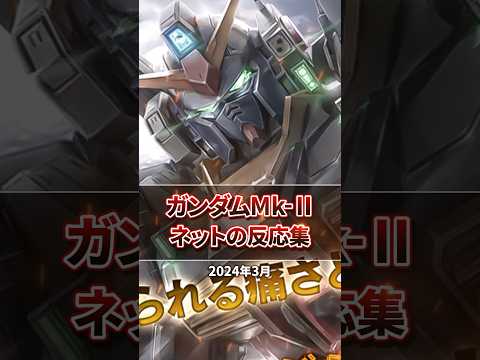
▶ Watch the original YouTube video
The Gundam Mk-II has become the benchmark mobile suit in Battle Operation 2, praised by both newcomers and veteran players for its exceptional versatility and balanced design. Drawing on 15 years of Gundam gaming experience and extensive community research, this analysis explores why this machine continues to define the game’s meta and represents an ideal model of game design.
What Happened
The Gundam Mk-II has emerged as one of the most consistently praised mobile suits in Battle Operation 2 since its implementation. Community feedback across Twitter, YouTube, Reddit, and 2channel forums reveals overwhelmingly positive reception, with players at all skill levels recommending it as both a beginner-friendly starter machine and a viable choice for competitive play. Unlike many other mobile suits that experience fluctuating popularity with balance patches, the Mk-II has maintained stable, high regard throughout the game’s lifecycle.
Why It Matters
The Mk-II’s sustained popularity offers valuable insights into successful game design principles. In an online multiplayer game constantly introducing new units, the ability of a single machine to remain relevant and beloved reveals something fundamental about balancing accessibility with depth. The Mk-II demonstrates that a well-designed “middle ground” unit can actually outperform specialized machines when the game’s core systems reward versatility and team coordination over individual specialization. This has implications for how developers approach balance in live-service games.
Background
Battle Operation 2 launched in 2018 as a free-to-play team-based mobile suit combat game. The author began playing in 2019, approximately three years after launch, bringing with them over a decade of experience from other Gundam games including Mobile Suit Gundam VS., Gundam Online, and Gundam Breaker 3. The Mk-II’s position in Battle Operation 2 stands in stark contrast to its historical treatment in previous Gundam games, where it was typically classified as a mid-tier unit. In Battle Operation 2, it has achieved the highest community evaluation across all Gundam game titles.
Key Points
- Exceptional Versatility: The Mk-II supports multiple weapon configurations (beam rifle, beam saber, grenade launcher, shield) enabling adaptation to various combat ranges and team compositions
- Skill-Level Agnostic Design: The machine performs effectively for beginners learning fundamental mechanics while remaining viable for advanced players optimizing performance
- Game System Alignment: Battle Operation 2’s emphasis on team coordination and flexible roles perfectly suits the Mk-II’s balanced, multi-purpose design philosophy
- Consistent Community Consensus: Unlike other units that generate debate, the Mk-II receives almost universal praise with virtually no negative community sentiment
- Balance Anchor Point: Evidence suggests the Mk-II functions as the game’s baseline reference unit for balance adjustments, remaining stable even as new machines are introduced
- Source Fidelity: The machine’s game implementation perfectly reflects its role in the original Gundam narrative as a reliable, unspecialized support unit
Comparative Analysis Across Gundam Games
The Mk-II’s evaluation varies significantly across different Gundam game titles, revealing how game design philosophy shapes unit perception:
Mobile Suit Gundam VS. (2006): Positioned as a mid-tier unit with balanced stats but overshadowed by specialized machines. Rating: ★★★
Gundam Online (2010): Recommended for beginners due to high versatility, but evaluation limited to “beginner-friendly” category. Rating: ★★★★
Gundam Breaker 3 (2019): Valued for superior customization parts, appealing to players focused on loadout optimization. Rating: ★★★★
Battle Operation 2 (2018–present): Recognized as the highest-tier unit by both casual and professional players, with evaluation transcending skill-level categories. Rating: ★★★★★
This progression demonstrates that the Mk-II’s exceptional standing in Battle Operation 2 stems not merely from superior statistics, but from optimal alignment with the game’s core design systems emphasizing team-based warfare and role flexibility.
Design Philosophy and Community Perception
The Mk-II’s weapon loadout reflects deliberate design architecture addressing all essential combat requirements: mid-range firepower (beam rifle), close-quarters burst damage (beam saber), area denial (grenade launcher), and defensive capability (shield). This comprehensive toolkit enables players to respond dynamically to evolving battlefield conditions without requiring machine swaps.
Community analysis reveals that the Mk-II’s appeal transcends pure performance metrics. Players frequently express preference for “using the Mk-II” rather than “using a strong machine,” indicating emotional investment beyond mechanical optimization. This attachment likely stems from the machine’s narrative positioning in the original Gundam series as a dependable, unspectacular support unit—a characterization perfectly mirrored in its game implementation.
The absence of meaningful criticism in community discourse is particularly notable. Searches across social media platforms yield virtually no complaints about the Mk-II being underpowered or ineffective. This consensus stands in contrast to typical online gaming communities, where balance discussions invariably generate disagreement. The uniformity of positive sentiment suggests the machine has achieved a design equilibrium rarely accomplished in competitive games.
Broader Implications for Game Design
The Mk-II’s sustained relevance raises important questions about balance architecture in live-service games. The machine appears to function as an intentional baseline reference point for developers, with new units evaluated relative to its performance profile. This approach provides stability and prevents power creep while maintaining design flexibility.
However, the Mk-II’s dominance presents a potential design challenge: the machine’s completeness may discourage players from experimenting with alternative units. Some community members have noted that “the Mk-II is sufficient, making other machines unnecessary,” which could limit engagement with the broader roster. Managing this tension—maintaining the Mk-II’s excellence while ensuring other machines offer compelling reasons to use them—represents an ongoing development consideration.
The machine exemplifies successful implementation of several design principles: balancing accessibility with depth, maintaining source material fidelity while optimizing for gameplay, and creating a unit that serves multiple playstyles simultaneously. These achievements suggest the Mk-II represents a model worthy of industry-wide examination.
Practical Recommendations for Players
For new Battle Operation 2 players, the Mk-II provides the optimal learning platform. Rather than selecting a specialized machine, beginning with the Mk-II enables players to develop comprehensive combat fundamentals across shooting, melee combat, defense, and support roles simultaneously. Players with 500 hours of Mk-II experience demonstrate significantly superior game understanding compared to those with equivalent playtime in specialized units.
The recommended loadout for general play combines beam rifle, beam saber, and grenade launcher—a configuration addressing all combat ranges while maintaining flexibility for team composition adjustments. Advanced players seeking to maximize the Mk-II’s potential should prioritize pilot skill optimization, as the machine’s balanced design makes it particularly responsive to skill-based enhancements.
Successor machines including the Mk-III and Jegan offer specialized advantages, but players who have mastered the Mk-II’s comprehensive approach will find these machines’ distinctive characteristics more intuitive to understand and deploy effectively.
Conclusion: A Model of Balanced Game Design
The Gundam Mk-II’s exceptional and sustained popularity in Battle Operation 2 demonstrates that the most valuable game design achievement is not creating the strongest unit, but rather creating a machine that provides equal satisfaction to diverse player populations. The Mk-II serves beginners and veterans, aggressive and defensive players, competitive optimizers and character enthusiasts—simultaneously.
This inclusive design philosophy, combined with perfect alignment between the machine’s narrative role and its mechanical implementation, has established the Mk-II as the game’s foundational reference point. As Battle Operation 2 continues evolving with new content, the Mk-II’s position appears secure, serving as both a welcoming entry point for new players and a reliable standard against which all future machines will be measured.
The machine ultimately represents an ideal that extends beyond gaming: the value of thoughtful, balanced design that serves everyone without compromising excellence for anyone.