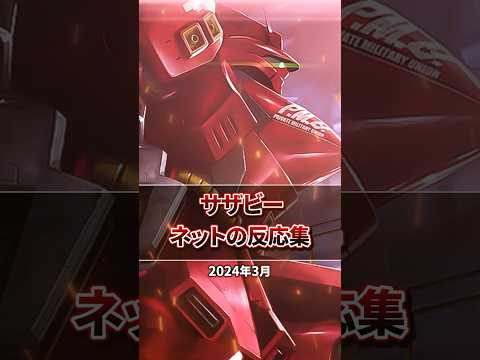
▶ Watch the original YouTube video
Battle Operation 2 Sazabi Analysis: Why This Mobile Suit Divides the Community
The Sazabi, a high-cost mobile suit in Battle Operation 2, has become the subject of conflicting online opinions ranging from “overpowered” to “difficult to use.” An analysis of player feedback reveals that the suit’s evaluation varies dramatically based on skill level, playstyle, and the current metagame environment.
What Happened
The Sazabi, a high-cost mobile suit in Battle Operation 2, has generated diverse and often contradictory evaluations within the gaming community since its implementation in April 2022. Some players regard it as a powerful unit with exceptional firepower and armor, while others criticize it for slow movement speed and difficulty in adapting to current gameplay trends. This divergence in opinion has sparked ongoing debate about the suit’s actual viability in competitive and casual play.
Why It Matters
The Sazabi’s polarized reception highlights a fundamental challenge in game balance design: how to evaluate mobile suit performance when player skill, team composition, and environmental factors significantly influence outcomes. Understanding why experienced players and newcomers reach opposite conclusions about the same unit reveals deeper insights into how Gundam games evolve and how communities assess game balance. This analysis is relevant to both casual players considering whether to invest time in the Sazabi and to developers seeking to understand community perception of high-cost units.
Background
Battle Operation 2 is a 6v6 team-based mobile suit combat game where players pilot various Gundam units across different cost brackets. The Sazabi is positioned as a high-cost unit designed around high firepower and heavy armor, but with notably reduced mobility compared to lighter alternatives. Since its introduction, the suit has existed in a complex evaluation space influenced by shifting metagame trends, player skill progression, and the evolving balance of competing units.
The author’s experience spans over three years of continuous play, during which the Sazabi’s perceived value has fluctuated alongside broader changes in the game’s competitive environment. Initial struggles with the suit’s slow movement speed eventually gave way to a 58% win rate after approximately 50 matches, demonstrating how player adaptation affects unit evaluation.
Key Points
- Skill-Level Dependency: Beginners perceive the Sazabi as difficult due to slow movement, while intermediate and advanced players recognize its strengths when properly positioned and supported by teammates.
- Metagame Sensitivity: The suit’s evaluation has shifted across three distinct periods: a high-firepower-favored era (2022 early), a high-speed-unit era (2022 late–2023 early), and the current balanced-unit era (2023 late–2024), demonstrating how environmental changes affect unit viability.
- Definition Ambiguity: Online debates often fail to converge because “strong” lacks a consistent definition—whether measured by win rate, ease of use, or peak performance potential.
- Team Dynamics Impact: Unlike smaller-scale Gundam games, Battle Operation 2’s 6v6 format means the Sazabi’s value depends heavily on team coordination and role fulfillment rather than individual mechanical skill alone.
- Comparative Analysis: The Sazabi’s evaluation complexity mirrors historical patterns observed in other Gundam titles, where high-performance units undergo significant re-evaluation as player knowledge deepens.
- Industry Trend: High-cost units across Gundam games have experienced relative value decline due to increased player diversity, balance adjustment difficulty, and the growing emphasis on team-oriented gameplay.
Timeline
- April 2022: Sazabi implementation; author begins testing with initial poor results due to movement speed adaptation challenges.
- May 2022: After 50 matches, author achieves 58% win rate following tactical comprehension breakthrough; community evaluation remains divided.
- 2022 Early: High-firepower-unit meta favors Sazabi; community consensus leans toward “strong unit” evaluation.
- 2022 Late–2023 Early: High-speed unit buffs shift metagame; Sazabi evaluation declines due to perceived vulnerability to mobile opponents.
- 2023 Late–2024 Present: Balanced-unit meta emerges; Sazabi repositioned as specialized rather than universally strong; evaluation becomes conditional on environmental factors.
Perspectives
Beginner Players: Beginners (Rank: Enlisted to First Lieutenant) typically classify the Sazabi as “difficult to use” due to slow movement speed preventing escape from disadvantageous positions and inability to leverage the suit’s firepower without proper positioning knowledge.
Intermediate Players: Intermediate players (Rank: Captain to Major) show divided opinions. Those who understand the Sazabi’s positioning requirements rate it as strong, while those still adapting rate it as situational or environment-dependent.
Advanced Players: Advanced players (Rank: Lieutenant Colonel and above) offer the most nuanced evaluation: the Sazabi is “strong but heavily influenced by metagame conditions.” They recognize it as powerful when environmental factors align but acknowledge its vulnerability in unfavorable matchups.
Community Analysis: Online comments reveal three distinct response categories. Positive responses emphasize high firepower and armor potential when mastered. Negative responses focus on movement speed limitations and cost efficiency concerns. Neutral responses acknowledge environmental dependency and skill-level variance, representing a more analytical perspective.
Comparative Game Design Context
Examining Battle Operation 2 alongside the Gundam VS series reveals structural differences affecting unit evaluation. Battle Operation 2’s 6v6 format with high teamwork importance contrasts with the Gundam VS series’ 2v2 structure emphasizing individual skill. This difference fundamentally changes how mobile suit performance is measured: in Battle Operation 2, “strength” depends on team role fulfillment and environmental adaptation, while in Gundam VS, strength correlates more directly with individual mechanical superiority.
Historical precedent from the Gundam VS series demonstrates that high-performance units often undergo significant re-evaluation as player research progresses. The Unicorn Gundam, initially rated “strongest unit” in Gundam VS Gundam NEXT PLUS (2013), was later re-evaluated as “strong but easily countered” once tournament play revealed effective strategies against it. The Sazabi appears to follow this same pattern: initial evaluation as “strong due to high stats” has evolved into more complex assessment acknowledging situational viability.
The Definition Problem
A critical insight emerges from analyzing conflicting online opinions: the term “strong” lacks consistent definition across the community. Three competing definitions produce contradictory conclusions about the Sazabi:
Definition 1—Win Rate Based: If “strong” means “maintains high win rate,” the Sazabi is situational, as its win rate fluctuates significantly with metagame shifts.
Definition 2—Accessibility Based: If “strong” means “easy for beginners to use effectively,” the Sazabi is weak, as its slow movement speed creates a steep learning curve.
Definition 3—Peak Performance Based: If “strong” means “maximum potential when optimally piloted,” the Sazabi is very strong, as skilled players achieve exceptional results.
This definitional ambiguity explains why online discussions frequently reach impasse: participants operate from incompatible evaluation frameworks without explicit acknowledgment of their differing premises.
Industry Trends Affecting High-Cost Units
The Sazabi’s complex evaluation reflects broader industry trends in Gundam games over the past five years. High-cost units have experienced relative value decline due to three factors:
Player Base Diversification: As Gundam game audiences expand, casual players preferring mid-cost units increasingly outnumber hardcore players favoring high-cost specialization. This demographic shift reduces demand for high-cost units and influences community perception.
Balance Adjustment Difficulty: High-cost units present unique balancing challenges—excessive power breaks game balance, while insufficient power leaves them unused. This narrow balance window makes high-cost units particularly susceptible to evaluation volatility.
Team Game Emphasis: The shift toward team-based gameplay (exemplified by Battle Operation 2’s 6v6 format) prioritizes units that enable team success over units that dominate individually. The Sazabi’s specialization in individual firepower becomes less valuable in this context compared to units offering greater team utility.
Practical Guidance for Sazabi Players
Foundation Building: New Sazabi pilots should first master other high-cost units (such as Zeong or Hamma Hamma) to develop high-cost unit positioning fundamentals before specializing in the Sazabi. This preparatory phase significantly accelerates Sazabi proficiency.
Movement Adaptation: Rather than viewing slow movement as a weakness, successful Sazabi pilots treat it as a design parameter requiring active positioning strategy. This means securing advantageous positions before engagement rather than relying on reactive mobility.
Team Coordination: Sazabi effectiveness depends critically on teammate coordination. Optimal play occurs when teammates draw enemy attention while the Sazabi delivers overwhelming firepower from a secured position. Voice communication significantly improves this coordination.
Learning from Experts: Studying advanced player gameplay videos (50+ videos recommended) provides concrete examples of effective Sazabi positioning and engagement timing that accelerate skill development beyond solo experimentation.
Comparative Analysis: Understanding how the Sazabi differs from alternatives (Zeong’s high-speed/high-firepower balance, Hamma Hamma’s area-denial armor) clarifies the Sazabi’s specific role and optimal deployment scenarios.
Future Outlook
Based on observed metagame trends, the author predicts that Battle Operation 2’s environment will shift toward re-emphasizing high-firepower and high-armor units. This prediction rests on two observations: first, the current balanced-unit meta may have created player demand for specialized unit gameplay; second, developer statements suggest increasing focus on unit diversity, potentially including high-cost unit buffs.
If this prediction proves accurate, the Sazabi’s evaluation would likely shift from “conditional strength” back toward “strong unit” classification. However, two alternative scenarios remain possible: developers could either reinforce the Sazabi’s specialized role (maintaining current conditional evaluation) or rebalance it toward generalist capability (reducing its distinctive characteristics).
Insights
The Sazabi’s polarized reception reveals that game balance evaluation cannot be reduced to simple numerical comparisons. Instead, unit viability emerges from the complex interaction of player skill, team dynamics, metagame conditions, and temporal context. What constitutes a “strong” unit depends fundamentally on the framework used to measure strength—a reality that online communities often overlook when debating unit balance.
The Sazabi exemplifies how specialized units create evaluation complexity. Unlike generalist units that perform consistently across conditions, specialized units like the Sazabi excel in specific environments while struggling in others. This specialization generates legitimate disagreement: players experiencing favorable conditions perceive strength, while those facing unfavorable conditions perceive weakness. Both perspectives are simultaneously correct within their respective contexts.
The broader lesson extends beyond the Sazabi: game evaluation is inherently perspectival and temporal. A unit’s value shifts as the competitive environment evolves, as player knowledge deepens, and as the player base composition changes. Treating unit balance as a fixed property rather than a dynamic relationship between unit design, player skill, and environmental context leads to unproductive debate.
For the Gundam franchise specifically, the Sazabi’s complexity reflects the series’ core appeal: unit diversity. The existence of specialized units like the Sazabi, each with distinct strengths and weaknesses, creates the tactical depth that distinguishes Gundam games from more homogeneous competitive titles. Preserving this diversity—even when it complicates balance evaluation—may ultimately serve the franchise better than pursuing perfect numerical balance.