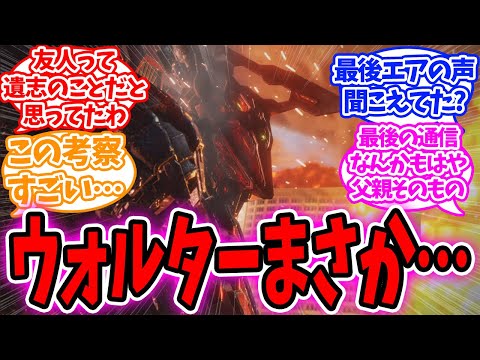
▶ Watch the original YouTube video
Armored Core 6: Internet Theories About Handler Walter’s True Identity and Mysterious Past
After 15 years of analyzing FromSoftware titles, one gaming analyst examines viral internet theories about Armored Core 6’s Handler Walter, questioning whether he is truly a “father figure” or something far more complex. The character’s mysterious background, connection to the Coral technology, and ambiguous relationship with protagonist C.O.621 have sparked widespread debate in the gaming community about his real motivations and hidden past.
What Happened
Following the release of Armored Core 6, the gaming community has engaged in extensive analysis of Handler Walter, a seemingly benevolent character who guides the player throughout the game. What initially appeared to be a straightforward “kind superior” archetype has evolved into one of the most debated character interpretations in recent FromSoftware discourse. Internet theorists have proposed multiple competing hypotheses about Walter’s true identity, his connection to the Coral technology, and whether his paternal affection toward the protagonist is genuine or manipulative.
Why It Matters
FromSoftware has built its reputation on layered storytelling where surface-level narratives conceal deeper mysteries. Understanding Walter’s character is essential to comprehending Armored Core 6’s thematic core. The theories surrounding Walter reflect broader patterns in FromSoftware’s narrative design—where characters rarely operate from simple motivations, and where past traumas shape present actions. For players invested in the game’s lore, Walter’s true nature directly impacts how they interpret the game’s multiple endings and the moral weight of their choices throughout the campaign.
Background
Armored Core 6 takes place in a world where Coral—a mysterious technology with both transformative and destructive properties—has become central to military and industrial power. The game references “Rubicon Day,” a catastrophic event from 50 years prior that appears to have shaped the current geopolitical landscape. Handler Walter serves as the player’s primary contact throughout the campaign, providing mission briefings, tactical advice, and seemingly genuine emotional support. However, careful examination of his dialogue, the game’s multiple endings, and in-game archives suggests Walter harbors significant secrets about his past, his connection to Coral technology, and his true motivations for guiding the protagonist.
Key Points
- Multiple Identity Theories: Internet analysis proposes Walter may be a former Geofront researcher, a person carrying out a deceased friend’s final wishes, or possibly a Coral-enhanced being himself
- The “Friend” Mystery: Walter’s cryptic reference to having “made a friend” remains ambiguous—whether this refers to an individual, an organization, or something Coral-related is hotly debated
- Relationship Ambiguity: While some interpret Walter as a paternal figure, others argue his consistent willingness to send the protagonist into lethal situations suggests manipulation rather than genuine care
- Coral Connection: Walter’s access to Coral engine technology and his deep knowledge of Coral mechanics strongly suggest involvement with Geofront, the organization responsible for Coral research
- Kyla’s Role: The nature of Walter’s relationship with AI character Kyla remains unclear—she may be the daughter of Walter’s deceased friend, an AI inheriting a researcher’s knowledge, or something else entirely
- Temporal Inconsistencies: If Rubicon Day occurred 50 years ago and Walter is currently in his early 60s, he would have been a child during the catastrophe, raising questions about how he became involved in Coral management
Timeline
- 50 Years Ago: Rubicon Day occurs—a catastrophic event involving Coral that fundamentally alters the world’s geopolitical structure
- Childhood/Young Adulthood: Walter potentially works under a Geofront researcher (his “friend”) and receives his initial Coral-related training
- Present Day: Walter operates as Handler, guiding C.O.621 through various military contracts while pursuing an undisclosed agenda
- Campaign Progression: Walter’s communications shift in tone and content depending on which faction the protagonist aligns with, suggesting his true loyalties may differ from his stated support
- Multiple Endings: Walter’s final communications vary significantly based on the player’s chosen ending, hinting at different aspects of his character depending on which path is taken
Perspectives
The Paternal Interpretation: Some players argue that Walter’s consistent encouragement, his concern for the protagonist’s wellbeing, and his final communications genuinely reflect a father-like bond. This reading emphasizes moments where Walter tells the protagonist to “rest a little” and suggests he views C.O.621 as more than merely a tool.
The Manipulator Theory: Conversely, critics point out that Walter consistently sends an enhanced human soldier into lethal situations while offering only verbal comfort. From this perspective, Walter’s kindness is performative—a psychological manipulation technique designed to ensure the protagonist’s compliance. One internet commenter notably observed that from an external viewpoint, Walter appears to be “an abnormal old man treating an enhanced mercenary like a child, playing house before using them up.”
The Tragic Inheritor Hypothesis: A third interpretation suggests Walter is a tragic figure bound by obligation to a deceased friend’s final wishes. Rather than acting from pure malice or pure love, Walter is trapped between his emotional attachment to the protagonist and his duty to complete his friend’s unfinished work. This reading draws parallels to Final Fantasy 7’s Aerith, whose will continues to guide the party even after her death.
The Coral-Enhanced Being Theory: Some analysts propose that Walter himself has undergone Coral modification, making him fundamentally different from ordinary humans. This would explain his seemingly superhuman knowledge of Coral mechanics and his ability to survive situations that should be lethal. However, this theory faces challenges, as the game suggests such modifications typically result in death or transformation rather than enhanced capability.
Insights
After extensive analysis comparing Armored Core 6 to FromSoftware’s previous works—including the Dark Souls series, Bloodborne, and Elden Ring—a clear pattern emerges: FromSoftware deliberately constructs characters whose motivations resist simple moral categorization. Walter exemplifies this design philosophy. He is simultaneously capable of genuine affection and ruthless pragmatism, a man bound by past obligations while forming new emotional connections.
The most compelling interpretation suggests Walter is a survivor of Rubicon Day who has spent 50 years managing the consequences of that catastrophe. Whether he was directly involved in the event, inherited responsibility from a deceased colleague, or was conscripted into service by larger forces remains deliberately ambiguous. This ambiguity is not a narrative flaw but rather a feature—it forces players to construct their own understanding of Walter based on limited information, much like how FromSoftware’s environmental storytelling requires active interpretation.
The debate surrounding Walter’s nature reflects a broader truth about Armored Core 6: the game resists definitive answers. Multiple endings exist not merely as gameplay variations but as acknowledgments that different players will reach different conclusions about the same events. Walter may be a father figure, a manipulator, a tragic inheritor, or some combination thereof. The game’s refusal to provide absolute clarity is intentional, inviting players to engage in the kind of collaborative analysis demonstrated across internet forums and video essays.
For players seeking to understand Walter more deeply, examining all multiple endings, carefully reading in-game archives related to Geofront and Coral technology, and paying close attention to subtle shifts in Walter’s communication tone across different mission branches provides the richest interpretation. The character ultimately represents FromSoftware’s commitment to creating NPCs whose complexity rivals that of the player character themselves.