▶ Watch the original YouTube video
The Mystery of Deoxys’s Triangle Form: Trainer Reactions and In-Depth Analysis
Deoxys’s enigmatic triangle form in Pokémon FireRed and LeafGreen has puzzled trainers for nearly two decades. This analysis examines the mysterious form’s purpose, the diverse fan theories surrounding it, and what it reveals about Pokémon game design philosophy.
What Happened
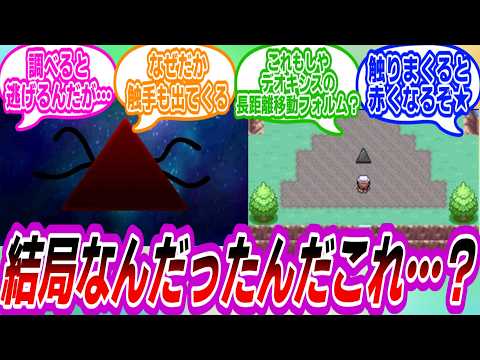
When trainers reach the summit of Birth Island in Pokémon FireRed and LeafGreen, they encounter an unusual red triangular object. Unlike typical Pokémon encounters, this form flees when examined, defying the standard game mechanic where Pokédex entries are recorded upon inspection. This peculiar behavior has sparked widespread speculation about the form’s true nature and purpose within the game’s design framework.
The triangle form represents one of Deoxys’s multiple forms—a concept that was revolutionary for the Pokémon series at the time. While the Attack and Speed forms were clearly documented, the triangle form remained shrouded in mystery, with no official in-game explanation provided for its existence or function.
Why It Matters
Deoxys’s triangle form exemplifies a critical aspect of game design: the strategic use of mystery and ambiguity to enhance player engagement. Rather than providing complete explanations for every game mechanic, the developers left room for interpretation, sparking decades of community discussion and analysis.
This design choice reflects a broader philosophy in Pokémon’s third generation, which introduced the concept of extraterrestrial Pokémon to the series. The triangle form serves as a visual representation of something fundamentally alien—something that doesn’t conform to earthly biology or standard game conventions. Understanding this form provides insight into how Pokémon games balance mystery with player comprehension.
Furthermore, the triangle form’s existence raises important questions about game accessibility and clarity. While mystery can enhance engagement, insufficient explanation can also frustrate players seeking understanding. This tension between intentional obscurity and necessary guidance remains relevant to modern game design discussions.
Background
Deoxys first appeared in Pokémon Ruby and Sapphire as a legendary extraterrestrial Pokémon with multiple forms. The third generation marked a significant shift in the series, introducing space-origin creatures and more complex form-change mechanics. FireRed and LeafGreen, released in 2004-2005 as remakes of the original Red and Green games, incorporated Deoxys as a post-game encounter on Birth Island.
The triangle form’s introduction in these remakes was particularly notable because it deviated from standard Pokémon encounter design. Most legendary Pokémon could be caught through conventional battle mechanics, but this form’s fleeing behavior created an unprecedented gameplay experience. The form’s appearance coincided with increased difficulty in the Pokémon League, requiring trainers to develop stronger teams to progress through the game.
In later games, particularly Pokémon Omega Ruby and Alpha Sapphire, Deoxys’s triangle form appeared more prominently during the “Episode Delta” post-game content, where it emerged from a meteorite in space. This appearance provided additional context but still left many questions unanswered regarding the form’s specific purpose and mechanics.
Key Points
- Mysterious Behavior: The triangle form flees when examined, breaking the standard Pokédex registration mechanic and creating tension and intrigue
- Multiple Interpretations: The community has proposed various theories—defense specialization, space-travel optimization, barrier form, and DNA structure representation
- Design Philosophy: The form represents the developers’ intention to visually convey that Deoxys is fundamentally alien and different from Earth-based Pokémon
- Game Balance Impact: FireRed and LeafGreen featured notably high difficulty in the Pokémon League, requiring strategic team building and resource management through slot machine gameplay
- Community Engagement: The form’s ambiguity has generated sustained fan discussion and analysis across multiple gaming generations
- Geometric Significance: The triangle shape may reference DNA molecular structure or represent optimal aerodynamic design for space travel
Timeline
- 2002-2003: Deoxys introduced in Pokémon Ruby and Sapphire with multiple documented forms
- 2004-2005: FireRed and LeafGreen released with the mysterious triangle form encounter on Birth Island
- 2008: Developer interviews reference the importance of conveying that Deoxys is non-terrestrial
- 2012: Analysis reveals that Pokémon form changes need not be completely explained in-game
- 2014-2015: Pokémon Omega Ruby and Alpha Sapphire feature the triangle form prominently in Episode Delta
- 2022-2023: Pokémon Scarlet and Violet introduce Terastal forms, suggesting evolution in form-change mechanics and explanation
Perspectives
The Defense Specialization Theory: Multiple trainers propose that the triangle form represents Deoxys in a pure defensive state, having abandoned combat capability entirely. This interpretation draws parallels to barrier mechanics in other Pokémon games, where defensive forms prioritize protection over offensive capability. The form’s fleeing behavior supports this theory—a creature focused entirely on defense would naturally avoid confrontation.
The Space-Travel Optimization Theory: Some analysts suggest the triangle shape represents an aerodynamic form optimized for space travel. The geometric properties of triangles—their structural efficiency and minimal air resistance—align with engineering principles. This theory gains credibility from the form’s appearance in space during Episode Delta in Omega Ruby and Alpha Sapphire. However, this interpretation faces a critical challenge: Deoxys’s core appears spherical in all forms, creating an apparent contradiction.
The DNA Structure Theory: Given that “Deoxys” derives from “deoxyribonucleic acid” (DNA), some theorists propose that the triangle form visually represents DNA molecular structure. DNA molecules contain triangular geometric elements within their complex three-dimensional structure. This interpretation connects the form’s appearance directly to the Pokémon’s biological origin and name, suggesting intentional design symbolism.
The Warning Signal Theory: The triangle form’s red coloration may serve as a warning signal, similar to warning coloration in nature. This interpretation aligns with animal behavior science, where bright colors indicate danger or toxicity. The form’s fleeing behavior combined with its warning color suggests a defensive posture designed to discourage engagement.
The Incomplete Explanation Perspective: Some trainers argue that the form simply lacks adequate in-game explanation. This viewpoint suggests the developers should have provided clearer context for the form’s existence, either through NPC dialogue, Pokédex entries, or explicit game mechanics. This criticism highlights the tension between intentional mystery and necessary clarity in game design.
Comparative Analysis: The Triangle Form in Context
Examining Deoxys’s triangle form alongside similar Pokémon encounters reveals its unique position in the series. Most legendary Pokémon appear in single, stable forms. Deoxys’s multiple forms—Attack, Defense, and Speed—were revolutionary, but the triangle form stands apart even among these variants.
In Pokémon Omega Ruby and Alpha Sapphire, the triangle form appears during the meteorite emergence sequence, providing visual context absent from FireRed and LeafGreen. The Sky Pillar in Ruby and Sapphire features triangular design elements, suggesting intentional thematic consistency. However, unlike Deoxys, the Sky Pillar’s triangular design receives no explicit explanation.
Legendary Pokémon in Gold and Silver, such as Ho-Oh and Lugia, maintain single forms and receive more detailed narrative context. This contrast suggests that Deoxys’s form complexity was experimental—a design choice that pushed the boundaries of what Pokémon games could present mechanically and narratively.
Game Design and Difficulty Considerations
FireRed and LeafGreen presented notably higher difficulty than the original Red and Green games, particularly in the Pokémon League. Champion Blue’s team featured Pokémon at approximately level 60, while the Champion’s Road averaged level 50. This significant level gap required strategic team building and resource management.
The games’ slot machine mini-game became crucial for progression. Trainers could earn substantial currency through slots, then invest those funds in items and Pokémon development. This mechanic created an additional gameplay layer beyond standard battle progression—one that taught resource management and risk assessment.
The removal of the Experience Share’s original mechanic, which distributed experience to the entire party, made leveling multiple Pokémon significantly more time-consuming. This design decision intensified the difficulty curve and made the slot machine’s currency generation essential for competitive team building.
Many trainers note that modern Pokémon games lack equivalent mini-games. While newer titles include various diversions, none replicate the slot machine’s engaging simplicity or its integration into the core progression loop. This absence represents a shift in game design philosophy—modern games prioritize streamlined progression over extended engagement mechanics.
Insights
Deoxys’s triangle form represents a deliberate design choice to introduce visual and mechanical alienness into the Pokémon series. Rather than providing complete explanation, the developers created an encounter that defied player expectations and encouraged speculation. This approach proved remarkably effective—nearly two decades later, the form continues generating discussion and analysis.
The form’s enduring mystery demonstrates that incomplete information can enhance engagement rather than diminish it. Players naturally seek to understand ambiguous elements, generating community discussion that extends a game’s cultural lifespan far beyond its release date. This principle remains relevant to contemporary game design, where player-generated content and community analysis significantly impact a game’s longevity.
However, the form also illustrates the risks of excessive ambiguity. Some trainers express frustration at the lack of official explanation, suggesting that mystery without any clarifying context can feel incomplete. The ideal balance appears to involve providing sufficient hints and context to guide player understanding while preserving enough mystery to encourage interpretation and discussion.
The triangle form’s connection to Deoxys’s extraterrestrial origin suggests that form diversity in Pokémon games can serve narrative and thematic purposes beyond mechanical differentiation. The form visually communicates “this creature is not from Earth” more effectively than any dialogue could. This visual storytelling approach remains underutilized in modern Pokémon games, representing a missed opportunity for deeper world-building.
Looking forward, newer Pokémon games like Scarlet and Violet introduce increasingly complex form-change mechanics through Terastal types. These systems attempt to systematize and explain form variations more thoroughly than previous generations. Whether this increased clarity enhances or diminishes player engagement remains an open question—one that Deoxys’s triangle form helps illuminate through its enduring mystery.
Recommendations for Players
For trainers seeking to understand Deoxys’s triangle form, several experiences are recommended:
- Play through FireRed or LeafGreen and encounter the triangle form directly, observing its behavior and appearance carefully
- Experience Pokémon Omega Ruby or Alpha Sapphire’s Episode Delta to see the form in its space-origin context
- Engage with fan communities and alternative interpretations to appreciate the form’s role in generating sustained discussion
- Reflect on how the form’s mystery enhanced your engagement compared to fully-explained game mechanics
The triangle form ultimately represents Pokémon game design at its most intriguing—a moment where mechanical ambiguity, visual distinctiveness, and narrative mystery converge to create something genuinely memorable. Whether the form represents a defensive state, space-travel optimization, DNA structure, or something entirely different may matter less than the fact that it continues to inspire curiosity and analysis across gaming generations.