▶ Watch the original YouTube video
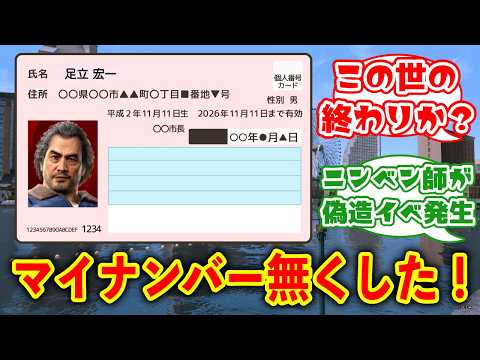
Engine Brothers’ recent video highlighting Adachi’s lost My Number card incident reveals how the Ryu Ga Gotoku series masterfully blends contemporary social issues with character-driven comedy. The scene exemplifies the franchise’s 18-year legacy of transforming everyday modern anxieties into moments of genuine humor that resonate with players across multiple levels of understanding.
What Happened
In a recent video by Engine Brothers, a scene from the Ryu Ga Gotoku series features Adachi, a former police officer and party member, losing his My Number card—Japan’s national identification number introduced in 2015. The incident triggers various comedic reactions from party members and generates diverse responses across social media platforms including Twitter and YouTube.
Why It Matters
This seemingly simple comedic moment illustrates how modern video games can authentically reflect contemporary social concerns while maintaining entertainment value. The scene demonstrates the Ryu Ga Gotoku franchise’s unique ability to merge real-world administrative problems with character personality, creating humor that operates on multiple interpretive levels. For players and critics alike, it showcases how gaming narratives can address modern anxieties—from data security to bureaucratic confusion—without sacrificing emotional authenticity or comedic timing.
Background
The Ryu Ga Gotoku series debuted in 2006 and has maintained a dedicated player base for nearly two decades. The franchise is known for grounding its narratives in contemporary Japanese society while developing deeply human characters. Adachi, a recurring character throughout the series, represents a particular archetype: a man of social standing (former law enforcement) who consistently encounters relatable, mundane problems typical of middle-aged life. The My Number card system, introduced in Japan in 2015, has been a subject of ongoing public debate regarding data security and personal information management, making it ideal material for the series’ brand of socially-aware comedy.
Key Points
- Multi-layered humor structure: The scene operates simultaneously as character comedy, social commentary, and administrative satire, allowing different audiences to find meaning at their preferred level of interpretation.
- Character consistency: Adachi’s loss of the My Number card maintains narrative consistency with his established pattern of “middle-aged man problems,” despite his former police background.
- Social problem integration: Real-world concerns about data security and personal information management are naturally woven into the game’s narrative rather than feeling forced or preachy.
- Sophisticated audience response: Online reactions demonstrate that players understand both the in-game system mechanics and real-world implications of My Number card loss, indicating a highly engaged and knowledgeable community.
- Expectation subversion: The humor derives from the classic comedic principle of violating audience expectations—viewers anticipate a former police officer would carefully manage important documents, making his carelessness surprising and funny.
- Contemporary relevance: The episode reflects broader industry trends of incorporating modern social issues into game narratives, similar to how other franchises address pandemic, colonization, or systemic inequality.
Analysis: Why Adachi’s Lost My Number Card Works Comedically
Psychological mechanism: The scene leverages the classical comedic structure of expectation versus reality. Players anticipate that a former police officer would maintain rigorous control over critical personal documents. When Adachi instead loses his My Number card—a document of significant bureaucratic importance—the violation of this expectation generates laughter. This technique proves remarkably effective across diverse media; similar patterns appear in anime like “Attack on Titan” and “My Hero Academia,” where character personality contradicts expected behavior.
Social context amplification: The My Number system represents a genuine source of public anxiety in Japan. Many citizens understand the card’s importance while harboring concerns about implementation and data protection. By transforming this collective unease into Adachi’s personal mishap, the game converts social anxiety into humor, allowing players to process real-world concerns through comedic distance.
Character evolution: Throughout the Ryu Ga Gotoku series, Adachi has gradually transformed from a stern law enforcement figure into a relatable middle-aged man. The My Number card incident represents the culmination of this character arc—his “middle-aged man” identity now supersedes his former professional status in determining his behavior and vulnerabilities.
Layered audience response: Online reactions reveal three distinct interpretive levels. First, players demonstrate technical knowledge of in-game systems, noting that “My Number cards don’t disappear” and referencing specific game mechanics. Second, commenters recognize real-world implications, discussing data security and information protection concerns. Third, viewers simply enjoy the character moment and comedic timing. This multi-layered functionality represents sophisticated game design, allowing diverse players to extract different forms of entertainment from identical content.
Comparative Analysis: Ryu Ga Gotoku’s Unique Approach
Versus Persona 5: While Persona 5 also addresses contemporary Japanese social issues, problem resolution typically connects to game progression. Adachi’s My Number card loss exists independently of main narrative advancement, functioning as pure “daily life” comedy rather than plot-driven conflict.
Versus Shenmue: Shenmue grounds itself in Japanese daily life but treats such depictions with seriousness. Ryu Ga Gotoku integrates comedy into daily life representation, creating greater accessibility and emotional warmth.
Versus Judgment: Although developed by the same studio, Judgment emphasizes legal and ethical problems. It lacks Ryu Ga Gotoku’s capacity to transform administrative issues into “middle-aged man problems” that generate both laughter and recognition.
| Franchise | Social Problem Treatment | Comedic Elements | Character Relatability |
|---|---|---|---|
| Ryu Ga Gotoku | Personal and everyday | Character personality versus problem mismatch | Very high |
| Persona 5 | Systemic and social | Integrated into game progression | High |
| Shenmue | Serious daily life depiction | Minimal | Moderate |
Community Response Analysis
Online reactions to the My Number card scene demonstrate exceptional community knowledge. Comments referencing specific game mechanics (“My Number cards don’t disappear,” “you need to combine them to use them”) indicate core players who understand intricate system details. Simultaneously, discussions about real-world data security concerns show that viewers connect in-game events to actual social problems. Comments like “Did he lose his identity?” demonstrate sophisticated, multi-layered humor appreciation—recognizing that My Number loss represents identity-related rather than mere information-leakage concerns.
This response pattern reveals that Ryu Ga Gotoku’s player community possesses unusually high levels of both game-specific knowledge and real-world contextual awareness. Such sophisticated audience engagement remains relatively rare across gaming communities.
Broader Industry Context
Recent gaming trends increasingly emphasize expressing social problems naturally within game narratives. Franchises like “The Last of Us” address pandemic fears, “Ghost of Tsushima” explores colonization, and “Ryu Ga Gotoku” focuses on everyday modern anxieties. The My Number card episode exemplifies this trend’s application to quotidian social concerns—the specific daily frustrations that affect ordinary citizens rather than civilization-scale catastrophes.
Future Implications
Adachi’s character evolution suggests that future Ryu Ga Gotoku installments will increasingly incorporate contemporary social problems as sources of character-driven comedy. Potential topics include social media complications, cybersecurity concerns, digital literacy gaps among aging populations, and economic inequality. The franchise’s demonstrated capacity to transform such issues into relatable humor positions it as a significant cultural commentary vehicle.
Insights
The My Number card incident ultimately demonstrates that video games function as social mirrors, reflecting contemporary anxieties while processing them through entertainment. The Ryu Ga Gotoku series excels at this function by refusing to separate “serious social problems” from “character personality.” Instead, it allows both to coexist, suggesting that modern life’s bureaucratic frustrations are not separate from human identity but integral to it.
This approach carries both promise and complexity. While transforming social anxiety into comedy provides cathartic value and accessibility, it risks trivializing genuine problems. The franchise’s continued success suggests that audiences appreciate this balance—they want entertainment that acknowledges real concerns without demanding activist commitment.
The broader significance lies in demonstrating gaming’s capacity to address contemporary social issues with sophistication and nuance. Rather than preaching or oversimplifying, Ryu Ga Gotoku allows players to recognize themselves in characters who struggle with modern life’s mundane complications. This approach has sustained the franchise for 18 years and continues to attract players seeking narratives that reflect their actual lived experience.