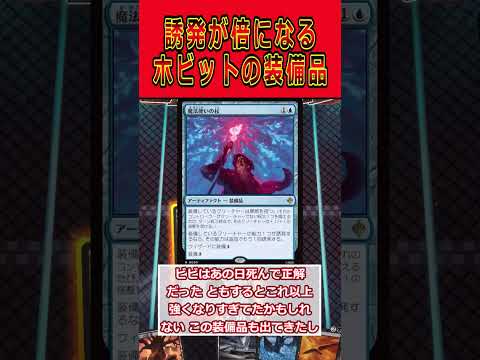
▶ Watch the original YouTube video
Magic: The Gathering’s Triggered Equipment Explained—Why the Wizard’s Staff Falls Short in Standard But Shines in Modern
A 15-year Magic: The Gathering veteran analyzes the Wizard’s Staff, a revolutionary equipment card that doubles triggered abilities. While theoretically powerful, the card faces significant hurdles in Standard due to mana costs and limited synergies—but may find its true home in Modern’s broader card pool.
What Happened
Magic: The Gathering has introduced the Wizard’s Staff, an equipment card with a revolutionary mechanic: it doubles the triggered abilities of equipped creatures. This represents a significant evolution in equipment design, moving beyond simple stat boosts to enable complex strategic interactions. However, despite its innovative design, the card has generated debate within the competitive community about its practical viability in current Standard formats.
Why It Matters
The Wizard’s Staff exemplifies how MTG continues to evolve its design philosophy, shifting focus toward revaluing existing cards and creating new combo opportunities. Equipment has traditionally served a limited role—providing stat boosts or granting abilities. The introduction of triggered-doubling mechanics signals a maturation of the equipment archetype. Understanding why this card succeeds in some formats but struggles in others reveals fundamental truths about MTG’s metagame and card design philosophy.
Background
Over the past 15 years, MTG equipment has undergone dramatic evolution. Early equipment like Bonesplitter (2009) and Godsend (2013) offered straightforward benefits: attack bonuses and evasion. The Wizard’s Staff represents a paradigm shift—rather than modifying a creature’s stats, it amplifies its abilities. This mechanic echoes past design experiments but with crucial limitations: it does not affect enters-the-battlefield (ETB) triggers, a deliberate balance restriction to prevent broken interactions with cards like Urza’s Saga.
Key Points
- Innovative Mechanic: Doubling triggered abilities is unprecedented for equipment and fundamentally changes how players evaluate creatures with continuous triggers.
- Mana Cost Concerns: At three mana to cast and three mana to equip, the card requires five mana total before providing value—too slow for current Standard’s fast-paced metagame.
- ETB Limitation: The card cannot double enters-the-battlefield triggers, which eliminates synergy with many of Standard’s most powerful draw engines and creature generators.
- Limited Creature Pool: Standard currently lacks sufficient creatures with continuous triggered abilities to fully exploit the Wizard’s Staff’s potential.
- Equipment Vulnerability: Like all equipment, the Wizard’s Staff is vulnerable to removal, making it a risky mana investment in fast-paced environments.
- Modern Potential: In Modern, the card may enable powerful combo strategies, particularly with creatures like Showoff that trigger every turn.
Timeline
- 2009: Equipment design focused on simple stat modifications (Bonesplitter era).
- 2013: Equipment becomes more complex with additional abilities (Godsend).
- 2017–2018: Urza’s Saga dominates Standard, establishing the power ceiling for triggered ability engines.
- 2020: Cards like Hydroid Krasis introduce complex triggered mechanics but with limited environmental impact.
- 2022–2024: Standard metagame accelerates, favoring fast decks that resolve games by turn four.
- Present: Wizard’s Staff launches, sparking debate about its viability across formats.
Perspectives
The Optimist’s View: Proponents argue that the Wizard’s Staff represents genuine innovation in equipment design and will eventually find its home as new creatures with continuous triggers are printed. The card’s potential in Modern formats is undeniable, with early research suggesting three-turn kill possibilities when paired with creatures like Showoff.
The Skeptic’s View: Critics point out that the card’s mana cost is prohibitive in Standard, where games often conclude before turn five. The restriction against doubling ETB triggers eliminates synergy with many of the format’s strongest cards. Additionally, equipment’s inherent vulnerability to removal makes it a risky investment compared to creatures or instants that provide immediate value.
The Pragmatist’s View: The Wizard’s Staff will likely see play in specific archetypes—particularly control and midrange decks in Standard that can afford to deploy it later in the game, and combo-focused decks in Modern. Its success depends entirely on the availability of creatures with continuous triggered abilities that justify the mana investment.
Community Consensus: Players on social media acknowledge the card’s innovative design while recognizing its practical limitations. Comments reflect awareness that balance restrictions (particularly the ETB limitation) were necessary to prevent broken interactions, and that the card’s true value may lie in Modern rather than Standard.
Insights
The Wizard’s Staff reveals several important truths about modern MTG design. First, equipment continues to evolve toward more complex, strategic roles—moving away from simple stat modifications toward mechanics that revalue existing cards and enable new synergies. This reflects MTG’s broader design philosophy: each new set should prompt players to reconsider older cards.
Second, the card’s struggle in Standard despite its innovative design highlights a fundamental tension in MTG: powerful mechanics must be balanced against mana costs and format speed. The Wizard’s Staff is not weak—it is simply too slow for a Standard environment where most games conclude by turn four or five. This is not a design failure; it is an intentional balance decision.
Third, the card’s potential in Modern demonstrates how card evaluation is format-dependent. A card that appears mediocre in Standard can become powerful when paired with a broader card pool. This dynamic—where new cards continuously revalue existing ones—is central to MTG’s enduring appeal.
Finally, the Wizard’s Staff exemplifies MTG’s commitment to preventing dominant strategies through careful restriction. The decision to exclude ETB triggers from the doubling effect prevented what could have been a format-warping card. This restraint in design, combined with the card’s genuine innovation, suggests that MTG’s designers are becoming more sophisticated in balancing power with playability.
For players interested in the Wizard’s Staff, the recommendation is clear: explore it in Modern first, where its potential is highest. In Standard, reserve it for slower control and midrange decks that can afford its mana cost. Above all, study past equipment cards and triggered-ability engines to understand how this card fits into MTG’s evolving design landscape.