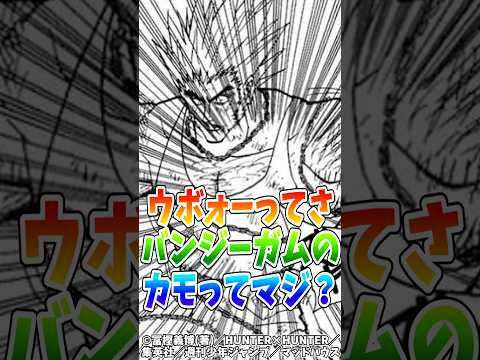
▶ Watch the original YouTube video
Is Uvogin Really Bungee Gum’s Easy Prey? A 15-Year Analysis of Hunter x Hunter’s Most Debated Matchup
Online fans of Hunter x Hunter continue to debate whether Uvogin is fundamentally outmatched against Bungee Gum, or whether the conflict simply represents a compatibility problem. A deep analysis of both characters’ abilities, strategic roles within the Phantom Troupe, and comparative examples from other shonen manga reveals that the answer is far more nuanced than a simple power hierarchy.
- What Happened
- Why It Matters
- Background
- Key Points
- The Nature of Uvogin’s Strength
- Chrollo’s Strategic Role
- Online Community Perspectives
- The Critical Distinction: “Easy Prey” vs. “Poor Matchup”
- Narrative Significance
- Comparative Analysis Across Shonen Manga
- Practical Guidance for Deeper Engagement
- Insights and Broader Implications
What Happened
The confrontation between Uvogin and Bungee Gum has sparked considerable debate across social media platforms including Twitter, 5channel, and YouTube. Fans argue about whether Uvogin is fundamentally weak against Bungee Gum or simply mismatched in terms of combat style. The discussion centers on Uvogin’s straightforward power-based approach versus Bungee Gum’s technical, experience-driven combat strategy. Many viewers interpret Uvogin’s defeat as evidence of inherent weakness, while others contend it reflects poor matchup compatibility rather than overall inferiority.
Why It Matters
This debate illuminates how Hunter x Hunter defines strength and power scaling. Unlike many shonen series that establish clear hierarchies, Togashi’s work emphasizes situational advantage, strategic compatibility, and the multifaceted nature of combat ability. Understanding this distinction changes how fans interpret character matchups and narrative outcomes. The Uvogin-Bungee Gum conflict serves as a case study for how manga can present nuanced power dynamics rather than absolute rankings, influencing how audiences engage with the story and discuss character capabilities.
Background
Uvogin is a member of the Phantom Troupe known for his extreme physical power and his Nen ability “Internal Rupture,” which maximizes bodily strength to devastating effect. Bungee Gum, by contrast, is an experienced combatant whose Nen ability “Bungee Gum” allows him to extend his body and manipulate opponents through physical restraint and psychological pressure. The two characters represent fundamentally different combat philosophies: Uvogin embodies pure, direct force, while Bungee Gum represents technical mastery developed through extensive battle experience.
Within the Phantom Troupe’s organizational structure, Uvogin functions as a specialized asset deployed for specific tactical purposes under Chrollo’s leadership. This role-based system mirrors organizational structures seen in other anime, such as the Zeon military in Mobile Suit Gundam, where individual soldiers serve distinct functions rather than existing in a simple power hierarchy.
Key Points
- Uvogin’s strength specializes in raw physical power, making him potentially vulnerable to technical, multi-layered combat styles like Bungee Gum’s approach
- Bungee Gum’s ability operates on three distinct levels: physical attack, restraint, and psychological pressure—a complexity that Uvogin’s single-dimensional power struggles to counter
- The distinction between being “easy prey” and having “poor matchup compatibility” is crucial; Uvogin is not inherently weak, but rather disadvantaged in this specific scenario
- Online fan reactions remain divided, with Twitter emphasizing matchup disadvantage while 5channel engages in detailed tactical analysis
- Hunter x Hunter’s design philosophy deliberately avoids absolute power rankings, instead emphasizing situational advantage and strategic deployment
- Comparable examples from other shonen series (Bleach, Naruto, Attack on Titan) demonstrate that matchup-based defeats are a universal narrative device, not evidence of fundamental weakness
The Nature of Uvogin’s Strength
Uvogin’s power derives from his ability to push physical capability to its absolute limit. His straightforward approach excels against opponents who rely on direct confrontation, but falters when facing adversaries who employ technical precision, movement complexity, or psychological manipulation. This is not a flaw in Uvogin’s character design but rather an intentional limitation that creates narrative tension and strategic depth.
Bungee Gum’s “Bungee Gum” ability operates across multiple tactical layers. The first layer involves direct physical assault through extended limbs. The second layer employs restraint and mobility restriction. The third layer inflicts psychological damage by creating a sense of inescapability. Against this multi-layered approach, Uvogin’s singular focus on overwhelming force becomes a liability rather than an asset.
Chrollo’s Strategic Role
The relationship between Chrollo and Uvogin provides critical context. Chrollo functions not merely as a leader but as a strategist who maximizes each member’s capabilities through appropriate deployment. This suggests that Chrollo does not view Uvogin as “easy prey” for any opponent, but rather as a specialized tool suited to particular combat scenarios. The Phantom Troupe’s structure reflects a role-based organization where individual members excel in specific contexts rather than maintaining universal dominance.
Online Community Perspectives
Twitter consensus: Most tweets acknowledge Uvogin’s strength while emphasizing that Bungee Gum represents a poor matchup. Common statements include “I respect Uvogin’s power, but Bungee Gum is a bad opponent for him” and “Uvogin specializes in pure force, so a technical fighter like Bungee Gum has the advantage.”
5channel analysis: Discussion threads provide more detailed tactical breakdowns. Users note that Bungee Gum’s restraint ability can neutralize Uvogin’s linear attack patterns, and that Bungee Gum’s experience allows him to exploit Uvogin’s tendency toward straightforward decision-making in combat.
YouTube comments: Many viewers express counterarguments such as “If Uvogin went all out…” reflecting uncertainty about Uvogin’s true power ceiling and inconsistent fan evaluation of his capabilities.
This divided response reflects Hunter x Hunter’s intentional design ambiguity. Togashi deliberately avoids establishing absolute power rankings, instead creating scenarios where outcome depends on context, preparation, and strategic compatibility.
The Critical Distinction: “Easy Prey” vs. “Poor Matchup”
The terminology used in this debate carries significant weight. Describing Uvogin as “easy prey” implies a one-directional power relationship where Uvogin cannot succeed regardless of circumstances. However, the more accurate assessment is that Uvogin faces a “poor matchup”—a situation where specific tactical factors favor Bungee Gum.
This distinction matters because it acknowledges that outcomes could differ under alternative conditions. If Uvogin possessed advance knowledge of Bungee Gum’s abilities and developed countermeasures, results might change. Environmental factors, timing, and preparation all influence the outcome. The battle represents a specific moment in time rather than a definitive statement about absolute capability.
Comparable examples from other shonen series illustrate this principle. In Bleach, Byakuya faces disadvantage against opponents whose abilities specifically counter his combat style, yet this does not render him universally weak. In Naruto, Sasuke’s defeat by Naruto results from complex psychological and developmental factors rather than simple power disparity. In Attack on Titan, Levi faces temporary disadvantage against the Beast Titan due to matchup incompatibility, not inherent weakness.
Narrative Significance
Uvogin’s defeat carries narrative weight beyond simple combat outcome. In shonen manga, character defeats function as turning points, growth opportunities, and catalysts for story progression. Uvogin’s loss against Bungee Gum serves as a narrative inflection point that propels the Hunter x Hunter story forward. This defeat should be understood as a “destiny branching point” rather than merely a demonstration of power differential.
The battle illustrates Hunter x Hunter’s thematic focus on complex interpersonal dynamics rather than absolute hierarchies. Togashi consistently emphasizes that strength emerges from the interaction between abilities, circumstances, experience, and psychological factors—not from simple numerical comparison.
Comparative Analysis Across Shonen Manga
The pattern of strong characters facing matchup-based defeats appears throughout shonen manga, suggesting this represents a universal narrative device rather than a Hunter x Hunter-specific phenomenon.
In Attack on Titan, Levi temporarily struggles against the Beast Titan not because Levi is weak, but because the Beast Titan’s ability creates tactical disadvantage for Levi’s combat style. In Naruto, Sasuke’s various defeats result from complex interactions between opponent capability, Sasuke’s psychological state, and strategic factors—not simple power ranking. In JoJo’s Bizarre Adventure, Dio Brando maintains superiority against many Stand users yet faces disadvantage against specific opponents whose abilities create poor matchups.
These examples demonstrate that matchup-based outcomes represent a fundamental principle in shonen storytelling. Uvogin and Bungee Gum’s conflict exemplifies this universal narrative principle.
Practical Guidance for Deeper Engagement
Observe combat flow rather than outcome: When viewing this battle, focus on how each character attacks and responds rather than simply tracking who wins. This reveals the fundamental nature of each ability and why compatibility matters.
Examine contextual episodes: Understanding Uvogin’s role within the Phantom Troupe and Bungee Gum’s background enriches interpretation of their conflict. Context transforms a simple fight scene into a meaningful narrative moment.
Compare with related battles: Viewing similar matchups in Rurouni Kenshin, Bleach, and other shonen series provides perspective on how different manga handle matchup-based outcomes and power dynamics.
Embrace multifaceted questioning: Rather than asking “Is Uvogin Bungee Gum’s easy prey?” (a binary question), ask “How does matchup compatibility change across different scenarios?” This approach generates richer discussion and deeper understanding.
Insights and Broader Implications
After extensive analysis, the evidence suggests that Uvogin is not fundamentally Bungee Gum’s “easy prey,” but rather faces a poor matchup in their specific confrontation. This distinction reflects Hunter x Hunter’s sophisticated approach to power dynamics, where strength emerges from complex interactions rather than absolute rankings.
Uvogin demonstrates a deeply human quality: the commitment to maximizing one’s inherent abilities. His defeat results not from personal weakness but from facing an opponent whose tactical approach neutralizes his strengths. This narrative choice enriches character development and thematic depth.
The ongoing fan debate itself validates Togashi’s design philosophy. The fact that viewers continue arguing about this matchup—rather than accepting a predetermined outcome—demonstrates that Hunter x Hunter successfully presents nuanced power dynamics. The ambiguity is intentional and generative, encouraging audiences to think critically about how strength functions in the narrative.
Hunter x Hunter’s 15-year legacy reveals a work fundamentally concerned with complex relationships between characters, abilities, and circumstances rather than simple hierarchies. The Uvogin-Bungee Gum conflict serves as a perfect case study for this principle, illustrating how matchup compatibility, experience, tactical thinking, and psychological factors combine to create outcomes that transcend simple power comparison.