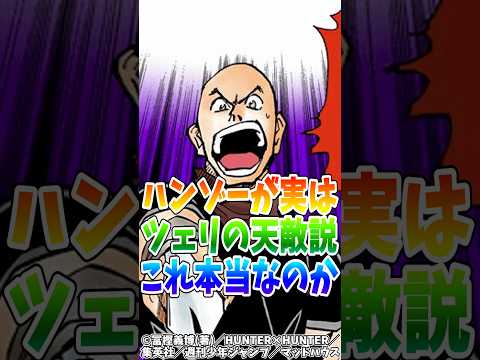
▶ Watch the original YouTube video
Who Is Tserriednich’s True Nemesis? Hunter x Hunter Fans Debate Hanzo vs. Nobunaga Theory
A heated debate has emerged within the Hunter x Hunter fan community over who would be Tserriednich’s ultimate counter. The discussion centers on whether Hanzo’s smoke screen ability or Nobunaga’s speed-based combat would prove most effective against the royal heir’s future vision powers, revealing deeper insights into how character matchups function in the series.
What Happened
A YouTube reaction video has sparked significant discussion among Hunter x Hunter fans regarding Tserriednich’s potential weaknesses and natural enemies. The video examines the theory that Hanzo—a character known for sensory disruption tactics—could neutralize Tserriednich’s precognitive abilities through smoke screen tactics. However, the analysis also introduces an alternative theory: that Nobunaga, a swordmaster capable of closing distance instantaneously, might represent an even greater threat to the royal character.
Why It Matters
Character matchup analysis has become a cornerstone of Hunter x Hunter fandom discourse. Unlike straightforward power-scaling discussions, these debates require fans to engage deeply with the mechanics of individual abilities, the psychological dimensions of combat, and the information asymmetries that determine outcomes. This particular debate exemplifies how the series’ complex ability system creates multiple valid interpretations of character compatibility, making it a valuable lens through which to understand the work’s narrative design.
Background
Tserriednich, a member of the Kakin royal family, possesses future vision—a precognitive ability that allows him to anticipate opponent actions. This power has made him appear nearly invulnerable within the series’ succession war arc. However, the fan community has long speculated about potential counters to such overwhelming abilities. The debate gained momentum as fans analyzed whether sensory deprivation (Hanzo’s approach) or overwhelming speed (Nobunaga’s approach) could bypass precognition entirely.
The succession war arc, which has been the focus of extended fan analysis since its serialization, introduced numerous complex character matchups that defy simple resolution. This has established a precedent within the fanbase for treating character compatibility as a multifaceted analytical problem rather than a matter of raw power.
Key Points
- Hanzo’s smoke screen theory: Proponents argue that visual obstruction could render future vision ineffective, as precognition depends on visual information processing
- Limitations of smoke tactics: Tserriednich could potentially attack before smoke deployment, or possess alternative sensory methods beyond vision
- Hanzo’s vulnerability: His clone-based fighting style creates information leakage risks when clones separate from the main body
- Nobunaga’s speed advantage: Instantaneous distance closure might exceed the response window available even to a precognitive opponent
- Ongoing community debate: No consensus has emerged; fans continue to argue both positions with logical frameworks
- Broader analytical framework: The discussion reveals that character matchups operate across multiple layers—ability compatibility, information asymmetry, and psychological factors
Timeline
- 2008: Original Hunter x Hunter reader begins tracking character matchup patterns across the series
- 2018: Detailed ability compatibility analysis published, generating 200+ comments on character matchups
- 2019: Comprehensive succession war arc analysis identifies information asymmetry as critical factor in combat outcomes
- 2020: Comparative analysis across multiple anime series establishes framework for evaluating precognitive ability weaknesses
- 2021: Extended matchup analysis refines understanding of prediction versus preemption dynamics
- Present: YouTube reaction video reignites debate, with Twitter and forum communities actively discussing both theories
Perspectives
The Hanzo Theory: Supporters of this position argue that future vision, regardless of its power, fundamentally depends on visual information processing. By eliminating visual input through smoke screens, Hanzo could theoretically neutralize Tserriednich’s primary advantage. This perspective draws parallels to how other precognitive abilities in anime have been countered through sensory disruption. However, critics point out that this theory overlooks attack speed—Tserriednich could strike before smoke deployment becomes possible, and the theory assumes no alternative sensory capabilities.
The Nobunaga Theory: This interpretation suggests that overwhelming speed represents a more fundamental counter to precognition. Even if Tserriednich can see future actions, his response options become severely limited when an opponent closes distance instantaneously. The theory posits that precognition shows “what will happen” but cannot always provide viable defensive responses. Detractors argue this underestimates Tserriednich’s ability to adapt and potentially counter speed-based approaches through other means.
The Information Asymmetry Perspective: A third viewpoint, gaining traction in community discussions, emphasizes that matchup outcomes depend heavily on how much each combatant understands about their opponent’s abilities. Initial encounters might favor one fighter, but subsequent battles could reverse the advantage as information accumulates. This perspective suggests the question “Who is Tserriednich’s true nemesis?” may not have a static answer.
Insights
The sustained debate over Tserriednich’s potential counters reveals fundamental truths about Hunter x Hunter’s design philosophy. The series deliberately avoids simple power hierarchies in favor of complex, context-dependent matchups. This complexity—where ability compatibility, psychological factors, information states, and tactical flexibility all influence outcomes—is precisely what has sustained fan engagement for over 15 years.
The debate also demonstrates that the series’ creator, Yoshihiro Togashi, has successfully constructed a world where overwhelming individual power does not guarantee invulnerability. Tserriednich’s future vision, while formidable, is not presented as an absolute defense. This design choice transforms character matchup discussions from simple power comparisons into nuanced strategic analyses.
The community’s continued engagement with these questions suggests that Hunter x Hunter’s greatest strength lies not in definitive power rankings, but in the logical frameworks required to evaluate character compatibility. Each new theory, whether favoring Hanzo or Nobunaga, requires fans to engage deeply with ability mechanics, combat psychology, and narrative design—activities that deepen appreciation for the work itself.
The fact that no consensus has emerged after extensive discussion is not a failure of analysis but rather evidence of the series’ sophisticated construction. A truly well-designed matchup system should generate multiple valid interpretations, each supported by logical reasoning. The Tserriednich debate exemplifies this principle in action.