▶ Watch the original YouTube video
Bandai Namco and Kairosoft have announced a surprising collaboration: a management simulation game featuring One Piece characters running a restaurant. With over 400 characters, Devil Fruit-inspired recipes, and a unified setting that brings together rival factions, the game represents a bold new direction for One Piece gaming.
What Happened
Kairosoft, the developer behind beloved management simulation games like Pocket League Story and Doraemon: Nobita’s Town-Building Game, has partnered with Toei Animation to create a One Piece-themed restaurant management game titled Gourmet Restaurant. The game tasks players with establishing and expanding Baratie 2, the legendary restaurant from the series, while recruiting over 400 One Piece characters to work and dine at the establishment.
Why It Matters
This collaboration represents a significant moment in One Piece gaming and anime adaptation strategy. Rather than focusing on action-adventure gameplay, the project explores a completely different narrative space—the everyday lives of characters who are typically locked in conflict. The game’s design philosophy suggests a growing trend in the industry toward creating “parallel world” interpretations of beloved franchises, allowing fans to experience character interactions that would be impossible within the canon storyline. This approach also demonstrates how niche game developers like Kairosoft can successfully handle massive intellectual properties with complex character rosters.
Background
Kairosoft has built a reputation for creating charming, addictive management simulations that blend simple mechanics with thematic depth. Their 2012 collaboration with the Doraemon franchise proved that character-driven franchises could work exceptionally well within the management game framework. That project featured approximately 135 characters and provided over 150 hours of gameplay, establishing Kairosoft as a trusted partner for anime and manga adaptations. One Piece, with its sprawling cast of over 1,600 named characters and complex political factions, presents a significantly more ambitious challenge.
Key Points
- 400+ Character Roster: The game features the largest character count of any official One Piece game, drawn from the entire series canon and including characters from opposing factions (Marines, Navy Admirals, Celestial Dragons, and pirates).
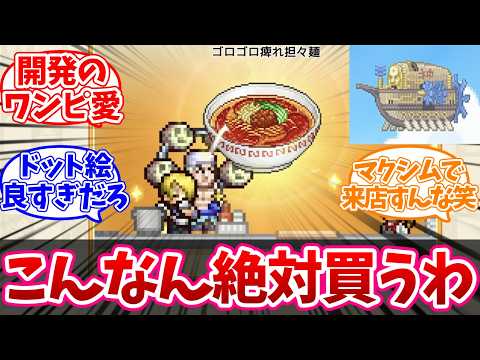
- Devil Fruit Cooking Mechanics: The game incorporates Devil Fruit abilities into recipe development—for example, using Enel’s Goro Goro no Mi (Rumble Fruit) to create electrified ramen dishes.
- Pixel Art Adaptation: Converting over 400 complex character designs into pixel art represents a substantial technical and artistic undertaking by the development team.
- Unified Setting: Baratie 2 serves as a neutral space where normally antagonistic factions coexist, creating a unique narrative framework that sidesteps canon contradictions.
- Management Simulation Core: Players develop recipes, manage staff, expand the restaurant, and attract customers while maintaining the addictive gameplay loop Kairosoft is known for.
- Parallel World Framework: The game operates as an alternate universe, allowing creative freedom while respecting character identities and relationships from the source material.
Design Philosophy and Execution
The decision to set the game at Baratie 2 is strategically sound. In One Piece canon, Baratie functions as a space where individuals from different backgrounds and allegiances can meet on neutral ground. This thematic alignment with the restaurant setting creates narrative coherence while solving the fundamental problem of how to justify rival factions working together. The choice also limits the scope to a manageable setting, allowing Kairosoft to maintain world-building consistency while accommodating an enormous character roster.
The incorporation of Devil Fruit abilities into cooking mechanics demonstrates careful attention to source material. Rather than treating character powers as cosmetic elements, the developers have integrated them into core gameplay systems. This approach mirrors Kairosoft’s previous success with the Doraemon adaptation, where character-specific traits (Doraemon’s preference for dorayaki, Nobita’s propensity for misfortune) directly influenced gameplay mechanics and narrative outcomes.
Comparative Analysis: Doraemon Game Precedent
The Doraemon: Nobita’s Town-Building Game provides valuable context for understanding Gourmet Restaurant’s design approach. The Doraemon project featured approximately 135 characters across the entire Fujiko F. Fujio catalog, while Gourmet Restaurant includes over 400 One Piece characters—roughly three times the character count. Both games employ a “parallel world” framework to avoid canon contradictions, though Gourmet Restaurant’s single unified location (Baratie 2) differs from Doraemon’s multi-world approach via the “Anywhere Door” mechanic.
The Doraemon game succeeded by ensuring each character retained their essential traits within the game systems. Doraemon’s signature food item provided gameplay benefits, while Nobita’s character archetype generated specific in-game events. This level of character-specific design depth is expected to carry over to Gourmet Restaurant, where individual Devil Fruit abilities and character personalities should influence gameplay interactions.
Addressing the Complexity Problem
One Piece presents unique challenges compared to previous Kairosoft collaborations. The series features clearly defined antagonistic factions—the Marines, Celestial Dragons, and various pirate crews—whose coexistence in a single restaurant setting requires narrative justification. The parallel world framework provides this justification, but the game’s success will depend on how thoroughly character relationships and personalities are reflected in gameplay systems.
The inclusion of deceased characters like Ace (who died in the Marineford arc) in a living, interactive capacity represents a deliberate creative choice. Rather than strictly adhering to canon timeline, the game prioritizes fan desire to experience these characters in everyday scenarios. This approach acknowledges that One Piece fans have long sought depictions of character daily life—moments the serialized narrative cannot accommodate.
Community Reception and Expectations
Online fan communities have responded positively to the announcement, with particular enthusiasm for Kairosoft’s involvement. Social media discussions highlight confidence in the developer’s track record, with comparisons to the successful Doraemon collaboration appearing frequently. The 400+ character count has generated excitement about the likelihood of favorite characters appearing in the game.
Some skepticism exists regarding narrative coherence—particularly questions about why Marines and Celestial Dragons would work in a pirate-affiliated restaurant. However, this apparent incongruity aligns with the game’s thematic exploration of neutral spaces where opposing forces can interact peacefully, a concept central to One Piece’s broader narrative about human connection transcending faction and ideology.
Expected Features and Future Content
Based on Kairosoft’s previous work, Gourmet Restaurant likely includes seasonal events, progressive character unlocks, and evolving gameplay systems. The Doraemon game featured time-based progression where new characters appeared and storylines developed as players advanced. One Piece’s broader narrative scope suggests similar systems could include:
- Costume variations reflecting character development arcs
- Progressive Devil Fruit recipe unlocks
- Character appearance changes based on in-game events
- Potential integration with ongoing One Piece manga developments
Insights
Gourmet Restaurant represents more than a simple character collection game—it embodies a creative solution to adapting sprawling, conflict-driven narratives into gameplay experiences. By establishing a thematic framework (the restaurant as neutral ground) and adopting a parallel world setting, Kairosoft has created space for fan desires that canon cannot accommodate. The game acknowledges what One Piece audiences have long wanted: depictions of character daily life, peaceful coexistence across factional lines, and the realization of Sanji’s dream of “All Blue”—reimagined as a restaurant where all characters gather.
The project also signals industry recognition that management simulation games can successfully accommodate massive character rosters when developers prioritize thematic coherence and character-specific design depth. With over 400 characters, Gourmet Restaurant expands the scale of previous anime-game collaborations while maintaining the intimate, character-focused design philosophy that made Kairosoft’s earlier projects successful.
For One Piece fans, the game offers something the main narrative cannot: a space where beloved characters exist in peaceful coexistence, where their personalities and abilities contribute to shared goals, and where the series’ underlying theme of human connection transcends conflict and ideology. In this sense, Gourmet Restaurant may represent the most thematically aligned One Piece game adaptation to date.