▶ Watch the original YouTube video
White Snake Stand Analysis: Why This JoJo’s Bizarre Adventure Ability Terrifies Fans
White Snake, the antagonist Stand from JoJo’s Part 6: Stone Ocean, represents a paradigm shift in Stand combat by directly targeting personal identity through memory extraction. Fan reactions reveal deep divisions over whether the ability constitutes revolutionary design or narrative imbalance, making it one of the most discussed Stands in the entire series.
What Happened
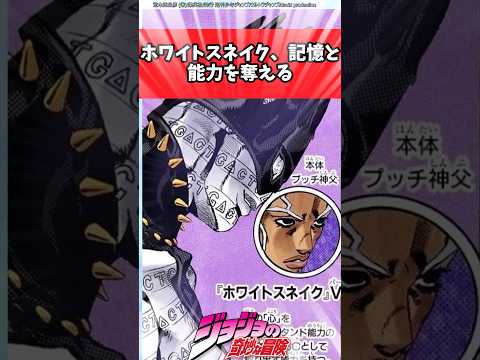
White Snake, wielded by an antagonist in Part 6 of JoJo’s Bizarre Adventure, possesses the unprecedented ability to extract memories and Stand abilities as physical DISCs. Unlike previous Stand powers that operate through physical or temporal manipulation, White Snake attacks the very foundation of a Stand user’s identity. The ability has generated intense discussion across fan communities on Twitter, 5channel, and YouTube, with reactions ranging from praise for its innovative design to criticism of its overwhelming power balance.
Why It Matters
White Snake’s emergence marks a critical evolution in how JoJo’s explores the nature of human identity. Rather than focusing solely on physical combat or temporal manipulation, the Stand introduces a philosophical dimension by weaponizing memory itself. This shift reflects broader thematic concerns in Part 6 about what constitutes personal identity when memories can be stolen. For long-time fans, White Snake represents the culmination of Stand ability progression; for newer readers, it signals entirely new possibilities within the Stand system. The ability’s design raises fundamental questions about consciousness, identity, and what makes a person fundamentally themselves.
Background
JoJo’s Bizarre Adventure has progressively introduced more complex Stand abilities across its six parts. Part 3 introduced The World’s time-stopping power, Part 4 featured Bites the Dust’s time-reversal mechanics, and Part 5 presented Gold Experience Requiem’s ability to negate intent itself. Each represented a significant departure from conventional Stand combat rules. Part 6, set in a prison environment, introduces White Snake as the primary antagonistic force. Creator Hirohiko Araki appears to have deliberately escalated the philosophical dimension of Stand powers, moving from physical dominance toward attacks on consciousness itself. The ability to extract and store memories as tangible objects—DISCs—introduces a materialist approach to what was previously understood as purely spiritual phenomena.
Key Points
- White Snake can physically extract memories and convert them into DISCs that can be stored, transferred, or destroyed
- It is the only Stand capable of directly stealing Stand abilities themselves, not merely disabling them temporarily
- The ability causes both psychological and physical damage by erasing the target’s sense of self and access to their powers
- Fan consensus rates it among the most dangerous Stands ever introduced, with some calling it “broken” or “cheat-tier”
- The power fundamentally challenges the established rules of Stand combat by attacking identity rather than the body
- Reader reactions diverge based on experience level: long-time fans see it as the ultimate evolution of Stand design, while newer fans view it as a revolutionary new paradigm
Comparative Stand Analysis
White Snake’s unique position becomes clearer when compared to other game-changing Stands:
| Stand Name | Core Ability | Target | Scope | Threat Level |
|---|---|---|---|---|
| The World | Time Stoppage | Time itself | Global | ★★★★★ |
| White Snake | Memory and Ability Extraction | Personal Identity | Contact Range | ★★★★★ |
| Bites the Dust | Time Reversal | Time and Memory | Limited | ★★★★★ |
| Gold Experience Requiem | Intent Negation | Target’s Will | Contact Range | ★★★★★ |
The distinction is critical: The World controls a universal element but remains subject to physical limitations. White Snake, by contrast, operates on the personal level but with potentially more devastating consequences. A victim of The World can still act during stopped time; a victim of White Snake loses access to their own abilities and memories, effectively ceasing to be themselves.
Thematic Significance and Creator Intent
Araki’s introduction of White Snake appears deliberately timed with broader narrative themes in Part 6. Where earlier parts explored the relationship between body and spirit, Part 6 interrogates the nature of memory and identity. The ability to materialize memories as DISCs represents a conceptual breakthrough—transforming the abstract notion of “spirit manifestation” into something tangible and transferable. This echoes similar identity-destruction mechanics in works like Ghost in the Shell, where consciousness itself becomes vulnerable to manipulation. The thematic resonance suggests White Snake functions not merely as a combat ability but as a philosophical statement about what constitutes human existence.
Fan Reception and Online Discourse
Across social media platforms, White Snake has generated unusually polarized responses. Twitter discussions frequently feature claims that it represents the “strongest Stand” or “most broken ability” in the series. On 5channel, more technical debates explore whether any defensive strategy could counter memory extraction. YouTube comments reveal emotional reactions—viewers describe the Stand as “terrifying” and “inhumane,” suggesting the ability triggers deeper psychological discomfort than conventional combat powers.
This emotional response appears rooted in a fundamental human fear: the loss of self through memory erasure. Physical injury, even severe, preserves identity; memory loss threatens the very continuity of consciousness. Fans recognize this distinction intuitively, which explains why White Snake generates more existential dread than Stands that merely inflict physical damage.
Perspectives on Power Balance
Critical analysis reveals two distinct interpretive camps. Supporters view White Snake as the logical endpoint of Stand evolution—a culmination of increasingly sophisticated abilities that progressively challenge the rules of combat. They argue the overwhelming power is narratively justified because it represents the ultimate threat to identity itself. Critics contend that the ability’s dominance creates narrative tension problems; with limited defensive options available, combat outcomes become predictable, potentially undermining dramatic stakes.
Both perspectives contain validity. The ability’s strength serves thematic purposes, yet it simultaneously constrains the range of viable tactical responses available to protagonists. This tension between thematic coherence and narrative flexibility remains unresolved in fan discourse.
Implications for Stand Design Evolution
White Snake’s introduction suggests a trajectory toward increasingly abstract Stand abilities. Part 7 introduced the concept of “Spin”—simultaneously physical and philosophical. Part 8 centers on “Destruction and Regeneration.” This progression indicates that future Stands may operate at even higher levels of abstraction, targeting not physical bodies or even memories, but more fundamental aspects of existence. White Snake represents a crucial transition point in this evolution, marking the shift from individual power to universal threat.
Insights
White Snake’s enduring relevance—fifteen years after Part 6’s serialization—demonstrates that Stand design transcends mere combat mechanics. The ability functions as a vehicle for exploring philosophical questions about identity, consciousness, and what persists when memory vanishes. Its power lies not in physical dominance but in the existential terror it represents. The polarized fan response reflects genuine disagreement about whether revolutionary design justifies overwhelming mechanical advantage, a question that extends beyond JoJo’s into broader discussions about narrative balance and thematic coherence. Ultimately, White Snake’s significance stems from its refusal to operate within established rules—it doesn’t merely defeat opponents, it unmakes them, forcing both characters and readers to confront uncomfortable truths about the fragility of self. This philosophical dimension, rather than raw power, explains why White Snake remains one of the most discussed and debated Stands in the entire series.