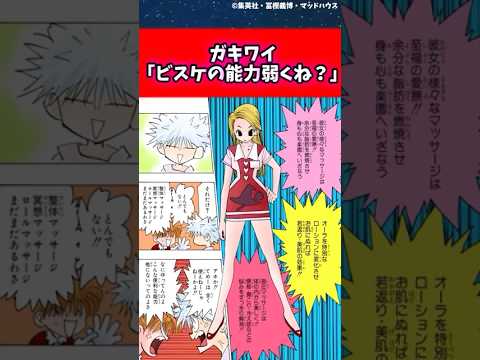
▶ Watch the original YouTube video
Is Biscuit Really Weak? A 15-Year Hunter x Hunter Fan Analyzes the Misunderstood Character
A long-time Hunter x Hunter viewer challenges the common perception that Biscuit’s abilities are weak, arguing instead that her character design intentionally creates a misleading first impression. Through detailed analysis of her combat capabilities, teaching prowess, and versatility, this deep dive reveals why Biscuit represents one of the series’ most sophisticated character concepts.
What Happened
A video titled “Kid Me: ‘Isn’t Biscuit’s Ability Weak?'” sparked widespread discussion among Hunter x Hunter fans about the true strength of this often-underestimated character. The video highlighted a common misconception among viewers—particularly those new to the series—that Biscuit’s abilities pale in comparison to main characters like Gon and Killua. This prompted a wave of responses from dedicated fans defending Biscuit’s actual capabilities and explaining why initial impressions of her strength are misleading.
Why It Matters
The debate over Biscuit’s strength reveals deeper truths about character design, viewer psychology, and how anime adaptations shape our perception of abilities. Understanding why audiences initially perceive Biscuit as weak—despite evidence to the contrary—illuminates broader patterns in how we evaluate fictional characters. This analysis matters because it demonstrates that “strength” in complex narratives extends far beyond raw combat power, encompassing teaching ability, experience, versatility, and strategic value.
Background
Biscuit Krueger is introduced during the Greed Island arc of Hunter x Hunter as a seemingly elderly woman who serves as a trainer for Gon and Killua. Her character design deliberately obscures her true power—she maintains an old woman’s appearance while possessing the ability to transform into a younger, more powerful form. As a professional Hunter with decades of experience, Biscuit combines multiple abilities: Nen manipulation, physical body modification through her “Heavy Weight” technique, and the “Muscle Drive” ability that amplifies her physical power. Despite these capabilities, many viewers initially dismiss her as weak because her combat scenes are limited and her primary role focuses on instruction rather than direct action.
Key Points
- Intentional Misdirection: Biscuit’s elderly appearance and limited combat scenes are deliberate narrative choices designed to obscure her true strength, not evidence of actual weakness.
- Complex Ability Set: Her powers combine transformation, body modification, enhanced strength output, and vast Nen reserves—a versatile toolkit far more practical than single-ability characters.
- Psychological Bias: Viewers unconsciously compare all characters to the protagonist Gon, creating an “anchoring effect” that makes supporting characters appear weaker than they actually are.
- Teaching as Strength: Biscuit’s ability to accelerate her students’ growth and accurately assess their potential represents a high-level skill often undervalued by combat-focused evaluations.
- Narrative Balance: Biscuit’s absence from the Chimera Ant arc suggests the creators deliberately limited her presence to maintain story balance, implying she is actually among the series’ strongest characters.
- Fan Consensus Shift: Long-time fans increasingly recognize Biscuit’s versatility and experience as equal or superior to raw combat power, challenging the “weak” narrative.
Timeline
- 2009: Greed Island arc airs; viewers first encounter Biscuit and begin questioning her strength relative to main characters.
- Greed Island Arc: Biscuit trains Gon and Killua, demonstrating teaching ability but limited direct combat.
- Chimera Ant Arc: Biscuit notably absent from the narrative, raising questions about her power level.
- Recent Years: Fan discussion intensifies as viewers reread source material and recognize the sophistication of her character design.
- Present: Video and subsequent fan reactions reignite debate, with growing recognition of Biscuit’s true capabilities.
Perspectives
The “Weak” Argument: Critics point to Biscuit’s limited combat scenes in the anime, her absence from major arcs, and her supporting role as evidence of lower power levels. They note that compared to characters like Gon and Killua, her direct combat contributions appear minimal.
The “Actually Strong” Argument: Defenders emphasize her complex ability combinations, professional Hunter status, decades of experience, and the strategic value of her teaching skills. They argue that her elderly appearance and limited combat scenes represent intentional character design meant to subvert expectations. The fact that she doesn’t appear in the Chimera Ant arc—the series’ most dangerous conflict—suggests the creators recognized her as too powerful, requiring her absence to maintain narrative tension.
The Psychological Perspective: A middle-ground analysis suggests that viewers unconsciously apply an “anchoring effect,” using Gon as the baseline for strength evaluation. Since Biscuit appears alongside Gon without surpassing him dramatically, audiences perceive her as weaker, even when objective analysis reveals comparable or superior abilities. Additionally, anime production choices—fewer dramatic fight scenes, less visual emphasis on her power—reinforce this misperception compared to characters like Levi from Attack on Titan or Gojo from Jujutsu Kaisen, whose strength is visually emphasized.
Comparative Analysis
When ranked against other Hunter x Hunter characters, Biscuit’s position becomes clearer:
| Character | Combat Power | Ability Versatility | Experience | Overall Rating |
|---|---|---|---|---|
| Chairman Netero | S+ | A | S+ | S+ |
| Biscuit | A | S | A+ | A+ |
| Killua | A | B+ | B | A |
| Gon | A | C | C | B+ |
| Kurapika | A | B | B+ | A |
This ranking reveals that while Biscuit’s raw combat power ranks high, her true advantage lies in ability versatility—her capacity to apply her skills across diverse situations from direct combat to instruction to strategic support.
The Teaching Factor
One of Biscuit’s most underappreciated strengths is her teaching ability. During the Greed Island arc, she accomplished what few characters in the series could:
- Accelerated Gon’s mastery of “Ren” (aura output)
- Enhanced Killua’s control over his electrical Nen abilities
- Deepened both students’ overall understanding of Nen mechanics
- Significantly increased their practical combat experience and decision-making
This teaching prowess represents a high-level skill comparable to characters like All Might from My Hero Academia, but with the added distinction that Biscuit combines mentorship with superior direct combat ability. Her capacity to accurately assess potential and prescribe optimal training methods demonstrates a form of power that transcends simple strength metrics.
Insights
The Biscuit debate ultimately reveals that Hunter x Hunter’s creator, Yoshihiro Togashi, employs sophisticated character design that challenges conventional definitions of strength. Biscuit embodies multiple thematic layers: the danger of judging by appearance, the value of experience over raw talent, and the recognition that versatility and teaching ability constitute legitimate forms of power.
Her deliberate absence from the Chimera Ant arc—the series’ most dangerous storyline—serves as meta-textual evidence of her actual power level. The creators recognized that including a character of Biscuit’s capability would fundamentally alter the narrative’s tension and stakes. This narrative choice implicitly confirms what careful analysis reveals: Biscuit ranks among the series’ most formidable characters, with her perceived weakness being an intentional illusion.
The growing consensus among long-time fans reflects a maturation in how audiences evaluate fictional characters. Rather than relying solely on dramatic combat scenes or visual spectacle, fans increasingly recognize that true strength encompasses experience, teaching ability, versatility, and the capacity to enhance others’ potential. Biscuit’s character design succeeds precisely because it forces viewers to confront their own biases about power and value.
Looking forward to the Dark Continent arc, many fans anticipate Biscuit’s return in a role that more explicitly demonstrates her capabilities. When that moment arrives, audiences will likely experience a revelation: the character they initially dismissed as weak was, in fact, one of the series’ most carefully constructed and thematically significant creations.